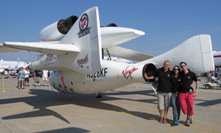
 Space Adventures is not the only player in town. Virgin Galactic also offers space enthusiasts the opportunity to travel to the Earth's outer reaches. Richard Branson, Paul G. Allen and Burt Rutan have teamed up to create a new class of traveler who wants to "hurtle through the edges of the atmosphere" and "see the cobalt blue sky turn to mauve and indigo and finally black...Out will come the stars, clear and bright... even though it is daytime!" And what is the power source? Nitrous oxide (laughing gas) and rubber, which Virgin Galactic claims is much safer than liquid propulsion systems or solid fuel rockets. And it seems folks are interested. Morethan $10 million has been collected from future passengers, and the waiting list includes William Shatner and Stephen Hawkings. The plan is to procure five spacecraft and send more than 700 people into space the first 18 months. Again, new ideas for the future. Let's give NASA and others a run for their money.
Wednesday, February 15
VSS Enterprise
Space Adventures is not the only player in town. Virgin Galactic also offers space enthusiasts the opportunity to travel to the Earth's outer reaches. Richard Branson, Paul G. Allen and Burt Rutan have teamed up to create a new class of traveler who wants to "hurtle through the edges of the atmosphere" and "see the cobalt blue sky turn to mauve and indigo and finally black...Out will come the stars, clear and bright... even though it is daytime!" And what is the power source? Nitrous oxide (laughing gas) and rubber, which Virgin Galactic claims is much safer than liquid propulsion systems or solid fuel rockets. And it seems folks are interested. Morethan $10 million has been collected from future passengers, and the waiting list includes William Shatner and Stephen Hawkings. The plan is to procure five spacecraft and send more than 700 people into space the first 18 months. Again, new ideas for the future. Let's give NASA and others a run for their money.


Tuesday, February 7
So You Want to Go Into Orbit?
 While the traditional route to space orbit has been a long training program at NASA, the private sector is now opening up new opportunties. For example, Space Adventures has programs from low orbit in a Mig-25, a trip to the International Space Station, and even travel around the moon. Space Adventures sells itself as "the only company in the world currently operating commercial orbital spaceflight and will be the first to launch clients using a new breed of lower cost suborbital spacecraft currently under development worldwide." Let's hope this new breed of space travel continues to grow. While government programs have done all of the work to date (or through others on contract basis), it may be time to try new approaches. And why stop with the Earth. We need a race to Mars, and these low cost private options may be the way to do it.
Wednesday, January 25
The Little "Snowstorm" That Couldn't
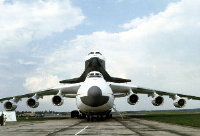 Remember the famous Buran (Russian for "Snowstorm") shuttle designed by the USSR to compete with NASA's shuttle? In fact, it looked almost identical from a distance. What ever happened to this experimental craft? When looking up some of the details I found that the Buran came off the production line in 1984, test launched in 1988, and was moth-balled in 1993. Last word is that the manufacturing plant now makes diapers and a Buran 1:1 scale version became a restaurant in Gorky Park. The Russians have a lot to be proud of throughout the space race, but this was not its high moment. Click here for more on the current Russian programs, including the OBSTANOVKA space weather project related to the International Space Station.
Tuesday, January 24
What is the Kuiper Belt?

Sunday, January 22
2.9 Billion Miles - For Dust?
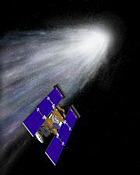 NASA's Stardust space capsule is now safely back on Earth after quite a journey. Scientists are now studying the payload (about one teaspoon of dust) that successfully landed in the Utah desert. We will now learn much more about the comets that circle our solar system and thereby more about the early foundations of our own planet some 4.5 billion years ago. Visit NASA's Jet Propulsion Laboratory for more on the progress of the research.
Friday, January 20
Viewing New Horizons
 We are off to a great start as we head towards the last planet in the solar system! The 3 billion mile trip to Pluto began yesterday and now we have a show that will last at least 9.5 years. NASA's New Horizons spacecraft broke away from Earth's and will someday visit Pluto and then break away from the inner solar system and inspect the Kuiper Belt - a cold and ice filled region from which planetoids periodically appear. You can monitor this little craft by visiting the Johns Hopkins University site.
Note: This if the first entry of Mars or Bust...a site designed to keep you wondering about this amazing world. Be it Pluto, Mars, the Milky Way or the Big Bang itself, the investigation is just beginning.
Subscribe to:
Posts (Atom)