Showing posts with label Pluto. Show all posts

Friday, July 29

Extended NASA Missions

Earlier this month NASA extended nine space missions via the 2016 Senior Review of Operating Missions, which area provided below in alphabetical order:

-Dawn;
-Lunar Reconnaissance Orbiter (LRO);
-Mars Atmospere and Volatile Evolution (MAVEN); 
-Mars Odyssey orbiter;
-Mars Reconnaissance Orbiter (MRO);
-New Horizons;
-the Opportunity and Curiosity Mars rovers; and
-support for the European Space Agency’s Mars Express mission.

That is quite an investment in Mars, but let's not forget ongoing missions as well such as Cassini around Saturn and Juno orbiting Jupiter. 

Unfortunely, Dawn is done exploring the asteroir belt. While a visit to another asteroid (145 Adeona) was proposed, the panel decided to keep the spacecraft in orbit around Ceres to learn more about the dwarf planet. 

Luckily, New Horizons will continue to explore the outer reaches of the solar system. The panel approved a mission to Kuiper Belt Object MU69 by 2019. So the exploration continues. 

Saturday, July 2

Great Image: The Solar System's Smaller Worlds

The image above recently posted by The Planetary Society is labeled "Every round object in the solar system under 10,000 kilometers in diameter, to scale." This impressive collection represents 2 planets, 18 or 19 moons, 1 or 2 asteroids, and 87 "trans-Neptunian" objects. 

You can see how the moons Ganymede and Titan outside Mercury, and our own Moon exceeds the size of Pluto.

The image below shows the objects we have already visited, including the recently explored Ceres and Pluto. We are making great progress in our explorations of the solar system. 
Image Credit: Montage by Emily Lakdawalla. Data from NASA / JPL, JHUAPL/SwRI, SSI, and UCLA / MPS / DLR / IDA, processed by Gordan Ugarkovic, Ted Stryk, Bjorn Jonsson, Roman Tkachenko, and Emily Lakdawalla.

Sunday, May 22

NYT's APP: A Trip to Pluto

The New York Times has released a 3D video for smartphones called "Seeking Pluto's Frigid Heart" that takes you on a trip to Pluto via New Horizons.  It's a gripping tour specifically designed for a mobile device since you need to turn your entire body to take in everything around you, including the distant Sun, Charon on the horizon, and even the dwarf planet's surface as you observe craters and icy plains. 

The New York Times created the app with the Lunar and Planetary Institute and the Universities Space Research Association. The 3D video debuted at the 2016 Tribeca Film Festival, which featured18 virtual reality movies.

You can also watch the video on your desktop, but it does not have the same effect and lacks the clarity of the app.  I recommend you download the app and enjoy the tour. 

Thursday, February 4

Plenty of Water on Pluto

NASA reported new findings from the New Horizons mission indicating a fair amount of water exists on Pluto's surface. The water-ice bedrock on the dwarf planet had already been known, but surface water is something else.  

NASA noted:
The new map shows exposed water ice to be considerably more widespread across Pluto's surface than was previously known — an important discovery. But despite its much greater sensitivity, the map still shows little or no water ice in the informally named places called Sputnik Planum (the left or western region of Pluto’s “heart”) and Lowell Regio (far north on the encounter hemisphere). This indicates that at least in these regions, Pluto's icy bedrock is well hidden beneath a thick blanket of other ices such as methane, nitrogen and carbon monoxide.
I am glad Pluto is back in the news since we have something concrete (or ice-solid) to study on an observed planet, dwarf or otherwise, rather than a speculative planet.

Saturday, January 23

Another Finding on a New Ninth Planet

Poor Pluto.  Even after all the amazing images from the New Horizons spacecraft, telescopes are peering beyond the dwarf planet looking for a ninth "planet," since the solar system is now one short and Pluto does not stack up. 

Researchers  and Mike Brown at the California Institute of Technology (Caltech) found indications that a planet about 10 times the size of Earth is lurking further our in our solar system.  This planet would be between the size of Earth and Neptune (shown below). 

One of the researchers is Mike Brown, the scientist that found the Kuiper Belt dwarf planet Eris that led to the demotion of Pluto. You can certainly call him determined. 

This assumed planet is so far out that it may take between 10,000 and 20,000 Earth years to circle the sun.  If you don't like winter, you certainly will not like a winter that lasts thousands of years (and any planet that far out would not have much of a summer anyway). 

Also, being about 200 astronomical units from our sun, it is five times more distant than Pluto.  Hence, we can point the New Horizons spacecraft at the proposed planet if we are willing to wait at least another 40 years for an answer (assuming the spacecraft has sufficient fuel and a clear destination). 

Here is a video from Caltech that explains this recent discovery.  You can also view more on the search for the ninth planet on this very helpful site at findplanetnine.com.

Wednesday, January 6

Top 15 Space and Astronomy Stories from Slate

Phil Plait in Slate put together a helpful video discussing the Top Space and Astronomy Stories in 2015, including New Horizons arriving at Pluto, the Dawn spacecraft over Ceres, and reusable rockets.  He also has time to mention the science in the movie The Martian as well as a cameo by Elon Musk on the Simpsons.  It is quite a list, as it has been quite a year. 

Thursday, December 31

New Horizons: First Class Act

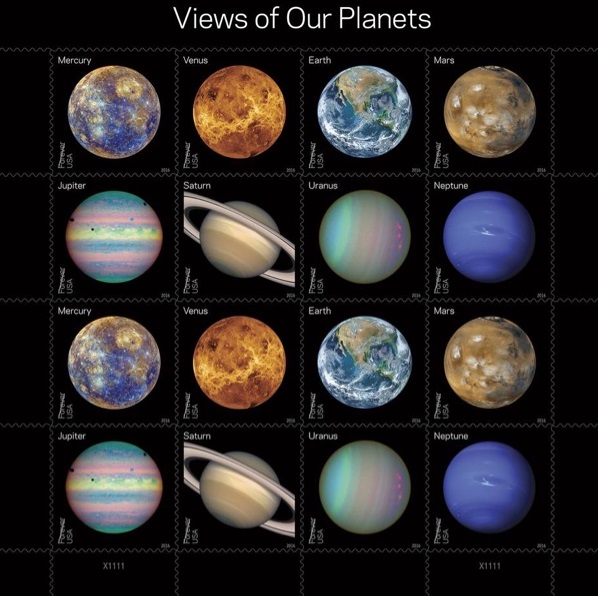
The US Postal Service is commemorating New Horizon's flyby of Pluto with a new forever stamp to be issued in 2016.  A nice idea. And you can expect even more stamps in 2016 covering the other planets in the solar system, our moon, and Star Trek. A great idea!

Saturday, December 12

Great Image: Pluto Up Close

NASA's New Horizons images of Pluto only become more stunning.  The image above shows mountains abutting a Sputnik Planum.  Did anyone really expect such a magical surface on this dwarf planet?  Here is the full description from NASA:
The Mountainous Shoreline of Sputnik Planum: In this highest-resolution image from NASA’s New Horizons spacecraft, great blocks of Pluto’s water-ice crust appear jammed together in the informally named al-Idrisi mountains. "The mountains bordering Sputnik Planum are absolutely stunning at this resolution," said New Horizons science team member John Spencer of the Southwest Research Institute. "The new details revealed here, particularly the crumpled ridges in the rubbly material surrounding several of the mountains, reinforce our earlier impression that the mountains are huge ice blocks that have been jostled and tumbled and somehow transported to their present locations."
Below we have another image showing the distant surface contains a series of smaller stories told over time.  Again, NASA describes the image in detail (and here is a video showing all these shots together):
This highest-resolution image from NASA’s New Horizons spacecraft reveals new details of Pluto’s rugged, icy cratered plains, including layering in the interior walls of many craters. "Impact craters are nature's drill rigs, and the new, highest-resolution pictures of the bigger craters seem to show that Pluto's icy crust, at least in places, is distinctly layered,” said William McKinnon, deputy lead of the New Horizons Geology, Geophysics and Imaging team, from Washington University in St. Louis. "Looking into Pluto’s depths is looking back into geologic time, which will help us piece together Pluto's geological history.”

Sunday, October 11

Blue Skies on Pluto

NASA provided more news last week about Pluto, the mysterious dwarf planet that is now starting to share its secrets. The latest discovery relates to water on the surface of Pluto as well as blue skies above this surface, as shown above. This news, plus previous reports of mountain ranges and open plains, is making the dwarf planet less strange and more amazing with each returning batch of data.

NASA reports:
Pluto’s haze layer shows its blue color in this picture taken by the New Horizons Ralph/Multispectral Visible Imaging Camera (MVIC). The high-altitude haze is thought to be similar in nature to that seen at Saturn’s moon Titan. The source of both hazes likely involves sunlight-initiated chemical reactions of nitrogen and methane, leading to relatively small, soot-like particles (called tholins) that grow as they settle toward the surface. This image was generated by software that combines information from blue, red and near-infrared images to replicate the color a human eye would perceive as closely as possible.
Image Credits: NASA/JHUAPL/SwRI

Friday, October 2

New Horizon Images of Charon

NASA's New Horizons continues to send one stunning shot after another.  The image above is from Pluto's moon Charon.  As with Mars, you can see a great canyon scarring the surface of the moon.  NASA notes:
High-resolution images of the Pluto-facing hemisphere of Charon, taken by New Horizons as the spacecraft sped through the Pluto system on July 14 and transmitted to Earth on Sept. 21, reveal details of a belt of fractures and canyons just north of the moon's equator. This great canyon system stretches more than 1,000 miles (1,600 kilometers) across the entire face of Charon and likely around onto Charon's far side. Four times as long as the Grand Canyon, and twice as deep in places, these faults and canyons indicate a titanic geological upheaval in Charon's past.
NASA expected even higher resolution images to be transmitted shortly.  New Horizons will be transmitting these amazing images over the next year or so.  The gift that keeps giving. 

Friday, September 18

New Pictures from Pluto

New Horizons caught plenty of amazing shots of Pluto during its July flyby and the image above is one great example. I wasn't expecting mountains ranges like these or an atmosphere. The dead little dwarf planet seems more lively than we could have imagined. 

Just 15 minutes after its closest approach to Pluto on July 14, 2015, NASA’s New Horizons spacecraft looked back toward the sun and captured this near-sunset view of the rugged, icy mountains and flat ice plains extending to Pluto’s horizon. The smooth expanse of the informally named Sputnik Planum (right) is flanked to the west (left) by rugged mountains up to 11,000 feet (3,500 meters) high, including the informally named Norgay Montes in the foreground and Hillary Montes on the skyline. The backlighting highlights more than a dozen layers of haze in Pluto’s tenuous but distended atmosphere. The image was taken from a distance of 11,000 miles (18,000 kilometers) to Pluto; the scene is 230 miles (380 kilometers) across.
Image Credits: NASA/JHUAPL/SwRI

Thursday, July 23

You Knew It Was Coming: The Pluto Petition

Now that New Horizons has provided us with a fascinating view of the dwarf planet Pluto, some are thinking it is time to restore Pluto to its rightful place among the full planets.  If you agree, you might want to visit change.org, which has a petition with about 4,300 names on it as of today.  

And what does this group want?  Hopefully, the petitioners can capture the attention of the International Astronomical Union (IAU), which is the same culprit that knocked Pluto off the planetary list:
The IAU meets again for its general assembly in August 2015. And in the coming weeks, New Horizons will collect unprecedented amounts of data about the Pluto system, calling in to question the definition set forth by the IAU.
I am wondering if I need to start a petition for Eris, also floating out there with Pluto, or even Ceres (shown below), now being studied by the Dawn spacecraft.  With the five dwarf planets, we would have 13 officials planet for now.  I say the more the merrier. 

Thursday, July 16

Great Image: Mountains on Pluto

Now that the flyby of Pluto is done, we have some great shots of the surface of the dwarf planet.  Images will continue to be broadcast from New Horizons to NASA for at least another 16 months, so prepare for many more pictures.  The image above shows relatively young mountains near Pluto's equator.

Here is the story from NASA:
A new close-up image of an equatorial region near the base of Pluto’s bright heart-shaped feature shows a mountain range with peaks jutting as high as 11,000 feet (3,500 meters) above the surface of the icy body.
The mountains on Pluto likely formed no more than 100 million years ago -- mere youngsters in a 4.56-billion-year-old solar system. This suggests the close-up region, which covers about one percent of Pluto’s surface, may still be geologically active today.
“This is one of the youngest surfaces we’ve ever seen in the solar system,” said Jeff Moore of the New Horizons Geology, Geophysics and Imaging Team (GGI) at NASA’s Ames Research Center in Moffett Field, California.
Unlike the icy moons of giant planets, Pluto cannot be heated by gravitational interactions with a much larger planetary body. Some other process must be generating the mountainous landscape.
“This may cause us to rethink what powers geological activity on many other icy worlds,” says GGI deputy team leader John Spencer at SwRI.
 Image Credit:  NASA/JHU APL/SwRI

Wednesday, July 15

New Horizons Back Online

The New Horizons flyby of Pluto has been  a success, with the spacecraft communicating again yesterday after coming within 7,800 miles of the dwarf planet's surface.  Images from the mission will be coming back to Earth for some time to come as NASA continues to analyze the treasure trove of new information.

NASA Administrator Charles Bolden stated:
I know today we’ve inspired a whole new generation of explorers with this great success, and we look forward to the discoveries yet to come...This is a historic win for science and for exploration. We’ve truly, once again raised the bar of human potential.

Monday, July 13

Pluto Mission Broadcast on Television

In addition to watching the NASA website, you can see a number of television specials this week to mark the Pluto flyby.  Tomorrow on the National Geographic Channel, you can see Mission Pluto, where the scientists at the John Hopkins Applied Physics Laboratory and NASA discuss the events leading up to New Horizons' historic arrival at the former planet Pluto.  You can also see a trailer for the new show on the website. 

And on July 15th, PBS's NOVA will be showing Chasing Pluto:
On July 14, 2015, the New Horizons spacecraft, one of the most advanced ever built, is scheduled to fly by Pluto to take the very first detailed images of the dwarf planet. After nine years and 3 billion miles, we will finally get a close look at this strange, icy world, but only if the craft can survive the final, treacherous leg of its journey, which could take it through a dangerous field of debris. If it does, New Horizons is poised to make dramatic new discoveries, not just about Pluto, but about the vast realm of icy bodies lurking beyond Neptune, relics of the earliest days of the solar system’s formation. Back on Earth, the planetary scientists who have spent decades working on this mission anxiously await a signal from their spacecraft. Our cameras will be there to witness the moment. If all goes well, we’ll see Pluto’s mysterious surface in unprecedented detail and learn new secrets about other alien worlds at the far limits of our solar system.

Saturday, July 11

Another Red Planet: Pluto

With New Horizons set to make the long-awaited July 14th fly by of Pluto, we are getting an unprecedented view of this distant dwarf planet.   And now we can clearly see we have one more red planet (see the NASA image above), the color attributed to hydrocarbon molecules formed from the interaction of cosmic rays and solar ultraviolet light with Pluto's methane atmosphere and surface.

New Horizons principal investigator Alan Stern of the Southwest Research Institute, Boulder, Colorado, recently stated:
Pluto’s reddish color has been known for decades, but New Horizons is now allowing us to correlate the color of different places on the surface with their geology and soon, with their compositions...This will make it possible to build sophisticated computer models to understand how Pluto has evolved to its current appearance.
While Dr. Stern may believe everyone knew Pluto was a red planet, I am not sure that was the case with everyone in the past.  Take a look at solar system illustration below and you will see it was not a red planet for everyone.  Yet now we know, and I expect future graphics will be somewhat different. 

Friday, July 3

Amazing Image of Pluto and Charon

The film above shows us that New Horizons has arrived at Pluto and is already sending back amazing imagery.  Here is the story from NASA concerning the film above:
This is the first movie created by New Horizons to reveal color surface features of Pluto and its largest moon Charon. “It’s a bit unusual to see so much surface detail at this distance,” said New Horizons co-investigator William McKinnon of the Geology and Geophysics Investigation Team, Washington University in Saint Louis. “What’s especially noteworthy is the level of detail in both bodies. It’s certainly whetting our appetite for what’s to come.”
The images were taken between June 23 and June 29, 2015, as New Horizons’ distance to Pluto decreased from a distance of 15 million to 11 million miles (24 million to 18 million kilometers). Six high-resolution black-and-white images from New Horizons’ LORRI instrument were combined with color data from the Ralph instrument to produce the movie.

Saturday, October 11

Should Pluto Be Returned to the Family of Planets?

Should we still be having this argument about whether or not Pluto is a planet? Is this a scientific duel, or more the earlier generation complaining that they still want to use the mislabeled name brontosaurus rather than Apatosaurus? I am fine with the 2006 decision to make Pluto a dwarf planet, but some at Harvard-Smithsonian Center for Astrophysics are still debating the topic. Last month, after hearing a debate among three leading experts in planetary science, the audience voted and decided that Pluto is still a Planet.  While this settles nothing, it was still a good debate (you can see it on YouTube at https://www.youtube.com/user/ObsNights).

I am more interested in labeling exoplanets rather than relabeling our neighbors, but I do not expect this issue to die anytime soon.  So while the local debate continues, I hope the telescopes will be trained on much more distant matters as we ponder the wild and strange universe. 

Thursday, September 4

Triton Comes into Focus 25 Years Ago


With all the talk of exoplanets, we sometimes forget how little we know about the planets and moons in our own solar system.  For example, 25 years ago on August 25, 1989, the Voyager 2 spacecraft shined a light on the system as it headed towards the edges of the solar system and beyond.  The image above of Neptune's moon Triton was restored recently by the NASA-funded Lunar and Planetary Institute and turned into a film.  Even back then Voyager 2 could see Triton was an active planet with atmospheric plumes.  Triton is a little larger than Pluto and most likely started the same as Pluto but was caught in the orbit of Neptune.  We should see more of Pluto next July when the New Horizons spacecraft visits the dwarf planet. 

Thursday, August 14

Google Now Maps the Moon and Mars

Google Earth has expanded beyond our planet and now provides tours of the Moon and Mars.  For instance, Moon in Google Earth allows you to:

-- Take tours of landing sites, narrated by Apollo astronauts;
-- View 3D models of landed spacecraft;
-- Zoom into 360-degree photos to see astronauts' footprint, and
-- Watch rare TV footage of the Apollo mission.

For example, the image below shows various keys points in the Apollo 11 mission. And should you want to track the activities of the Curiosity Rover on Mars you can do that as well.  All you need to do is download the Google Earth program and choose your location.  The navigation and content is not perfect, but it provides a good sense of where you are accompanied by panoramic images. 

I look forward to more planets and moons in the future.  And with NASA's New Horizons heading towards Pluto, we will soon be able to add dwarf planets to the list.