Sunday, March 7

Lost in Space?

Presidents have made a number of space-related statements over the years that inspired the Nation:

President Kennedy (1961):
We choose to go to the moon in this decade and do the other things, not because they are easy, but because they are hard, because that goal will serve to organize and measure the best of our energies and skills, because that challenge is one that we are willing to accept, one we are unwilling to postpone, and one which we intend to win, and the others, too. -- President John F. Kennedy's May 25, 1961 Speech before a Joint Session of Congress (see story here)

President George H. W. Bush (1990):
We stand at a halfway point. . . . Thirty years ago, NASA was founded and the space race began. And 30 years from now, I believe man will stand on another planet. -- President George H.W. Bush in a commencement address at Texas A&I University. Looking beyond the travails of a national budget crisis, President Bush outlined a timetable for human exploration of Mars, calling for an American flag to be planted on the surface of the red planet no later than the year 2019, the 50th anniversary of the Apollo moon landing (see story here)

President George W. Bush (2004): Mankind is drawn to the heavens for the same reason we were once drawn into unknown lands and across the open sea. We choose to explore space because doing so improves our lives and lifts our national spirit. -- President George W. Bush, in a speech at NASA headquarters, unveiled an ambitious plan to return Americans to the moon by 2020 and use the mission as a steppingstone for future manned trips to Mars and beyond (see story here).

President Obama (2010): No quote to date on latest policy. However, last month,
the Administration announced plans to redirect America's space program by eliminating NASA's $100-billion plans to return astronauts to the moon and using much of that money for new rocket technology research (see story here).

So there we have it. First we reach the moon, then we reach for Mars, then we look closer to home and go back to the moon, and finally we throw in the towel and refuse to provide any particular destination. In a time of great economic turmoil, Americans should still be able to dream. So much for hope.

Saturday, January 16

This Week in Space

The Spaceflight Now website has recently added a webcast called "This Week in Space," which has some interesting content. If you can ignore the odd backgrounds and poor video quality, you will find a good set of stories on the U.S. space program. It bills itself as follows: A new show dedicated to keeping space lovers up to speed on the stories and issues making news off the planet.

Only two webcasts are available at this time; December 22, 2009 and January 15, 2010. Each are worth a quick look or, better yet, you can subscribe to the program on the website or iTunes and get every episode.

A Bit of Fun...


Friday, January 1

Milestones in 2009

The magazine NetworkWorld had a good list of NASA's 2009 projects worth highlighting here because it shows the diversity of the U.S. space program. The article notes

2009 was a critical year for NASA. The space agency saw its very existence reviewed by the United States Human Space Flight Plan Committee and it watched as its venerable space shuttle fleet ticked off five of its remaining 10 missions. But there were plenty of other projects that took center stage such as the development of the next generation heavy lift rocket, Ares, and the extension of the agency's Antarctica's sea ice monitoring program as well as its ongoing Mars operations.

Here are some other projects mentioned in the article, some of which I hope to follow-up on throughout 2010.

  • NASA partnered with the U.S. Air Force Research Laboratory to develop a plan for reusable commercial spaceships.
  • NASA offered $50 million in stimulus money to develop private commercial spacecraft - the Commercial Crew and Cargo Program plans to develop safe, reliable, and cost-effective capabilities to transport cargo to low-Earth orbit and eventually astronauts to the International Space Station.
  • NASA's Lunar CRater Observing and Sensing Satellites (LCROSS) crashed into the moon in October 2009 confirming the presence of water on the surface.
  • NASA's Mars rover Spirit became stuck in a sand trap in a place NASA calls "Troy" on April 23, 2009 - however, the little guy continues to conduct experiments.
  • NASA and the European Space Agency (ESA) agreed to cooperate on a future trip to Mars.
  • NASA's Centennial Challenges program awarded $1.65 million in prize money to two aerospace companies that successfully simulated landing a spacecraft on the moon, as was as lifting off again. The $1 million first prize went to Masten Space Systems and the $500,000 second prize went to Armadillo Aerospace.
  • NASA and Goodyear developed an airless tire for large, long-range vehicles transporting heavy loads across the surface of the moon.
Not a bad year at all, and plenty to do in 2010.

Sunday, September 27

Water, Water Everywhere

Last week NASA had two reports on extraterrestrial water in our solar system. First, NASA reported that water molecules had been definitely found on the surface of the Moon. The amount of water was estimated to be about 32 ounces of water for every ton of surface material. The second NASA report on water was associated with Mars. The Mars Reconnaissance Orbiter located water just below Mar's surface at a latitude which was much further south than anticipated. New craters revealed the water near the surface. Amazingly, NASA's Viking Lander 2 might have discovered this water back in 1976 had it dug just 4 inches deeper.

Monday, September 21

Tavis Smiley Interviews NASA's Administrator

Just this past weekend I listened in on Tavis Smiley's radio interview of NASA's new Administrator General Charles Bolden. It was a good interview, but what surprised me the most was Bolden's statement that the United States may not be the first nation to put a man on Mars. I had not heard this before from such a high level in the Administration, let alone from the man who is supposed to make it happen. I find this a little sad. Yes, we are all one global village, but what we need is determination and drive, not an attitude of "Oh well, I am sure someone will do it." Let's hope we find a little bit of that can-do spirit real soon before we go back in for budget talks.

You can download the interview here.

Friday, September 18

The Future of the Moon Shot

The recent study of the Human Space Flight Review Committee, released by NASA, indicates our ambitions are outstripping our resources. To quote,

The U.S. human spaceflight program appears to be on an unsustainable trajectory. It is perpetuating the perilous practice of pursuing goals that do not match allocated resources. Space operations are among the most complex and unforgiving pursuits ever undertaken by humans. It really is rocket science. Space operations become all the more difficult when means do not match aspirations. Such is the case today.

The report covers a number of topics, including plans to return to Moon and the fate of the International Space Station (ISS). In terms of the Moon, the Committee appears to support the idea of using the Moon landing as a good test on our way to eventually visiting Mars. In fact, robotic exploration of other solar system bodies first (called "Flexible Path") may also have more benefits for awhile before storming Mars. The report states

Mars is the ultimate destination for human exploration; but it is not the best first destination. Both visiting the Moon First and following the Flexible Path are viable exploration strategies. The two are not necessarily mutually exclusive; before traveling to Mars, we might be well served to both extend our presence in free space and gain experience working on the lunar surface.

If NASA follows these recommendations it is possible the Mars plans will be pushed even further into the future.

Concerning the ISS, the report believes the station should remain in orbit longer than planned. After all, it will be a $100 billion asteroid at some point, but maybe we can wait awhile.

Finally, the report recommends more commercial involvement and relevant competitions to spur development. I like this idea. To quote,

Commercial services to deliver crew to low-Earth orbit are within reach. While this presents some risk, it could provide an earlier capability at lower initial and lifecycle costs than government could achieve. A new competition with adequate incentives should be open to all U.S. aerospace companies. This would allow NASA to focus on more challenging roles, including human exploration beyond low-Earth orbit, based on the continued development of the current or modified Orion spacecraft.

All in all, the Committee's findings make a lot of sense. Much of the debate comes down to resources, and given the state of the U.S. economy and plans for future government programs, such as health care, we are unlikely to see a huge rush to fund expanded space programs. NASA will be lucky to hold onto its current budget.

Tuesday, August 11

Not So Inspiring

Well, now that we have read the words of President Kennedy, maybe we can find something similarly inspiring from our current President. Or maybe not. As Douglas MacKinnon notes in his editorial, President Obama is not so keen on space and, as a result, "...the promise of space may be lost to us for decades." What did Obama say? Back in 2007 then-Senator Obama said, as part of proposing cuts to NASA's budget, "We're not going to have the engineers and scientists to continue space exploration if we don't have kids who are able to read, write and compute." While I concur that the education of the next generation of America is critical, this does not replace the need for a space program but rather gives it new energy. Such national projects as a mission to another planet is what can inspire kids to achieve great things. It's not one or the other, but instead a combination of efforts (i.e. education, safety-nets, important national achievements, etc.) that can make a nation great. I hope now-President Obama realizes this.

Monday, July 20

The Anniversary

Here is an excerpt from President John Kennedy's May 25, 1961 speech delivered before a joint session of Congress. Take a look at the entire speech after reading this and you will see the theme was the continual battle with the Soviet Union for military dominance. The space program was just one small part of this strategy.

Finally, if we are to win the battle that is now going on around the world between freedom and tyranny, the dramatic achievements in space which occurred in recent weeks should have made clear to us all, as did the Sputnik in 1957, the impact of this adventure on the minds of men everywhere, who are attempting to make a determination of which road they should take. Since early in my term, our efforts in space have been under review. With the advice of the Vice President, who is Chairman of the National Space Council, we have examined where we are strong and where we are not, where we may succeed and where we may not. Now it is time to take longer strides--time for a great new American enterprise--time for this nation to take a clearly leading role in space achievement, which in many ways may hold the key to our future on earth.

I believe we possess all the resources and talents necessary. But the facts of the matter are that we have never made the national decisions or marshalled the national resources required for such leadership. We have never specified long-range goals on an urgent time schedule, or managed our resources and our time so as to insure their fulfillment.

Recognizing the head start obtained by the Soviets with their large rocket engines, which gives them many months of leadtime, and recognizing the likelihood that they will exploit this lead for some time to come in still more impressive successes, we nevertheless are required to make new efforts on our own. For while we cannot guarantee that we shall one day be first, we can guarantee that any failure to make this effort will make us last. We take an additional risk by making it in full view of the world, but as shown by the feat of astronaut Shepard, this very risk enhances our stature when we are successful. But this is not merely a race. Space is open to us now; and our eagerness to share its meaning is not governed by the efforts of others. We go into space because whatever mankind must undertake, free men must fully share.

I therefore ask the Congress, above and beyond the increases I have earlier requested for space activities, to provide the funds which are needed to meet the following national goals:

First, I believe that this nation should commit itself to achieving the goal, before this decade is out, of landing a man on the moon and returning him safely to the earth. No single space project in this period will be more impressive to mankind, or more important for the long-range exploration of space; and none will be so difficult or expensive to accomplish. We propose to accelerate the development of the appropriate lunar space craft. We propose to develop alternate liquid and solid fuel boosters, much larger than any now being developed, until certain which is superior. We propose additional funds for other engine development and for unmanned explorations--explorations which are particularly important for one purpose which this nation will never overlook: the survival of the man who first makes this daring flight. But in a very real sense, it will not be one man going to the moon--if we make this judgment affirmatively, it will be an entire nation. For all of us must work to put him there.

Secondly, an additional 23 million dollars, together with 7 million dollars already available, will accelerate development of the Rover nuclear rocket. This gives promise of some day providing a means for even more exciting and ambitious exploration of space, perhaps beyond the moon, perhaps to the very end of the solar system itself.

Third, an additional 50 million dollars will make the most of our present leadership, by accelerating the use of space satellites for world-wide communications.

Fourth, an additional 75 million dollars--of which 53 million dollars is for the Weather Bureau--will help give us at the earliest possible time a satellite system for world-wide weather observation.

Let it be clear--and this is a judgment which the Members of the Congress must finally make--let it be clear that I am asking the Congress and the country to accept a firm commitment to a new course of action, a course which will last for many years and carry very heavy costs: 531 million dollars in fiscal '62--an estimated seven to nine billion dollars additional over the next five years. If we are to go only half way, or reduce our sights in the face of difficulty, in my judgment it would be better not to go at all.

Now this is a choice which this country must make, and I am confident that under the leadership of the Space Committees of the Congress, and the Appropriating Committees, that you will consider the matter carefully.

It is a most important decision that we make as a nation. But all of you have lived through the last four years and have seen the significance of space and the adventures in space, and no one can predict with certainty what the ultimate meaning will be of mastery of space.

I believe we should go to the moon. But I think every citizen of this country as well as the Members of the Congress should consider the matter carefully in making their judgment, to which we have given attention over many weeks and months, because it is a heavy burden, and there is no sense in agreeing or desiring that the United States take an affirmative position in outer space, unless we are prepared to do the work and bear the burdens to make it successful. If we are not, we should decide today and this year.

This decision demands a major national commitment of scientific and technical manpower, materiel and facilities, and the possibility of their diversion from other important activities where they are already thinly spread. It means a degree of dedication, organization and discipline which have not always characterized our research and development efforts. It means we cannot afford undue work stoppages, inflated costs of material or talent, wasteful interagency rivalries, or a high turnover of key personnel.

New objectives and new money cannot solve these problems. They could in fact, aggravate them further--unless every scientist, every engineer, every serviceman, every technician, contractor, and civil servant gives his personal pledge that this nation will move forward, with the full speed of freedom, in the exciting adventure of space.

For the full text of the speech, click here.

Monday, July 13

Peaceful Space Programs?

The United States has moved anti-missile systems to Hawaii to ward off stray North Korean missiles, while the North Korean leader continues to claim that they are part of a peaceful space mission. Is there such a thing today? And was there ever?

In the Wall Street Journal review of Craig Nelson's book Rocket Men (see below), we read of a quote by then Vice President Lyndon Johnson stating, "Control of space means control of the world. From space the masters of infinity would have the power to control the Earth's weather, to cause droughts and floods, to change the tides and raise the level of the sea, divert the Gulf stream and change the temperature to frigid." And we think North Korea is a little bit crazy? The Vice President sounds like Dr. Evil in Austin Powers. Maybe you remember this bit:
Shit. Oh hell, let's just do what we always do. Hijack some nuclear weapons and hold the world hostage. Yeah? Good! Gentlemen, it has come to my attention that a breakaway Russian Republic called Kreplachistan will be transferring a nuclear warhead to the United Nations in a few days. Here's the plan. We get the warhead and we hold the world ransom for... ONE MILLION DOLLARS!

40 Years Later - Rocket Men

I guess I should not be surprised with the number of books out there on the 40th anniversary of our landing a man on the Moon. Its a feat yet to be equaled by any other nation, and certainly a high point to a decade that saw the assassination of President, as well as his brother, the shooting of Martin Luther King, and the slow erosion of American influence as we slogged through Vietnam. But what a way to exit the 1960s!

One of these books is Craig Nelson's Rocket Men. His story about Apollo 11 is getting some great reviews. Here is how Fred Bortz describes it in The Dallas Morning News:

The book is divided into three parts. Part I introduces the astronauts, their families and the Apollo launch and mission control teams. Part II presents a distinctive view of NASA’s evolution from its origin to the day of that momentous launch. Part III picks up after Apollo 11’s liftoff and continues to the moon and beyond. It closes with a poignant and thought-provoking discussion of the biggest question faced by the astronauts and agency alike: What do you do after you’ve been to the moon?

Nelson faced his own daunting mission in telling the Apollo story in a fresh way. He rises to the occasion with meticulous research, skillful storytelling rich in detail and a narrative as stimulating and disciplined as Apollo 11’s trajectory through space and history.

For example, the book’s lengthy but exquisitely controlled opening sentence puts readers on the scene on May 20, 1969, as the 30-story-tall Saturn V rocket “was painstakingly trundled five miles across the raging heat and searing green of central Florida’s eastern coast by an eleven-man Kennedy Space Center crew aboard the world’s largest land vehicle, a six-million-pound, tank-wheeled crawler out of NASA’s Vehicle Assembly Building, itself so massive that … clouds would form under its 525-foot ceiling … and it would rain.”

To introduce Part II, Nelson writes: “The standard version of the history of NASA has always been that, alarmed and deflated by Sputnik and Yuri Gagarin, the United States created a wholly civilian agency that, through the vital legacy of its youngest president, won the space race ‘in peace for all mankind.’ Besides the fact that almost all these assertions are either misleading or expressly false … [t]he actual story is much richer and the achievements more profound.”

Part III is full of heart-pounding detail that reaches its peak as Armstrong searches for a boulder-free area when unknown lunar mass concentrations cause Eagle to overshoot its planned landing spot. Nelson begins by putting the oral history in context. “From a height of two thousand feet while traveling twenty feet per second, Armstrong tried to orient himself to the landscape below from his studies of the Apollo 10 photographs, but Eagle was now too low to the ground, and too far off-course,” he writes. Then he leaves the rest of the story to flight director Gene Kranz, Buzz Aldrin, Armstrong and Armstrong’s wife, Jan.

Whether or not we need to go back to the Moon is its own question, but the fact that we made it there at all is a marvel and a turning point in human history.

Friday, July 3

Who Wants to Go to the Moon?

In a recent Wall Street Journal article, Michio Kaku discusses the race for the Moon and how China, Japan and India all have plans to land on the surface of the Moon sometime around 2020. Not to be outdone, the European Space Agency (ESA) plans a manned mission to Mars in 2030 called the Aurora Program. (Note: The ESA's own site is calling for an "international human mission" to Mars by 2025, so it seems ESA does not plan to go on its own). Even so, Mr. Kaku seems to be worried about a "traffic jam" on the surface of the Moon. An interesting idea (and less worrisome than an explosion that pushes the Moon away from Earth ala Space 1999).

Mr. Kaku also calls a trip the Moon "symbolic," citing its lack of military value, lack of air and water, and expensive-to-retrieve minerals. Finally, he worries about the Outer Space Treaty of 1967, wondering if it is up to the task when all these visits start of occur. Here are the basics:

  1. the exploration and use of outer space shall be carried out for the benefit and in the interests of all countries and shall be the province of all mankind;
  2. outer space shall be free for exploration and use by all States;
  3. outer space is not subject to national appropriation by claim of sovereignty, by means of use or occupation, or by any other means;
  4. States shall not place nuclear weapons or other weapons of mass destruction in orbit or on celestial bodies or station them in outer space in any other manner;
  5. the Moon and other celestial bodies shall be used exclusively for peaceful purposes;
  6. astronauts shall be regarded as the envoys of mankind;
  7. States shall be responsible for national space activities whether carried out by governmental or non-governmental activities;
  8. States shall be liable for damage caused by their space objects; and
  9. States shall avoid harmful contamination of space and celestial bodies.
It still seems pretty relevant today, but maybe a recommitment to these principles might make sense just to make sure everyone has read the fine print. Overall, a new space race is not such a bad idea if it stimulates new approaches and technologies that can advance mankind in the Heavens and here on Earth.

Phobos or Bust?

The New York Times had an interesting interview with Buzz Aldrin in its Sunday magazine. Asked about a return to the Moon, Aldrin thought we should be aiming higher. For instance, the Russians are planning a trip to Phobos, one of Mars' "moons," as a stepping stone to the Martian surface. Aldrin noted "Russia perhaps is still entertaining the possibility that the moons of Mars might have access to ice or water." An interesting approach. Aldrin would rather send robots to the Moon and men to Mars, which is the very reverse of the current American plans. Maybe he is onto something.

Tuesday, June 9

NASA Administrator Named

Just to follow up on an earlier posting, President Obama has named General Charles Bolden as the new Administrator of NASA. According to the NASA press release, General Bolden has a pretty impressive background:

Gen. Charles Bolden, Nominee for Administrator of NASA Charles Bolden retired from the United States Marine Corps in 2003 as the Commanding General of the Third Marine Aircraft Wing after serving more than 34 years, and is currently CEO of JackandPanther LLC, a privately-held military and aerospace consulting firm. Gen. Bolden began his service in U.S. Marine Corps in 1968. He flew more than 100 sorties in Vietnam from 1972-73. In 1980, he was selected as an astronaut by NASA, flying two space shuttle missions as pilot and two missions as commander. Following the Challenger accident in 1986, Gen. Bolden was named the Chief of the Safety Division at the Johnson Space Center with responsibilities for overseeing the safety efforts in the return-to-flight efforts. He was appointed Assistant Deputy Administrator of NASA headquarters in 1992. He was Senior Vice President at TechTrans International, Inc. from 2003 until 2005. Gen. Bolden holds a B.S. in Electrical Engineering from the U.S. Naval Academy, Annapolis and a M.S. in Systems Management from the University of Southern California.

Of course, none of this says anything about the General's vision for NASA, so we will have to wait a little longer to hear about this.

Saturday, April 25

More on Moon Dust

Brian O'Brien, an Australian physicist, has figured out the secret of moon dust, or what is officially called regolith. Mr. O'Brien worked on the Apollo program back in the 1960s and his curiosity related to the Moon's surface continued all this time. Now it seems the amount of sunlight on the Moon's surface impacts the stickiness of the regolith. It appears the sun's radiation on the surface puts a positive charge on the regolith, causing it to stick to anything from a space suit to NASA instruments. What does this mean for future missions? Well, NASA will need to find a way to overcome this positive charge. Of course, one option is to work on the dark side of the Moon, but I am not sure anyone likes that idea just yet.

In fact, NASA has been running regolith competitions for years to "promote the development of mechanical designs to excavate lunar regolith." NASA keeps adding money to the pot but no one has really come up with a winning design. The 2009 competition will be August 15-16. The rules for competing can be found here. Just think of it as an advance version of the Pinewood Derby.

Monday, April 6

HD 189733b

Okay, the name is not as memorable as Mars or the ice planet of Hoth, but HD 189733b is the first distant world where traces of carbon dioxide has been detected. And while it might be a fiery giant about 64 light years away, it provides some new insights into another solar system. HD 189733b is said to be about the same size as Jupiter, though it orbits much close to its sun. For more on the specifics of this exoplanet, visit Universe Today.

Saturday, March 28

Who Will be NASA's Administrator?

One of the names that had been bouncing around as the new Administrator is retired Air Force Major General Scott Gration, one of his advisors during the campaign. However, not everyone was happy with this name, including Senator Nelson from Florida.

So, what is the situation today? Well, the Major General will be going to Sudan after being selected as a special envoy. President Obama stated "Standing alongside Secretary Clinton and Ambassador Rice, his appointment is a strong signal of my Administration’s commitment to support the people of Sudan while seeking a lasting settlement to the violence that has claimed so many innocent lives." Interestingly enough, the Major General was born in Congo. This is good news for Sudan, but what about NASA?

Also, maybe this is not where the Major General wants to be. The New Republic notes that "...Gration originally had his heart set on running NASA. Obama tried to put him there until defense lobbyists scotched the idea."

So who else is on the NASA list? Other names have been
U.S. Marine Corps Maj. Gen. Charles Bolden, a former space shuttle commander; Charles Kennel, who chairs the National Academy of Science's Space Studies Board; Alan Stern, former NASA associate administrator for science; Scott Hubbard, former director of NASA's Ames Research Center; Wesley Huntress, former NASA associate administrator for space science; and Steve Isakowitz, who was recently reappointed chief financial officer at the Energy Department.

According to The Washington Post, President Obama said he will make a selection any day now. We shall see, since he had orginally planned to this before the inauguration. The Congress is certainly getting impatient, as the letter below demonstrates.

Bipartisan Letter Expressing Need for an Administrator Who Will Minimize the Spaceflight Gap

Dear President Obama:

We write to you as Members of Congress with an abiding interest in the important contributions of the National Aeronautics and Space Administration (NASA). NASA has been a leading catalyst for innovation and technology development and has enjoyed over 50 years of broad public interest and strong bipartisan political support. The agency’s work is linked to larger issues facing our country such as national security, climate change and American competitiveness. Currently, NASA faces numerous time-sensitive challenges and needs decisive leadership.

One of the most important issues facing NASA and our nation is the impending retirement of the Space Shuttle, and the subsequent five year gap in independent U.S. access to the International Space Station before the Ares 1 and Orion systems can be deployed. This issue has been identified by the Government Accountability Office as one of thirteen ‘urgent’ items for your administration to address. As you know, this issue is linked to our economic recovery since the gap could result in layoffs for several thousand highly skilled aerospace engineers and technicians over the next two years.

We believe it is imperative for NASA to have a leader who understands the implications of a five year or longer hiatus in America’s independent access to space. The new NASA Administrator should grasp the broad strategic and international aspects of NASA’s mission, as well as the technical, budgetary and programmatic tradeoffs that lie ahead. We urge you to keep these issues in mind as you search for a NASA Administrator candidate with the right background, integrity and focus on minimizing the spaceflight gap and preserving the agency’s cutting edge science and aeronautics programs. Maintaining a focused policy and providing the necessary funding to allow NASA to succeed are essential to the technological advances and scientific discoveries that benefit all Americans.

We fully recognize the difficult challenges our nation faces, and we believe that a focused and properly funded NASA can aid our national economy and contribute to our shared goals of sustaining our technological edge and competing on a global stage.

We look forward to working with you and a new Administrator to ensure a robust, successful NASA. We stand ready to work together with you and continue providing the nation’s civilian space and aeronautics agency our steadfast support.

Thank you for your attention to this important issue.

Sincerely,

Suzanne Kosmas (D-FL)
Ken Calvert (R-CA)
Robert Aderholt (R-AL)
John Culberson (R-TX)
Al Green (D-TX)
Parker Griffith (D-AL)
Ralph Hall (R-TX)
Sheila Jackson-Lee (D-TX)
Michael McCaul (R-TX)
Pete Olson (R-TX)
Bill Posey (R-FL)
Adam Schiff (D-CA)
Lamar Smith (R-TX)
Debbie Wasserman-Schultz (D-FL)


Source: Office of Rep. Suzanne Kosmas

Where is NASA Going?

As of today, if you review the NASA organizational chart you will see an acting Administrator (Christopher Scolese) and a missing Deputy Administrator. So, when do we see some new leadership at NASA, and will the priorities change? A January article in The Economist magazine called "Mars Rising?" that spelled out a few arguments for a change in the U.S. space policy, including a greater reliance on robots. What concerns me more is a possible Obama Adminstration preference for satellites looking back onto Earth rather than keeping our eyes on the Heavens. I would prefer to place the Earth-focused projects into another agency so NASA's mission can be primarily other-worldly. We have plenty to explore and better understand on this planet, including the oceans that cover most of our world, but we should have the resources to stare back at our navel and reach for distant locations.

Anyway, here is the article in full for those who are interested:

Mars rising?

Jan 22nd 2009
From The Economist print edition

Why NASA should give up its ambitions to send men into space

AS LONG as people have looked up at the night sky, they have wondered whether humanity is alone in the universe. Of places close enough for people to visit, Mars is the only one that anybody seriously thinks might support life. The recent confirmation of a five-year-old finding that there is methane in the Martian atmosphere has therefore excited the hopes of exobiologists—particularly as the sources of three large plumes of the gas now seem to have been located. These sources are probably geological but they might, just, prove to be biological.

The possibility of life on Mars is too thrilling for mankind to ignore. But how should we explore such questions—with men, or machines? Since America is the biggest spender in space, its approach will heavily influence the world’s. George Bush’s administration strongly supported manned exploration, but the new administration is likely to have different priorities—and so it should.

Bug-eyed monsters

Michael Griffin, the boss of American’s National Aeronautics and Space Administration (NASA), a physicist and aerospace engineer who supported Mr Bush’s plan to return to the moon and then push on to Mars, has gone. Mr Obama’s transition team had already been asking difficult questions of NASA, in particular about the cost of scrapping parts of the successor to the ageing and obsolete space shuttles that now form America’s manned space programme. That successor system is also designed to return humans to the moon by 2020, as a stepping stone to visiting Mars. Meanwhile, Mr Obama’s administration is wondering about spending more money on lots of new satellites designed to look down at the Earth, rather than outward into space.

These are sensible priorities. In space travel, as in politics, domestic policy should usually trump grandiose foreign adventures. Moreover, cash is short and space travel costly. Yet it would be a shame if man were to give up exploring celestial bodies, especially if there is a possibility of meeting life forms—even ones as lowly as microbes—as a result.

Luckily, technology means that man can explore both the moon and Mars more fully without going there himself. Robots are better and cheaper than they have ever been. They can work tirelessly for years, beaming back data and images, and returning samples to Earth. They can also be made sterile, which germ-infested humans, who risk spreading disease around the solar system, cannot.

Humanity, some will argue, is driven by a yearning to boldly go to places far beyond its crowded corner of the universe. If so, private efforts will surely carry people into space (though whether they should be allowed to, given the risk of contaminating distant ecosystems, is worth considering). In the meantime, Mr Obama’s promise in his inauguration speech to “restore science to its rightful place” sounds like good news for the sort of curiosity-driven research that will allow us to find out whether those plumes of gas are signs of life.

Sunday, March 15

Keep Track of the New Planets

Now that the Kepler spacecraft is on its way, we need some way to keep track of all the new planets we hope to discover. Well, do not fear because The Planetary Society is here to help. The Society has set up a new Catalog of Exoplanets to store information on all the new discoveries. This Catalog will include essential information about each exoplanet, such as : (1) planet's location and home star; (2) mass; (3) orbital period; (4) method by which it was detected; and (5) date of discovery.

The Society notes that

Researchers have discovered more than 300 exoplanets to date. Most are gas giants hundreds of times the mass of the Earth, many orbiting very close to their home stars. But as the sensitivity of the search and the range of detection methods have increased, so has the variety of known exoplanets. Planetary systems composed of as many as five planets have been discovered, some of them sharing similarities with our own solar system. Planet-hunters are also detecting smaller and smaller planets, as small as twice the diameter of the Earth. As detection techniques improve, scientists are closing in on the exoplanet we are all waiting for: an alien “Earth” orbiting a distant star.

Life on Other Planets?

It's good to hear NASA's Kepler spacecraft is safely on its way into its 6-year mission to study the heavens and find other Earth-like planets. The Delta II rocket carried Kepler aloft on March 6th with no problems. Kepler is expected to study between 100,000 and 170,000 sunlike stars in the Milky Way galaxy in the hopes of finding orbiting planets. To do this, Kepler will analyze shifts in each star's brightness.

According to NASA, the mission is as follows:

The scientific objective of the Kepler Mission is to explore the structure and diversity of planetary systems. This is achieved by surveying a large sample of stars to:
  1. Determine the percentage of terrestrial and larger planets there are in or near the habitable zone of a wide variety of stars;
  2. Determine the distribution of sizes and shapes of the orbits of these planets;
  3. Estimate how many planets there are in multiple-star systems;
  4. Determine the variety of orbit sizes and planet reflectivities, sizes, masses and densities of short-period giant planets;
  5. Identify additional members of each discovered planetary system using other techniques; and
  6. Determine the properties of those stars that harbor planetary systems.
This is quite a mission and it should be interesting to read about the results in the years to come.

Saturday, January 17

$70 Million Per Astonaut?

Last month NASA awarded a $3.5 billion cargo contract to Orbital Sciences Corp. and Space Exploration Technologies (SpaceX). This should help get the United States through the 2010-2015 period when the shuttles are offline and a new system is being developed. However, to get our astronauts to the International Space Station (ISS) during this same period the Russians will be charging $70 million per astronaut. That is one expensive trip. I would rather we consider a private firm such as Space Adventures, which successfully placed Richard Garriott onto the ISS in October 2008. Given the current budget situation, we should be partnering as much as possible with the private sector. We will need the creativity and ingenuity of all interested parties to meet all of the expected challenges.

Note: The image above is the SpaceX Dragon to be used to carry cargo. The craft has also been designed to carry crew, though that is not the mission at this time.

NASA Will Be Part of Parade

Well, while we do not know where the space program fits into the Obama budget priorities (see my earlier posting), at least we know that NASA will be part of the inaugural parade on Tuesday. According to a NASA press release, "The crew of NASA's recent STS-126 space shuttle mission and other agency officials will join representatives from across the country and our armed forces in this historic parade down Pennsylvania Avenue in Washington following swearing-in ceremonies on the steps of the Capitol." A protype rover related to the 2020 Moon mission will also be present for the celebration. Maybe this is the reminder the President will need, though for some reason the President may have a few additional items on his mind.

Saturday, December 27

Other 2008 Events - India

On October 22nd of this year the Indian Space Research Organization (ISRO) launched its first probe to our Moon - the Chandrayaan-1. This 2,875-pound spacecraft is scheduled to spend up to two years mapping lunar terrain and studying the satellite's minerals from an orbit about 62 miles high. The probe carries 5 scientific payloads from Indian institutions and another 6 from other countries, including the United States.


This artist's concept shows the Indian lunar mission Chandrayaan 1. Credit: ISRO

NASA's Moon Mineralogy Mapper is aboard the Chandrayaan-1. This device, called the M3, is a 15-pound imaging spectrometer from the Jet Propulsion Laboratory in Pasadena, Calif. The M3 will map the moon's mineral resources (including water at the poles) through high resolution visible and near-infrared wavelengths. NASA officials will then use these maps to plan future Moon mission landing sites.

Other instruments include:

  • C1XS - an Europen Space Agency (ESA)-funded payload jointly developed by the U.K. lab, the University of Helsinki and ISRO. C1XS will survey the chemical compounds on the moon by detecting the X-ray signature of surface elements.
  • RADOM - a Bulgarian radiation detector.
  • SIR 2 - a German near-infrared spectrometer. Financed by ESA, this device will provide information similar to the M3 but on a much narrower spectral band.
  • MiniSAR - a U.S. payload from the Johns Hopkins University Applied Physics Laboratory, specifically planned to accompany M3 to look for signs of water ice near the Moon's poles.
  • SARA - an ESA-funded probe, which includes component parts from Sweden, Switzerland, Japan and India. The probe will monitor solar wind particles impacting the lunar surface.
One of India's own devices is a 64-pound impactor to be dropped from the orbiting spacecraft for a nosedive into the moon. Hopefully, this crash landing will also provide valuable data on the Moon's composition.

So, the race is on and luckily the United States is part of this Indian mission so it can plan for it own return to the Moon. And India joins a small club of countries that have been to the Moon - the U.S., Russia, ESA, Japan and China. Rumors are that India plans to put a rover on the moon in 2011 and possibly follow this with a manned mission.

Monday, December 22

Time to Take a Look Again...

Okay, I have been gone for awhile, so now that I am back and we have a new President, we must be back on track for Mars, right? Let's take a look. How many times is Mars mentioned in President-Elect Obama's Plan for America? I went to his Change.gov and visited the "Technology" section but could not find a single sentence on the Moon or Mars. In fact, I searched the entire site and could not find anything on Mars. Does this mean we are Earth-bound for another generation? This is not clear, but it appears stem cells and patent protection will be more important in the near future than exploring the great unknown. Fortunately, the plan has one section called Invest in the Sciences stating his Plan would "Double federal funding for basic research over ten years, changing the posture of our federal government to one that embraces science and technology." I guess we can fit the space program in there somewhere. I am not sure how that will do against other topics such as addressing the dropout crisis and diverse media ownership, but we shall see.

Note: To be fair, in his December 20, 2008 YouTube address, he did use the word "Moon" once, as shown below: 

Right now, in labs, classrooms and companies across America, our leading minds are hard at work chasing the next big idea, on the cusp of breakthroughs that could revolutionize our lives. But history tells us that they cannot do it alone. From landing on the moon, to sequencing the human genome, to inventing the Internet, America has been the first to cross that new frontier because we had leaders who paved the way: leaders like President Kennedy, who inspired us to push the boundaries of the known world and achieve the impossible; leaders who not only invested in our scientists, but who respected the integrity of the scientific process.

Tuesday, March 4

Let the Space Race Continue!

Once again we are looking to private initiative to find a new way into space, and $30 million is a nice incentive. Launched in September 2007, the Google Lunar X PRIZE is an international competition to safely land a robot on the surface of the Moon, travel 500 meters over the lunar surface, and send images and data back to the Earth. Teams must be at least 90% privately funded and must be registered to compete by December 31, 2010. The first team to land on the Moon and complete the mission objectives will be awarded $20 million; the full first prize is available until December 31, 2012. After that date, the first prize will drop to $15 million. The second team to do so will be awarded $5 million. Another $5 million will awarded in bonus prizes. The final deadline for winning the prize is December 31, 2014.

And the interest is impressive. Dr. Peter H. Diamandis, Chairman and CEO of the X PRIZE Foundation, announced the teams at Google Headquarters in Mountain View, California. “I’m very pleased to welcome our first 10 fully registered teams to the Google Lunar X PRIZE. Only 6 months after the announcement of this competition, the response has been incredible – we’ve received over 560 expressions of interest from more than 53 nations."

With the U.S. government, China, Japan and others pushing for the moon as well, it is a positive sign to see a truly open international competition to open up the moon. Just as we had our period of settling the western spaces in America, it seems the new slogan could be "Go up, young man".

Monday, January 21

Why the Moon?


If you have asked yourself that question, then you are the prime audience for NASA's poster "Why the Moon?" You can get a copy here.

Sunday, January 20

News on Mercury!

On January 14, the MESSENGER spacecraft (MErcury Surface, Space ENvironment, Geochemistry, and Ranging) flew by Mercury and took a unique picture showing a side of the planet we have never seen. The image shown was taken 18 minutes after close approach, when MESSENGER was about 3,000 miles away from the planet. The image is about 125 miles across.

Launched in the summer of 2004, the MESSENGER spacecraft is expected to go into orbit around Mercury in 2011 after a 4.9-billion mile journey that includes 15 trips around the sun. MESSENGER is only the second spacecraft sent to Mercury - Mariner 10 flew past it three times in 1974-75.

Saturday, May 12

Spacefest 2007

I bumped into an ad for the Spacefest 2007 conference in Mesa, Arizona. It actually looks like an interesting weekend of events. For instance, speakers include author David Levy, astronaut John Young, and director Louis Friedman from the Planetary Society. The event will also include a space auction (wait, they are not selling Moon plots just yet), including items such as this Gemini 10 mission patch. Moreover, a variety of astronauts will be on hand to sign autographs (sometimes for a fee). It could be a fun few days.

Saturday, April 14

Rain, Sleet, or Snow...Oh, Wait!

Yes, our invincible, intergalactic fleet has been grounded again by snowballs. Okay, hail, but still pretty sad. The Atlantis shuttle is still grounded in Florida since the hailstorm back in February. At the time of the event NASA reported that

"a severe thunderstorm with golf ball-size hail caused what could be 1,000 to 2,000 divots in the giant tank's foam insulation and minor surface damage to about 26 heat shield tiles on the shuttle's left wing. Further evaluation of the tank is necessary to get an accurate accounting of foam damage and must be done in the Vehicle Assembly Building, where the entire tank can be more easily accessed."

As of today, NASA states the Atlantis may get of the ground in June. Miss this window and we will be into hurricane season - what fun.

Who do we blame? NASA for wimpy construction, or Al Gore for not predicting this in his film? We may want to follow the example of the Europeans and more our space launch sites closer to the equator. If it is not hail it will be a rising sea overtaking Cape Canaveral. How about floating platforms, similar to the private sector space industry? Then not even Global Warming can stop our attempts to resettle on Mars before everything Earth-side is gone.

Oh well, keep your fingers crossed.

Note: The image above is a refurbished North Sea oil platform owned by Sea Launch, a private sector firm. The launch platform provides accommodations for 68 crew and launch system personnel
.

Saturday, February 17

Katsuura , We Have a Problem

Japan has announced that its long delayed Moon mission may be scrapped. According to a MSNBC story, the Lunar-A probe, designed to place two seismic sensors on the lunar surface for the purpose of learning more about the origins of the Moon, has been delayed for more than a decade. The Japanese still have plans to put a man on the Moon by 2025. Maybe he/she can visit our new trailer park.

A Little Place on the Moon

NASA hopes to have humans landing on the Moon by 2020 and occupying the surface by 2024, at least for a week at a time. The base would be located on one of the lunar poles to allow for almost continuous solar energy (and access to the limited water below the surface). And we would allow other nations to visit and/or participate in the project.

Of course, the Moon would also operate as a staging ground for a trip to Mars, the strongest argument for setting up there in the first place.

"Using the space station and building an outpost on the moon to prepare for the trip to Mars are critical milestones in America's quest to become a truly spacefaring nation," Griffin writes. "I think that we should want that. I want that. I want it for the American people, for my grandchildren, for my great-grandchildren."

I still say we should have a new race to the moon, but this time by commercial companies. This does not mean a new homesteading program, but NASA could be a partner in some innovative projects. The Moon project will take considerable funding, so all options should be explored.

Besides, the International Space Station is not exactly the most successfully model. It seems to represent PR for space more than real science. Of course, the ISS could prove useful in that the space station modules might be reconfigured for placement on the Moon. Yes, NASA is creating a trailor park on the Moon's surface. But its a start. Did you expect the Jetsons?

For more, visit NASA's Moon site.

Also, take a look at the Space Foundation's publication "The Case for Space." This document offers some good support for the Moon and Mars missions.

Wednesday, February 14

Weird Tales from NASA

While some of us are concerned about water on Mars, the Great Space Race with China, and other mighty issues, the press seems to be quite concerned about astronauts in diapers and the latest boyfriend of Martha Stewart.

I suppose this is to be expected in a country where reality TV is still the rage, but maybe it is not such a bad thing. The more the austronauts seem like the rest of us the more we can relate to them. Maybe we are not looking for super people anymore. And the expansion of commercial space represents the movement towards the regular folks reaching the heavens.

I was even surprised to recently read that the circulation of National Geographic (8.5 million) is more than twice that of People magazine (3.7 million). So maybe we like our gossip, but we also like our science (and by extension, our scientists).

Friday, February 2

Save Our Science

The Planetary Society continues with its SOS campaign. According to the Society's site, they recently delivered a petition containing more than 5,000 signatures to the White House calling on President Bush to restore funding for space science and exploration in his 2008 budget proposal to the U.S. Congress. The Society is concerned about cuts in astrobiology programs and solar system research. White House cut also include a Europa mission to investigate a possible habitat for life beyond Earth and the Terrestrial Planet Finder, a search for Earth-like worlds elsewhere in the galaxy. In addition, the Administration earlier in the year cut all work on a Mars Sample Return mission and precursor activities for human exploration of the Red Planet. While we have heard a lot of talk about upcoming manned missions, let's remember that most of the real work (and science) is done by the less glorious yet more capable robotic missions. Maybe we need to increase the funding for our space program rather than eliminating the science. Follow SOS events by clicking here.

Saturday, January 6

Discovery of New Flaws

I am glad to read that Discovery had another successful mission to the International Space Station last December. However, I am still puzzled with the news stories stating the mission was almost scrubbed because the shuttle could not fly during the New Year. It seems the shuttle's computers are not designed to go from one year to the next. Yes, while NASA boasts the space shuttle is "the most complex machine every built" with a "robust capacity," it cannot seem to deal with the complexities of the calendar. God forbid we also lose a coffee maker mid-flight.

James Webb Space Telescope?

Now that the Hubble has been saved (read more here) until 2012, we will not go blind anytime soon. But I recently read that the next generation telescope will be called the James Webb Space Telescope. While some have been critical of the naming of a NASA item after a "bureaucrat," Mr. Webb was always a strong supporter of a balance between a manned program and robotic craft that could do the necessary science. As NASA notes, "Webb's vision of a balanced program resulted in a decade of space science research that remains unparalleled today. During his tenure, NASA invested in the development of robotic spacecraft, which explored the lunar environment so that astronauts could do so later, and it sent scientific probes to Mars and Venus, giving Americans their first-ever view of the strange landscape of outer space."

My only concern is that this telescope will be put into an orbit where it cannot be visited and repaired. Maybe we need to consider the lessons from the Hubble telescope and ensure we have a backup plan.

Noogle

So, NASA and Google are cooperating. Does this mean more NASA work with some extra money, or less openness with the space program? Only time will tell, but given NASA budget situation - trying to fund a mission to Mars while also maintaining its science programs - every dollar will help. However, the funding aspect is still somewhat vague. Some of the benefits of this marriage may be 3-D maps of the moon and Mars and even real-time tracking of the International Space Station and shuttle (hopefully better than what you see on the airplane as you cross the Atlantic). Here is the NASA press release: "This agreement between NASA and Google will soon allow every American to experience a virtual flight over the surface of the moon or through the canyons of Mars," said NASA Administrator Michael Griffin at Headquarters in Washington. Of course, I remember doing this on my home computer 15 years ago with a private sector package.

Monday, November 27

The Search for New Planets

The French and European Space Agency have plans to launch the COROT spacecraft in December to look for exoplanets, or planets outside of our solor system. NASA is not far behind, planning to send the Kepler into space in October 2008. And how many explanets have been discovered to date? According to the California and Carnegie Planet Search site, about 182 exoplanets have been detected by astronomers. For example, the site currently highlights a "Super-Earth" orbiting the star Gliese 876. This newly discovered planet is a 7.5 Earth-mass planet orbiting this star and the lowest mass exoplanet known to be nearby.

All is Quiet with the God of War

The Mars Global Surveyor went quiet on November 2nd, and the chance of restoring communications is slim. The spacecraft has been circling Mars for more than 10 year, about 8 years longer than anticipated, so we have been lucky to date. Mars is still covered by a variety of craft, including the Mars Reconnaissance Orbiter, Mars Odyssey, two Mars rovers, and Mars Express. The problem is believed to be a disabled solar power array. For more on the mission, visit this link.

Monday, September 4

First Alberto, and Now Ernesto!

Fortunately, the Atlantis crew is back in Florida getting ready for their delayed flight. After Ernesto was downgraded to a tropical storm, everything was back on track. Which is important since the International Space Station is already behind schedule and a total of 15 flights will be necessary to finalize the project. Let's hope nothing scuttles the Wednesday launch. Hey, maybe it is time to consider some alternative launch sites. The predicted weather for Florida is not all that sunny in the years to come. The Sunshine State has become the Sometime State. Just as we are diversifying away from the old shuttle, let's think about diversifying away from the old Cape Canaveral. Back up systems are a good thing.

Update: The Atlantis did not actually get off the ground until September 9, but the overall mission was a success. The shuttle still sustained some damage, but this time from space debris. NASA noted "The hit, which left a hole about one-tenth of an inch in diameter, didn't endanger the spacecraft or the crew, nor did it affect mission operations." For more NASA shuttle news go here.

Sunday, August 20

The Great Space Race

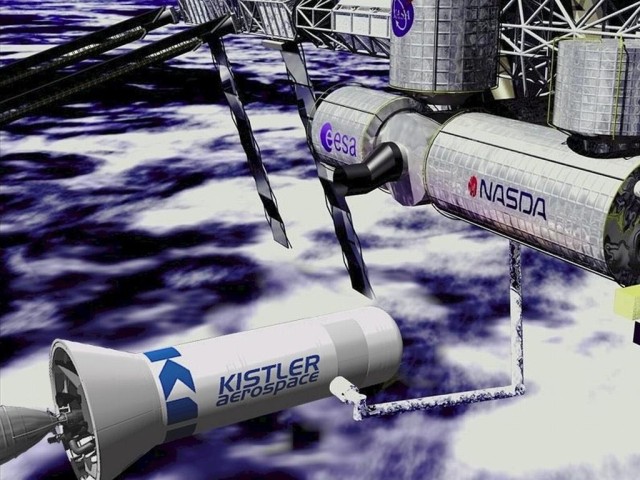
NASA deserves credit for motivating and financially backing private sector initiatives to travel into space. The space agency started a competition for a privately-run workhorse (called COTS for "Commercial Orbital Transportation Services") to assist NASA with future space lifts to the International Space Station (and who knows, maybe the Moon and beyond). NASA's concern is that the Shuttles will go offline in 2010 and the planned Crew Exploration Vehicle may not be available until 2014. The commercial spacecraft could will the gap and meet other future needs as well.

So NASA offered the winner(s) of the contest $500 million in seed money, something it has never attempted before. About two dozens companies competed and NASA announced the two winners last Friday - SpaceX and Rocketplane Kistler.

"By stimulating the development of commercial orbital spaceflight, the NASA COTS program will have the same positive effect on space travel as the Air Mail Act of 1925 had on the development of safe and affordable air transportation," said Elon Musk, SpaceX CEO. "Moreover, the requirement for significant private investment and the fact that NASA only pays for objective, demonstrated milestones ensures that the American taxpayer will receive exceptional value for money."

The new support for the space industry could lead to additional spinoffs, including space tourism. Stay tuned.

For more on the contest, click here.
For more on the overall NASA initiative, click here.

Update: A $3.9 billion dollar contract was awarded to Lockheed Martin Corp. to build the Crew Exploration Vehicle. The multi-part contract is expected to cost as much as $7.5 billion through 2019. For more visit this link.

Saturday, August 19

Alone in Space - And Almost Blind!

Hubble still hovers over our planet, but its camera stopped working back in June possibly due to a bad transistor. The telescope/spacecraft was launched back in 1990 and has been the subject of prior rescue efforts. Fortunately, NASA was able to work around the problem and get the camera back online.

"This is the best possible news," said Ed Ruitberg, deputy associate director for the Astrophysics Division at NASA's Goddard Space Flight Center, Greenbelt, Md. "We were confident we could work through the camera issue, and now we can get back to doing more incredible science with the camera." (Click here for more on the story.)

In addition to a bad transistor, NASA noted that the Hubble needs new batteries and gyroscopes to remain operational beyond next year. With the Shuttle delays and International Space Station backlog, it will be interesting if NASA can find the time and funds to make the necessary repairs. We have been well served by Hubble, including the fantastic picture of Jupiter above, and it would be nice if we could keep it going for many more years.

Update: NASA has decided to send a rescue mission to save the Hubble. The overall mission is slated for May 2008 and is expected to cost $900 million and last 11 days. With the repairs, the Hubble should remain active until at least 2013. Visit this link for more information.

Ever Hear of 2004 XP14?

No, this is not a new reusable rocket designed by Boeing. It is the name of an asteroid that missed the earth by 269,000 miles last month - appoximately the distance between the Earth and the Moon. The half-mile wide asteroid was first spotted back in 2004 (hence its name). If you missed it this time don't you worry. It will be back another 10 times over the next century (the rest being near misses as well, or so we hope).

Wednesday, August 2

But Will We Want to Come Back?

Have you heard of the Alliance to Rescue Civilization (with the cute acronym ARC)? While it may sound a little wild to worry about the day we can no longer live on this lovely blue planet, maybe they have the right idea. Always know where the fire exit is before you settle down in a new place.

ARC's mission is to "protect the human species and its civilization from destruction that could result from a global catastrophic event, including nuclear war, acts of terrorism, plague and asteroid collisions." How about simply bad management? None of that here, right?

The group envisions an off-site location, such as a space station or the moon, to act as a back up system. The site would store seeds, DNA, historic records, technology, literature, and more. Could we maybe store a leader or two up there - don't worry, we will call you if we need you.

We have already left a lot of our memories and technology around the solar system, and some is even leaving the solar system on the Voyager spacecraft. And what about the Russian and American space junk on the moon?

So why not try to be more orderly about it? I support the idea of a backup system, but let's also make sure we take care of what we have. The problem with any backup system is that we may take the original for granted. We may not be able to do a lot about an asteroid (though some would disagree), but war, terrorism and plague is a human specialty that we could do without (and should try and remove from the body politic, not move it out into space).