Tuesday, March 4

Let the Space Race Continue!

Once again we are looking to private initiative to find a new way into space, and $30 million is a nice incentive. Launched in September 2007, the Google Lunar X PRIZE is an international competition to safely land a robot on the surface of the Moon, travel 500 meters over the lunar surface, and send images and data back to the Earth. Teams must be at least 90% privately funded and must be registered to compete by December 31, 2010. The first team to land on the Moon and complete the mission objectives will be awarded $20 million; the full first prize is available until December 31, 2012. After that date, the first prize will drop to $15 million. The second team to do so will be awarded $5 million. Another $5 million will awarded in bonus prizes. The final deadline for winning the prize is December 31, 2014.

And the interest is impressive. Dr. Peter H. Diamandis, Chairman and CEO of the X PRIZE Foundation, announced the teams at Google Headquarters in Mountain View, California. “I’m very pleased to welcome our first 10 fully registered teams to the Google Lunar X PRIZE. Only 6 months after the announcement of this competition, the response has been incredible – we’ve received over 560 expressions of interest from more than 53 nations."

With the U.S. government, China, Japan and others pushing for the moon as well, it is a positive sign to see a truly open international competition to open up the moon. Just as we had our period of settling the western spaces in America, it seems the new slogan could be "Go up, young man".

Monday, January 21

Why the Moon?


If you have asked yourself that question, then you are the prime audience for NASA's poster "Why the Moon?" You can get a copy here.

Sunday, January 20

News on Mercury!

On January 14, the MESSENGER spacecraft (MErcury Surface, Space ENvironment, Geochemistry, and Ranging) flew by Mercury and took a unique picture showing a side of the planet we have never seen. The image shown was taken 18 minutes after close approach, when MESSENGER was about 3,000 miles away from the planet. The image is about 125 miles across.

Launched in the summer of 2004, the MESSENGER spacecraft is expected to go into orbit around Mercury in 2011 after a 4.9-billion mile journey that includes 15 trips around the sun. MESSENGER is only the second spacecraft sent to Mercury - Mariner 10 flew past it three times in 1974-75.

Saturday, May 12

Spacefest 2007

I bumped into an ad for the Spacefest 2007 conference in Mesa, Arizona. It actually looks like an interesting weekend of events. For instance, speakers include author David Levy, astronaut John Young, and director Louis Friedman from the Planetary Society. The event will also include a space auction (wait, they are not selling Moon plots just yet), including items such as this Gemini 10 mission patch. Moreover, a variety of astronauts will be on hand to sign autographs (sometimes for a fee). It could be a fun few days.

Saturday, April 14

Rain, Sleet, or Snow...Oh, Wait!

Yes, our invincible, intergalactic fleet has been grounded again by snowballs. Okay, hail, but still pretty sad. The Atlantis shuttle is still grounded in Florida since the hailstorm back in February. At the time of the event NASA reported that

"a severe thunderstorm with golf ball-size hail caused what could be 1,000 to 2,000 divots in the giant tank's foam insulation and minor surface damage to about 26 heat shield tiles on the shuttle's left wing. Further evaluation of the tank is necessary to get an accurate accounting of foam damage and must be done in the Vehicle Assembly Building, where the entire tank can be more easily accessed."

As of today, NASA states the Atlantis may get of the ground in June. Miss this window and we will be into hurricane season - what fun.

Who do we blame? NASA for wimpy construction, or Al Gore for not predicting this in his film? We may want to follow the example of the Europeans and more our space launch sites closer to the equator. If it is not hail it will be a rising sea overtaking Cape Canaveral. How about floating platforms, similar to the private sector space industry? Then not even Global Warming can stop our attempts to resettle on Mars before everything Earth-side is gone.

Oh well, keep your fingers crossed.

Note: The image above is a refurbished North Sea oil platform owned by Sea Launch, a private sector firm. The launch platform provides accommodations for 68 crew and launch system personnel
.

Saturday, February 17

Katsuura , We Have a Problem

Japan has announced that its long delayed Moon mission may be scrapped. According to a MSNBC story, the Lunar-A probe, designed to place two seismic sensors on the lunar surface for the purpose of learning more about the origins of the Moon, has been delayed for more than a decade. The Japanese still have plans to put a man on the Moon by 2025. Maybe he/she can visit our new trailer park.

A Little Place on the Moon

NASA hopes to have humans landing on the Moon by 2020 and occupying the surface by 2024, at least for a week at a time. The base would be located on one of the lunar poles to allow for almost continuous solar energy (and access to the limited water below the surface). And we would allow other nations to visit and/or participate in the project.

Of course, the Moon would also operate as a staging ground for a trip to Mars, the strongest argument for setting up there in the first place.

"Using the space station and building an outpost on the moon to prepare for the trip to Mars are critical milestones in America's quest to become a truly spacefaring nation," Griffin writes. "I think that we should want that. I want that. I want it for the American people, for my grandchildren, for my great-grandchildren."

I still say we should have a new race to the moon, but this time by commercial companies. This does not mean a new homesteading program, but NASA could be a partner in some innovative projects. The Moon project will take considerable funding, so all options should be explored.

Besides, the International Space Station is not exactly the most successfully model. It seems to represent PR for space more than real science. Of course, the ISS could prove useful in that the space station modules might be reconfigured for placement on the Moon. Yes, NASA is creating a trailor park on the Moon's surface. But its a start. Did you expect the Jetsons?

For more, visit NASA's Moon site.

Also, take a look at the Space Foundation's publication "The Case for Space." This document offers some good support for the Moon and Mars missions.

Wednesday, February 14

Weird Tales from NASA

While some of us are concerned about water on Mars, the Great Space Race with China, and other mighty issues, the press seems to be quite concerned about astronauts in diapers and the latest boyfriend of Martha Stewart.

I suppose this is to be expected in a country where reality TV is still the rage, but maybe it is not such a bad thing. The more the austronauts seem like the rest of us the more we can relate to them. Maybe we are not looking for super people anymore. And the expansion of commercial space represents the movement towards the regular folks reaching the heavens.

I was even surprised to recently read that the circulation of National Geographic (8.5 million) is more than twice that of People magazine (3.7 million). So maybe we like our gossip, but we also like our science (and by extension, our scientists).

Friday, February 2

Save Our Science

The Planetary Society continues with its SOS campaign. According to the Society's site, they recently delivered a petition containing more than 5,000 signatures to the White House calling on President Bush to restore funding for space science and exploration in his 2008 budget proposal to the U.S. Congress. The Society is concerned about cuts in astrobiology programs and solar system research. White House cut also include a Europa mission to investigate a possible habitat for life beyond Earth and the Terrestrial Planet Finder, a search for Earth-like worlds elsewhere in the galaxy. In addition, the Administration earlier in the year cut all work on a Mars Sample Return mission and precursor activities for human exploration of the Red Planet. While we have heard a lot of talk about upcoming manned missions, let's remember that most of the real work (and science) is done by the less glorious yet more capable robotic missions. Maybe we need to increase the funding for our space program rather than eliminating the science. Follow SOS events by clicking here.

Saturday, January 6

Discovery of New Flaws

I am glad to read that Discovery had another successful mission to the International Space Station last December. However, I am still puzzled with the news stories stating the mission was almost scrubbed because the shuttle could not fly during the New Year. It seems the shuttle's computers are not designed to go from one year to the next. Yes, while NASA boasts the space shuttle is "the most complex machine every built" with a "robust capacity," it cannot seem to deal with the complexities of the calendar. God forbid we also lose a coffee maker mid-flight.

James Webb Space Telescope?

Now that the Hubble has been saved (read more here) until 2012, we will not go blind anytime soon. But I recently read that the next generation telescope will be called the James Webb Space Telescope. While some have been critical of the naming of a NASA item after a "bureaucrat," Mr. Webb was always a strong supporter of a balance between a manned program and robotic craft that could do the necessary science. As NASA notes, "Webb's vision of a balanced program resulted in a decade of space science research that remains unparalleled today. During his tenure, NASA invested in the development of robotic spacecraft, which explored the lunar environment so that astronauts could do so later, and it sent scientific probes to Mars and Venus, giving Americans their first-ever view of the strange landscape of outer space."

My only concern is that this telescope will be put into an orbit where it cannot be visited and repaired. Maybe we need to consider the lessons from the Hubble telescope and ensure we have a backup plan.

Noogle

So, NASA and Google are cooperating. Does this mean more NASA work with some extra money, or less openness with the space program? Only time will tell, but given NASA budget situation - trying to fund a mission to Mars while also maintaining its science programs - every dollar will help. However, the funding aspect is still somewhat vague. Some of the benefits of this marriage may be 3-D maps of the moon and Mars and even real-time tracking of the International Space Station and shuttle (hopefully better than what you see on the airplane as you cross the Atlantic). Here is the NASA press release: "This agreement between NASA and Google will soon allow every American to experience a virtual flight over the surface of the moon or through the canyons of Mars," said NASA Administrator Michael Griffin at Headquarters in Washington. Of course, I remember doing this on my home computer 15 years ago with a private sector package.

Monday, November 27

The Search for New Planets

The French and European Space Agency have plans to launch the COROT spacecraft in December to look for exoplanets, or planets outside of our solor system. NASA is not far behind, planning to send the Kepler into space in October 2008. And how many explanets have been discovered to date? According to the California and Carnegie Planet Search site, about 182 exoplanets have been detected by astronomers. For example, the site currently highlights a "Super-Earth" orbiting the star Gliese 876. This newly discovered planet is a 7.5 Earth-mass planet orbiting this star and the lowest mass exoplanet known to be nearby.

All is Quiet with the God of War

The Mars Global Surveyor went quiet on November 2nd, and the chance of restoring communications is slim. The spacecraft has been circling Mars for more than 10 year, about 8 years longer than anticipated, so we have been lucky to date. Mars is still covered by a variety of craft, including the Mars Reconnaissance Orbiter, Mars Odyssey, two Mars rovers, and Mars Express. The problem is believed to be a disabled solar power array. For more on the mission, visit this link.

Monday, September 4

First Alberto, and Now Ernesto!

Fortunately, the Atlantis crew is back in Florida getting ready for their delayed flight. After Ernesto was downgraded to a tropical storm, everything was back on track. Which is important since the International Space Station is already behind schedule and a total of 15 flights will be necessary to finalize the project. Let's hope nothing scuttles the Wednesday launch. Hey, maybe it is time to consider some alternative launch sites. The predicted weather for Florida is not all that sunny in the years to come. The Sunshine State has become the Sometime State. Just as we are diversifying away from the old shuttle, let's think about diversifying away from the old Cape Canaveral. Back up systems are a good thing.

Update: The Atlantis did not actually get off the ground until September 9, but the overall mission was a success. The shuttle still sustained some damage, but this time from space debris. NASA noted "The hit, which left a hole about one-tenth of an inch in diameter, didn't endanger the spacecraft or the crew, nor did it affect mission operations." For more NASA shuttle news go here.

Sunday, August 20

The Great Space Race

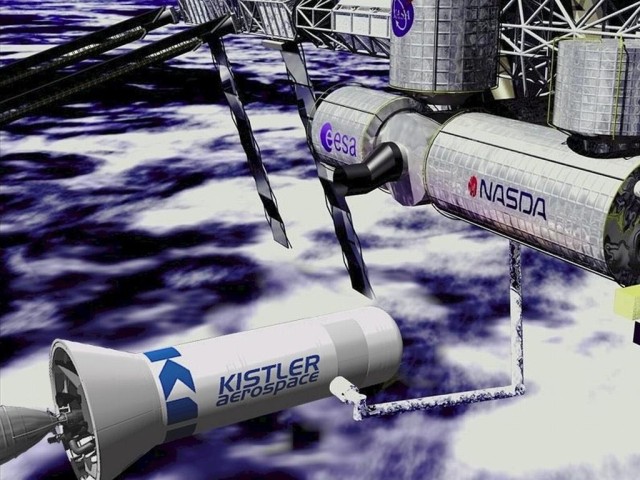
NASA deserves credit for motivating and financially backing private sector initiatives to travel into space. The space agency started a competition for a privately-run workhorse (called COTS for "Commercial Orbital Transportation Services") to assist NASA with future space lifts to the International Space Station (and who knows, maybe the Moon and beyond). NASA's concern is that the Shuttles will go offline in 2010 and the planned Crew Exploration Vehicle may not be available until 2014. The commercial spacecraft could will the gap and meet other future needs as well.

So NASA offered the winner(s) of the contest $500 million in seed money, something it has never attempted before. About two dozens companies competed and NASA announced the two winners last Friday - SpaceX and Rocketplane Kistler.

"By stimulating the development of commercial orbital spaceflight, the NASA COTS program will have the same positive effect on space travel as the Air Mail Act of 1925 had on the development of safe and affordable air transportation," said Elon Musk, SpaceX CEO. "Moreover, the requirement for significant private investment and the fact that NASA only pays for objective, demonstrated milestones ensures that the American taxpayer will receive exceptional value for money."

The new support for the space industry could lead to additional spinoffs, including space tourism. Stay tuned.

For more on the contest, click here.
For more on the overall NASA initiative, click here.

Update: A $3.9 billion dollar contract was awarded to Lockheed Martin Corp. to build the Crew Exploration Vehicle. The multi-part contract is expected to cost as much as $7.5 billion through 2019. For more visit this link.

Saturday, August 19

Alone in Space - And Almost Blind!

Hubble still hovers over our planet, but its camera stopped working back in June possibly due to a bad transistor. The telescope/spacecraft was launched back in 1990 and has been the subject of prior rescue efforts. Fortunately, NASA was able to work around the problem and get the camera back online.

"This is the best possible news," said Ed Ruitberg, deputy associate director for the Astrophysics Division at NASA's Goddard Space Flight Center, Greenbelt, Md. "We were confident we could work through the camera issue, and now we can get back to doing more incredible science with the camera." (Click here for more on the story.)

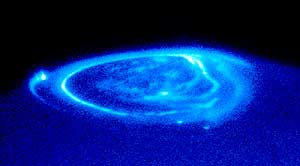
In addition to a bad transistor, NASA noted that the Hubble needs new batteries and gyroscopes to remain operational beyond next year. With the Shuttle delays and International Space Station backlog, it will be interesting if NASA can find the time and funds to make the necessary repairs. We have been well served by Hubble, including the fantastic picture of Jupiter above, and it would be nice if we could keep it going for many more years.

Update: NASA has decided to send a rescue mission to save the Hubble. The overall mission is slated for May 2008 and is expected to cost $900 million and last 11 days. With the repairs, the Hubble should remain active until at least 2013. Visit this link for more information.

Ever Hear of 2004 XP14?

No, this is not a new reusable rocket designed by Boeing. It is the name of an asteroid that missed the earth by 269,000 miles last month - appoximately the distance between the Earth and the Moon. The half-mile wide asteroid was first spotted back in 2004 (hence its name). If you missed it this time don't you worry. It will be back another 10 times over the next century (the rest being near misses as well, or so we hope).

Wednesday, August 2

But Will We Want to Come Back?

Have you heard of the Alliance to Rescue Civilization (with the cute acronym ARC)? While it may sound a little wild to worry about the day we can no longer live on this lovely blue planet, maybe they have the right idea. Always know where the fire exit is before you settle down in a new place.

ARC's mission is to "protect the human species and its civilization from destruction that could result from a global catastrophic event, including nuclear war, acts of terrorism, plague and asteroid collisions." How about simply bad management? None of that here, right?

The group envisions an off-site location, such as a space station or the moon, to act as a back up system. The site would store seeds, DNA, historic records, technology, literature, and more. Could we maybe store a leader or two up there - don't worry, we will call you if we need you.

We have already left a lot of our memories and technology around the solar system, and some is even leaving the solar system on the Voyager spacecraft. And what about the Russian and American space junk on the moon?

So why not try to be more orderly about it? I support the idea of a backup system, but let's also make sure we take care of what we have. The problem with any backup system is that we may take the original for granted. We may not be able to do a lot about an asteroid (though some would disagree), but war, terrorism and plague is a human specialty that we could do without (and should try and remove from the body politic, not move it out into space).

Tuesday, July 4

Discovery is Off!

Great news...the delays are over and Discovery is off the ground. Neither weather nor foam would get the better of the shuttle. It is not necessarily encouraging that NASA spent millions of dollars to reengineering the insulation on the external tank and still the safefy inspector voted against the launch. According to NASA Administrator Michael Griffinm "You could mail 10 of these things with the cost of a single first-class stamp. We're talking about a very, very minor piece of foam here. This is not an issue." Are you reassured? For updates on the mission click here.