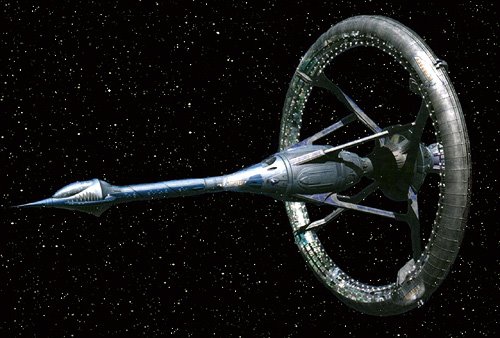
 Okay, let's just get it on the table. Space facts are fascinating, but so are space stories, real or otherwise. Under unreal comes science fiction, but let's not dismiss it too quickly. How many astronomers were first stimulated by watching Star Trek? Check out this page to learn more on this issue. Of course, we should leave room for skeptics. Nonetheless, I must admit I am enjoying the drama on Battlestar Galactica. Is it because of the hard science? No. In fact, the entire show is more like a Norse drama - "We will all die in the end, but drink up and prepare for another battle!" Still, we sometimes need the animation of possibility to become interested again in reality. Astronomers may seem like a dry lot, but they can be dreamers as well. In fact, I would not trust any group if it did not have space for dreamers. So let's keep our eyes open and our hopes high.
Friday, June 16
Yes, I Admit It...
Okay, let's just get it on the table. Space facts are fascinating, but so are space stories, real or otherwise. Under unreal comes science fiction, but let's not dismiss it too quickly. How many astronomers were first stimulated by watching Star Trek? Check out this page to learn more on this issue. Of course, we should leave room for skeptics. Nonetheless, I must admit I am enjoying the drama on Battlestar Galactica. Is it because of the hard science? No. In fact, the entire show is more like a Norse drama - "We will all die in the end, but drink up and prepare for another battle!" Still, we sometimes need the animation of possibility to become interested again in reality. Astronomers may seem like a dry lot, but they can be dreamers as well. In fact, I would not trust any group if it did not have space for dreamers. So let's keep our eyes open and our hopes high.


Monday, June 12
Mars Society is Meeting
The Mars Society has announced its 9th Annual International Mars Society Conference. The conference runs from August 3rd through the 6th. Speakers include Michael Griffin, NASA's Administrator. This is a way for enthusiasts to show their support for the Red Planet.
Thanks, Alberto
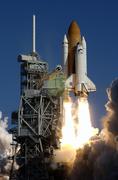 It is nice to see the shuttle being readied again. Unfortunately, the events may be delayed as tropical storm Alberto runs across the state. Space Shuttle Discovery is expected to launch on July 1 and stay up for about 12 days as the crew conducts repairs on the International Space Station. It is important that we get the shuttle back on track. However, as mentioned earlier on this page, we also need to be thinking post-shuttle. What is next?
Friday, March 24
What is Japan Up To?
 The Japan Aerospace Exploration Agency is in the process of retrieving asteroid samples. The Hayabusa spacecraft , launched in May 2003, intercepted the asteroid Itokawa, landed on its surface, collected approximately 1/10 of an ounce of material, and is now on the way back to Earth. Of course, that's the theory. JAXA is now wondering whether it actually obtained a sample, and also whether or not the craft will ever make it make to Earth. A fuel leak has jeopardized its timely return - originally set for June 1007. It is more likely to return in June 2010, if JAXA is lucky. The good news is that the spacecraft also carried a series of names to the asteroids surface - 877,490 to be exact - including the name Arthur C. Clark. Let's keep our fingers crossed for a safe return.
Note: JAXA also has other things underway, including building components of the International Space Station, space planes, and a mission to Venus.
Thursday, March 23
More on Mars...
 Now that the Mars Reconnaissance Orbiter is in orbit around the Red Planet (after a 7 month journey) we may learn more about our neighbor. The MRO will circle the planet for the next four years, collecting enough data to keep scientists busy for years to come. In addition to looking for water, the MRO will look at potential landing sites for future robotic, and possible human, explorers. The MRO is also one of many craft now circling Mars - the Mars Global Surveyor (NASA), Mars Odyssey (NASA) and Mars Express (ESA) are also scanning the planet's surface. In addition, NASA still has two rovers on the surface poking around. Things are getting crowded.
Sunday, March 12
What 's Next with Atlantis on its Way Out?
 With NASA announcing the retirement of the Atlantis shuttle by 2008, one wonders where our space program is going next. Sadly, we are down to three shuttles, and now Atlantis will be cannibalized for parts. Of course, Atlantis has been in use for more than 20 years, but I have not seen a lot of press on the replacements. The President spoke of traveling to Mars, and yet we cannot even maintain the rickety crafts that transports people and materiel to local satellites and the space station. Maybe we need to get the private companies into the act even sooner. This is not a new idea - read this USAToday editorial by Robert Zimmerman, an award-winning space historian.
Saturn or Bust
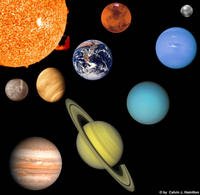 It seems that NASA's Cassini spacecraft, a cooperative project of NASA, the European Space Agency and the Italian Space Agency, may have found evidence of liquid water reservoirs on Saturn's moon Enceladus. The water erupts from the moon's surface in large geysers. We know of other moons with water, including Jupiter's Europa with its internal seas, and even our Moon with water reserves deep down near its poles. However, it is still an interesting set of circumstances since we know that water is essential to life as we know it. Maybe we are not such oddballs after all. Click here for more.
Wednesday, February 15
VSS Enterprise
 Space Adventures is not the only player in town. Virgin Galactic also offers space enthusiasts the opportunity to travel to the Earth's outer reaches. Richard Branson, Paul G. Allen and Burt Rutan have teamed up to create a new class of traveler who wants to "hurtle through the edges of the atmosphere" and "see the cobalt blue sky turn to mauve and indigo and finally black...Out will come the stars, clear and bright... even though it is daytime!" And what is the power source? Nitrous oxide (laughing gas) and rubber, which Virgin Galactic claims is much safer than liquid propulsion systems or solid fuel rockets. And it seems folks are interested. Morethan $10 million has been collected from future passengers, and the waiting list includes William Shatner and Stephen Hawkings. The plan is to procure five spacecraft and send more than 700 people into space the first 18 months. Again, new ideas for the future. Let's give NASA and others a run for their money.
Tuesday, February 7
So You Want to Go Into Orbit?
 While the traditional route to space orbit has been a long training program at NASA, the private sector is now opening up new opportunties. For example, Space Adventures has programs from low orbit in a Mig-25, a trip to the International Space Station, and even travel around the moon. Space Adventures sells itself as "the only company in the world currently operating commercial orbital spaceflight and will be the first to launch clients using a new breed of lower cost suborbital spacecraft currently under development worldwide." Let's hope this new breed of space travel continues to grow. While government programs have done all of the work to date (or through others on contract basis), it may be time to try new approaches. And why stop with the Earth. We need a race to Mars, and these low cost private options may be the way to do it.
Wednesday, January 25
The Little "Snowstorm" That Couldn't
 Remember the famous Buran (Russian for "Snowstorm") shuttle designed by the USSR to compete with NASA's shuttle? In fact, it looked almost identical from a distance. What ever happened to this experimental craft? When looking up some of the details I found that the Buran came off the production line in 1984, test launched in 1988, and was moth-balled in 1993. Last word is that the manufacturing plant now makes diapers and a Buran 1:1 scale version became a restaurant in Gorky Park. The Russians have a lot to be proud of throughout the space race, but this was not its high moment. Click here for more on the current Russian programs, including the OBSTANOVKA space weather project related to the International Space Station.
Tuesday, January 24
What is the Kuiper Belt?

Sunday, January 22
2.9 Billion Miles - For Dust?
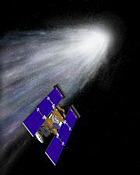 NASA's Stardust space capsule is now safely back on Earth after quite a journey. Scientists are now studying the payload (about one teaspoon of dust) that successfully landed in the Utah desert. We will now learn much more about the comets that circle our solar system and thereby more about the early foundations of our own planet some 4.5 billion years ago. Visit NASA's Jet Propulsion Laboratory for more on the progress of the research.
Friday, January 20
Viewing New Horizons
 We are off to a great start as we head towards the last planet in the solar system! The 3 billion mile trip to Pluto began yesterday and now we have a show that will last at least 9.5 years. NASA's New Horizons spacecraft broke away from Earth's and will someday visit Pluto and then break away from the inner solar system and inspect the Kuiper Belt - a cold and ice filled region from which planetoids periodically appear. You can monitor this little craft by visiting the Johns Hopkins University site.
Note: This if the first entry of Mars or Bust...a site designed to keep you wondering about this amazing world. Be it Pluto, Mars, the Milky Way or the Big Bang itself, the investigation is just beginning.
Subscribe to:
Posts (Atom)