Saturday, January 29

A Sad Anniversary, In Many Ways


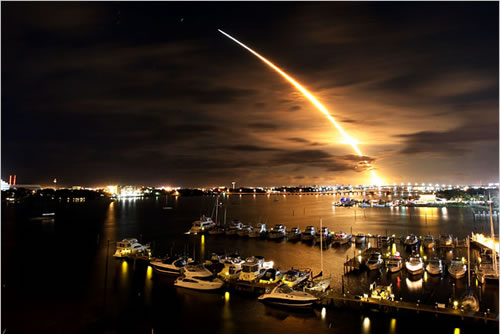
This past week represents the 25th anniversary of the Challenger explosion, a disaster that struck at the core of the American spirit. It was Apollo 1 all over again, yet in some ways worse due to the loss of more life and because every school child was glued to the television screen to see the first teacher in space.  However, as with the Apollo program, the nation regrouped, learned from the problem, and carried on, which was the best thing to do.

Of course, only two-thirds of the Space Shuttle fleet remain, after the loss of the Columbia in 2003.  And we are in the last year of these shuttle missions until we turn to the Russians to get us back into space.  A truly ironic, if not sad, situation where we are dependent on our Cold War foe who we beat to the moon.

This past Thursday, NASA Administrator Charles Bolden laid a wreath at Arlington National Cemetery to mark NASA's National Day of Remembrance (for a tribute page, go here). President Obama also had some comments on this day, including:


Throughout history, however, we have seen that achieving great things sometimes comes at great cost and we mourn the brave astronauts who made the ultimate sacrifice in support of NASA missions throughout the agency’s storied history. We pause to reflect on the tragic loss of the Apollo 1 crew, those who boarded the space shuttle Challenger in search of a brighter future, and the brave souls who perished on the space shuttle Columbia. 

As with any exploration, lives will be lost moving mankind to new limits and opportunities.  As long as we can learn from each failure, we have a better chance to get to that next goal.  Regardless of my concerns about the recent leadership of the space program, as one looks across the globe it is clear that mankind wants to continue to move outwards and upwards.  I only hope the United States can play a big part in this continuing effort.

Sunday, January 23

Moon Junk - Treasure Trove for Space Hunters

Mental Floss magazine had an interesting article in a recent issue discussing items left behind on the moon by the astronauts, including (1) a gold-plated olive branch, (2) Alan Shepard's golf balls, (3) a shrink-wrapped Polaroid of Charlie Duke's family, and (4) various other items such as moon boots and "defecation collection" devices.

After reading through the list of items, I starting thinking of what future generations or even distant visitors would find on the surface of the moon.  We know the Apollo missions left behind the lower portion of the lunar modules (see NASA map to the right).  In fact, NASA's Lunar Reconnaissance Orbiter spotted five of the six landing sites in July 2009.  the LRO also spotted scientific equipment the astronauts left behind, as well as the footpath created by the astronauts using these instruments.  

We also know that various crash sites can be found on the moon (and I am not talking about Transformers 3).  For instance, as recently as October 2009 NASA crashed the Lunar Crater Observation and Sensing Satellite (LCROSS) into the moon's south pole in the hopes of stirring up some water (this satellite is associated with the LRO mentioned above).  

A review of Wikipedia's list of moon junk shows mankind has left behind about 187 tons of material.  And while the United States and the former USSR are in the lead as litterers (both left 30 spacecraft on the surface before the first man even landed), objects have also been left behind by Japan, the European Union, China, and India. 

We shall see if the Chinese beat the other nations back to the moon, but the first race was quite spectacular.  For instance, while the United States will always get the credit for the first man on the moon, the Soviets were not far behind scientifically with their Luna 16 spacecraft (shown to the right) bringing back moon samples in 1970 (following the successful return of samples on the Apollo 11 and 12 missions).  However, the Soviets stopped sending craft to the moon in 1976, while the United States and other nations continue to explore the moon's surface.

Someday we will have moon archaeologists who will recover these odd objects and probably find some new stories among the wreckage.  And earthlings are doing their best to leave junk in other parts of the solar system, as the Voyager spacecraft shoot out of our solar system and into the great unknown.  The story (and litter) has just begun.

Wednesday, December 8

The Beginning of the Beginning?

Earlier today Space X's  Dragon spacecraft had a very successful launch, orbit, and landing.  This is the beginning of what NASA hopes will be the private sectors' take-over of low-earth orbit so the Agency can concentrate on more distant goals, such as Mars. 

NASA needed this success.  The Agency signed a $1.6 billion contract with SpaceX, requiring the contractor to provide cargo flights to the space station using the company's Dragon capsule. Currently, SpaceX plans to fly at least 12 unmanned missions to ferry supplies to the International Space Station.

It was interesting hearing Florida's Senator Bill Nelson earlier today make the following statement:  "We've arrived at the dawn of new era of U.S. space exploration that should ensure America remains a leader.

The last time I heard from him on NASA, he was trying to resurrect the shuttle program and spouting off conservative, go-slow statements to NASA like "walk before you run." I guess he has seen the light (or the dawn) as well as a good photo op.   

If this is our future, then we are off to a pretty good start.  I am not sure if this Congress (or the next one) has the stomach to fully fund our space initiatives.  We are better at pounding sand in the Middle East as compared to sifting sand on distant moons and planets.  But maybe we too will see the light one of these days.  On this planet, sadly there is nothing new under the sun (just read the papers from 10 years ago).  Fortunately, out in space there are a lot of new things under our sun, and I hope we get a chance to explore those areas soon.

Sunday, December 5

Quite a Week for Space Gawkers

It was certainly a fascinating week in terms of life on other planets and even life in other universes.  In terms of the first item, NASA announced last week that they located bacteria in California's Mono Lake that has a basic genetic structure that incorporates arsenic.  It was a surprise that life could exist with such chemistry, and caused many to wonder whether our definition of life has been too limited up to this point. 
"The definition of life has just expanded," said Ed Weiler, NASA's associate administrator for the Science Mission Directorate at the agency's Headquarters in Washington. "As we pursue our efforts to seek signs of life in the solar system, we have to think more broadly, more diversely and consider life as we do not know it." 
According to NASA, Mono Lake was selected for study due to its unusual chemistry, especially its high salinity, high alkalinity, and high levels of arsenic. Mono Lake has been from sources of fresh water for 50 years.

Another fascinating story in the New York Times related to a new take on the Big Bang.  Maybe it was really the Big Gasp.  British mathematician Roger Penrose believes evidence exists that two super-large black holes collided prior the Big Bang.  According to the New York Times, this challenges the current hypothesis that nothing existed before the Big Bang.  Of course, I am pretty sure that this could fit into other theories.  For instance, arguments have been going on for years as to whether the universe will continue to expand outwards and die a cold death like embers in the abandoned campfire, or will eventually collapse back onto itself due to gravity and start the process all over again. Could this be that echo?

I should also add that this theory does not appear to be a breaking story, though it may have rolled across the newpaper's desk just recently.  For instance, Australia was reporting on this more than three years ago.  And the idea itself was presented by Professor Penrose in 2005 - here is the lecture.  Is this also an echo?

And while the story was not all that clear in the recent article, a little more review of this matter indicates the theory relies on black holes basically cannibalizing the entire universe to the point that it resets itself.  To me at least, that is even more fascinating than a universe collapsing onto itself. 

Whatever the case, I find it all amazing to read about.  While I love to read science fiction for the pure enjoyment of new ideas, the regular scientific papers are doing their part to keep this strange universe of ours endlessly enchanting.

December 7 Update:  Not everyone is happy with NASA's announcement of arsenic-based life.   Take a look at Slate's article "This Paper Should Not Have Been Published."

Sunday, October 31

The Continuing Search for Intelligent Life

With the elections only a two days away, I started to think about intelligent life elsewhere (if only because I was wondering about its presence locally).  The discovery last month of a planet in the "inhabitable zone" of the Gliese 581 red dwarf star system provided the scientific community (and the rest of us) with some further evidence that we are not necessarily the only location for life.  This new planet, discovered using the W. M. Keck Observatory in Hawaii, is three times the mass of Earth and believed to have a rocky surface that is tidally locked to the star, meaning that one side is always facing the star.

If you recall the Drake Equation, it estimates the likelihood of finding intelligent life elsewhere in the Milky Way.  One of these factors ("L" from below) is the length of time such civilizations release detectable signals into space.

The equation calculates "L" at about 10,000 years.  Astronomer Carl Sagan had his doubts about a civilization reaching this point and not destroying itself, whereas Astrobiologist David Grinspoon was somewhat more optimistic.  In an Astrobiology Magazine article, Grinspoon states:
AM: You say that because life and its biosphere are so intertwined, it may not be possible to have an individual definition for "life."
DG: I suspect that life can only survive on a planet for billions of years if it has become deeply embedded in the geochemical, physical, and climatic cycles of that planet in a way that stabilizes the environment. If this is the case, life will not be found in isolated, discontinuous pockets on a mostly dead world, but will always, as on Earth, permeate its planet.

I think of life not as something that happens on a planet, but as something that happens to a planet. Life is a quality that the planet takes on. And it might be something that sticks and lasts through huge environmental and physical changes, as it has on Earth.

AM: You also state that humans may be the biosphere's way of gaining consciousness and self awareness, and that we are at the very beginning of this evolution.

DG: We don't know how hard it is for a planet to evolve a biosphere, or to become a "living world," but once it gets to that state, I would bet that such biospheres survive for billions of years. So they would last for much of the lifetime of their planet's parent star, and occasionally longer.

Stars have a limited life span. Stars like our sun, for instance, burn out after 10 billion years. After that, life on any habitable planets orbiting that star will go extinct. So if you want to outlive your star of birth, you will need to become complex and sentient and comfortable with space travel. Your biosphere must wake up and consciously choose survival, as Earth's is now attempting to do through the clumsy human experiment.
I hope we are smart enough to figure all of this out so we can live long and prosper.  In the meantime, we will  keep up the search for intelligence at home and abroad.

Chile and NASA

I am very happy, like everyone else, that the Chilean miners were safely brought to the surface after the mine collapse.  And the United States played a big role, including devising the drill-head used to burrow down to the miners' location.  In addition, NASA also a role by sharing information on how to survive in a hostile environment, as is the case on the International Space Station.  NASA also assisted with the design of the capsule that pulled the miners to safety.  Visit the NASA page for a small clip from Dr. Michael Duncan, deputy chief medical officer in NASA's Space Life Sciences Directorate at NASA's Johnson Space Center in Houston, who led the team assisting the Chilean authorities with the rescue.  I would like to see more of this sharing so that we can demonstrate that an international station can assist the world with a variety of issues.  I would rather see this than another Tang product on our store shelves.

Sunday, October 3

The End of This Week in Space

Just yesterday, Miles O'Brien from This Week in Space announced the end of his podcast show.  I wrote about this show last January when it started and I have enjoyed it ever since.  Miles took on the project after leaving CNN when the news network laid off its scientific staff (yes, real brilliant).  He now has a new role as the science correspondent on PBS's Newshour.  Miles noted that This Week in Space has been a "labor of love" that no longer pays the bills.  I liked the fact that he tried this new podcast format, and the quality and guests certainly increased over time.  Miles noted in his final broadcast that the show may return at some point in the future.  I hope it does.  In the meantime, I recommend subscribing to the podcast on iTunes or view is on YouTube.  You can also visit Miles O'Brien's page for updates on his show and his career.  I wish him the very best.

Saturday, October 2

New NASA Images Available

NASA recently started a partnership with Flickr Commons, called NASA on the Commons, that expands public access to the Agency's many photos of the space program.  For instance, the photo to the right, showing former President Johnson as he watches the launch of Apollo 11 on July 16, 1969, is from this new site.

This is just one of many vehicles for getting photos out to the rest of us.  In addition to NASA's own webpage, the Agency also created NASAimages.org, which has photographs and films related to the space program.  To date, the collection is more extensive than NASA on the Commons.

To the left is one of the photos from NASA.images.org.  This August 2006 photo shows astronaut Jeffrey N. Williams, Expedition 13 NASA space station science officer and flight engineer, as he is photographed during a almost 6 hour excursion that he shared with European Space Agency astronaut Thomas A. Reiter.

Such photos, combined with the various IMAX films shown around the country, can hopefully stimulate additional interest in space as the President and Congress chart the future of our space program.  We have much to be proud of and I look forward to many more fascinating photos on these websites.

Friday, September 3

Wonders of the Solar System

This new 5-episode series from the Science Channel is ending this week, but I highly recommend "Wonders of the Solar System" to anyone looking for an informative and fun take on the origins and oddities of our solar system.  Go here for the program trailer.

Narrated by Professor Brian Cox, who comes across as the goofy young brother of Carl Sagan, it is a thoroughly enjoyable tour of the solar system.  Just the visuals are stunning, but when you add in Dr. Cox's story telling, observations, demonstrations, and globe trotting, you find the hour flies by and you are now filled with a whole new set of interesting tidbits on this amazing corner of this enormous galaxy.

Dr. Cox is a professor of particle physics at the University of Manchester, though he has also been part of a rock band and looks the part.  Created by the BBC, the program broadcast over in Great Britain earlier this year to great acclaim.  The Telegraph stated "Cox is a confirmed atheist, but when I watched him on TV, his enchantment with nature both on this planet and beyond struck me as almost religious. As we talk, he has a near-permanent smile playing on his lips that puts me in mind of an earnest young vicar. He doesn’t reject the comparison."  Consider me a convert.  And I can only hope Dr. Cox will find time to make a second season.

Sunday, August 22

Fire Sale on Shuttles

NASA is seeking out museums and other parties that are willing to display the retired shuttles.  The only hitch is that you need to pay about $29 million just to get the shuttle to your location since it will be delivered via a special Boeing 747.  The Wall Street Journal had a good article on NASA's search, titled Shuttle Diplomacy: Museums Launch Bids for Retiring Space Planes.  One of the new locations has already been decided - Washington DC's National Air and Space Museum. The museum will be getting the shuttle Discovery.  And while the museum already has the shuttle Enterprise (which never left the ground), it is willing to put the Enterprise back into play so it is now one of the three shuttles to be relocated (the other two being Atlantis and Endeavour, since the Challenger and Columbia are no longer with us).

NASA requires that the other locations be in the United States and near a large airport that can handle the 747.  Another condition is that you need to get the shuttle from the airport to the proposed location intact, which is no easy feat for many locations.  Some potential future hosts of shuttles include New York City's Intrepid Sea, Air & Space Museum, Dayton's National Museum of the U.S. Air Force, Seattle's Museum of Flight, Houston's Johnson Space Center, and the Kennedy Space Center Visitor Complex.  Competition will be fierce, and congressional leaders are expected to muddy the waters with their own pleas. 

I am a bit concerned that we are fighting over these museum relics while our space program currently has nothing on the drawing board to replace the shuttle.  Remember the Soviet Union's Buran?  This Soviet shuttle was a complete rip-off of our space shuttle, which is itself a sad story given the Soviets great strides in space travel.  But the really sad story is the final end to the Buran.  It was retired in 1993 and destroyed when a hangar collapsed in 2002.  Nothing similar was ever tried again.

However, the Russians still have the last laugh since they currently have the only spacecraft that can get American astronauts up to the International Space Station.  Even more interesting, there were rumors of the Russian's trying to revive the Buran shuttle program to take advantage of the demise of the U.S. Space Shuttle program.  I have not read anything new about this, but it would certainly be an interesting turn of events.

Monday, August 9

More Plumbing Repairs?

This weekend we had two astronauts on a space walk to repair one of two cooling pumps in the American sector of the International Space Station (ISS).  This repair is not going well so far, but everyone is hopeful that the American crew will not need to abandon their section of the station and take refuge in the Russian section.  Last I heard, each shuttle mission to the ISS cost approximately $450 million.  And the ISS itself cost more than $100 billion.  So we are talking a fair amount of money to keep this thing afloat while we argue about whether or not we have enough funds to leave the Earth's orbit.  Does this make a lot of sense?  Yes, we are learning that cooling systems (and toilets) are critical to human survival and it is easier to fix them locally than when the spaceship is on its way to Mars.  But do we need to learn this multiple times at half a billion dollars per shot?  We have a Congress arguing about every penny here on the surface of the planet.  Some one else will do the math soon enough.  We need to start setting a bold vision that includes more than plumbing and cooling.  And maybe this is a chance to get the private sector involved, such as Home Depot.  They have some nifty plumbing/cooling tools and fixtures.

Saturday, August 7

Are We Looking for the Next Big Mac?

I was going through some earlier stories in the The Planetary Report, the journal of the Planetary Society, and came across a speech from Dr. Hawking after he received the Cosmos Award for Outstanding Public Presentation to Science on February 27, 2010.  It brought up a number of good points that are worth reflecting on.  In addition to linking Columbus' expedition to today's Big Mac (not the most convincing argument he made here), he noted the need for a long-term strategy for spreading into space:

This would mean hundreds, or even thousands, of years.  We could have a base on the Moon within 30 years, reach Mars in 50 years, and explore the moons of the outer planets in 200 years.  By "reach," I mean with manned, or should I say "personed," spaceflight.  We have already driven rovers on Mars, and we have landed a probe on Titan, a moon of Saturn, but if one is considering the future of the human race, we have to go there ourselves.

Such plans make sense, but we also live in a world where we laugh at 5-year plans (remember, they are a Communist tool), and approve NASA's budget annually, which is subject to the whim of legislators who need to be re-elected every 2 years rather than every 100 years.  So the vision thing may be a bit of a problem going forward for the United States.  It actually is better suited to the Chinese, who are still pretty happy with long-term planning.  That said, I would not want to bet against our private sector if we give them a good reason to get out there in space, such as profits.  And pride has worked in the past.  Would the United State's have put a man on the Moon if the Russians were not prodding us along?  Most probably not.

Dr. Hawking's also makes it clear that it is self-interest, such as rekindling American science, that should propel us outwards:

As new interest in space would also increase the public standing of science generally.  The low esteem in which science and scientists are held is having serious consequences.  We live in a society that is increasingly governed by science and technology, yet fewer and fewer young people want to go into science.  A new and ambitious space program would excite the young and stimulate them to go into a wide range of sciences, not just astrophysics and space science.  A high proportion of today's scientists say their interest in science was sparked by watching the Moon landings.

Dr. Hawking's also warns us to be careful, since not everything out there may be safe for human contact:

...an independent occurrence of life would be extremely unlikely to be DNA-based.  So watch out if you meet an alien.  You could be infected with a disease against which you have no resistance.

Dr. Hawking's gives us plenty to think about. I recommend you listen to his compete remarks.

Tuesday, June 29

What's Going on at NASA?

The news about the NASA Administrator is not good.  I have read of at least three investigations looking into Administrator Charles Bolden's actions in the past few months.  The latest story in the New York Times relates to an inquiry from the Hill regarding the treatment of Jeffrey M. Hanley, who was NASA's head of the moon program.  It seems Senators Rockefeller and Hutchinson have little faith in Administrator Bolden and believe Mr. Hanley may have been mistreated because he is not yet ready to give up on a moon mission, even if it is a smaller version of what was originally planned.

The increasing Hill oversight of the NASA program shows growing distrust between the White House and Congress regarding the direction of the space program.  The same article discusses a Government Accountability Office (GAO) review for the Congress regarding NASA's efforts to find alternatives to the moon plan, and the GAO is still reviewing allegations that NASA is interfering with Constellation contractors.

Another Wall Street Journal article noted Administrator Bolden is having trouble controlling the employees of his own Agency.  While Administrator Bolden has attempted to direct funding away from the old moon program and its contractors, more than $160 million was released to one moon program contractor and another $80 million promised to another moon program contractor.  All told, as much as $630 million in additional funding may be directed at contractors who are no longer needed in the eyes of the White House.  Make you wonder who is really in change over at NASA.

Wednesday, June 23

Another Chance for Atlantis

Soon after my last posting I read in the papers that NASA may use the Atlantis Shuttle one more time.  The Atlantis could fly one more time in June 2011, giving the shuttle program extended life.  This will be welcome news for thousands of Kennedy Space Center employees who will stay on the job a little longer.  Of course, nothing at NASA is cheap, and it could cost between $100-200 million per month to keep the program up and running.  It is also expected that private companies may be able to pick up some of the space cargo slack as soon as next year, so the extra mission may prove to be a nice bridge.

Saturday, May 15

The End of an Era

Yesterday the Atlantis Shuttle left the Earth's orbit for the last time. Interestingly enough, the Shuttle was bringing a Russian component to the International Space Station (ISS), its 11th and final voyage to the Station. Of course, with the end of the U.S. Space Shuttle program, we will need the Russians to get us back and forth to the ISS for a number of years into the future.

Overall, the Atlantis Shuttle has been quite a workhorse with 25 years of service and 115 million miles to its name. So farewell to a big part of America's space mission. Only two more Shuttle flights to go; Discovery in September and Endeavor in November. While the nature of future craft is still cloudy, let's hope we can still build such sturdy craft to get us to where we want to go.

Friday, April 30

Asteroid 24 Themis

If the Obama administration is looking for an asteroid worth a human visit, how about 24 Themis? As recently reported in the journal Nature, this asteroid between Mars and Jupiter was recently found to contain water and maybe even some organic molecules. This adds further support to the idea that asteroids and comets brought life to our planet.

Another asteroid probably more worthy of a visit is Ceres. A prior Nature article noted that various images
from the Hubble telescope led scientists to believe the asteroid Ceres may contain more fresh water than Earth. Ceres is 580 miles (930 km) in diameter (about the size of Texas) and represents about 25-30 percent of the asteroid belt's total mass. In fact, for about a century the asteroid was classified as a planet (see image for size comparisons with the Earth and the moon). NASA already has a spacecraft expected to encounter Ceres in 2015 (as well as the asteroid Vesta in 2011) - the Dawn Mission. Will humans follow?

Wednesday, April 21

Iceland and Memories of the Moon

With all of this talk about the volcanic ash from Iceland covering Europe, it may be worth remembering the role of Iceland in our first moon mission. This National Park Surface page notes "Since much of the moon's surface is covered by volcanic materials, it was very important that they know something about the lava they would encounter. This was the reason that the astronauts visited such places as Hawaii, Iceland, and Craters of the Moon."

Sunday, April 18

Planetary Society Supports the President's Vision

The Planetary Society released its own statement following President Obama's speech at NASA, stating:

The Planetary Society's leadership believes this new plan will take humans beyond Earth orbit to interplanetary space sooner than was possible under the old program, and it will take us farther and to more destinations than was ever planned with the Constellation program.

We commit our energy and resources to help turn this NASA plan from words to reality. Congress must now act upon the President's proposal. We recognize that it will be a long, hard fight, that there are entrenched interests that must be overcome, that business-as-usual must be surmounted, and, and that it will require breaking through technological barriers. But if human space explorers are to reach their destination of Mars within the next few decades -- a cherished dream of Society Members -- this is the only realistic way to get there.

Go here for the full statement.

Friday, April 16

The President Speaks

Here is the official version of the President's visit to NASA's Kennedy Space Center to discuss his vision for America's space program (go here for a video of the speech):

Astronauts will soar spaceward in commercial spacecraft while NASA develops technology so humans can venture to Mars and out into the solar system, President Barack Obama told a space conference Thursday at NASA's Kennedy Space Center in Florida.

Laying out his plans, President Obama committed NASA to a series of development milestones he said would lead to new spacecraft for astronauts to ride to the International Space Station, a modified Orion capsule developed as an emergency return spacecraft, and a powerful new rocket. He also promised a host of new technologies that would protect space travelers from radiation and other unique hazards.

"Early in the next decade, a set of crewed flights will test and prove the systems required for exploration beyond low Earth orbit," the president said. "And by 2025, we expect new spacecraft designed for long journeys to allow us to begin the first-ever crewed missions beyond the moon into deep space. We’ll start by sending astronauts to an asteroid for the first time in history. By the mid-2030s, I believe we can send humans to orbit Mars and return them safely to Earth. And a landing on Mars will follow. And I expect to be around to see it."

The president spoke to 200 senior officials, space and industry leaders, and academic experts inside the Operations and Checkout Building at Kennedy in the same area that was used to process Apollo spacecraft for the missions to the moon in the 1960s and 70s.

Standing in front of one of the space shuttle main engines that launched former U.S. Senator and astronaut John Glenn into orbit, President Obama said, "It was from here that men and women, propelled by sheer nerve and talent, set about pushing the boundaries of humanity's reach.

"The question for us now is whether that was the beginning of something, or the end of something. I prefer to believe it was the beginning of something."

The president's fiscal year 2011 budget proposal increases NASA's budget by $6 billion throughout the next five years to fund the plans.

Noting "the sense that folks in Washington -- driven less by vision than by politics -- have for years neglected NASA’s mission and undermined the work of the professionals who fulfill it," the president said the budget increase changes that.

The president's address comes at a critical juncture for NASA because the space shuttle fleet is scheduled to be retired after three more missions. The president said it will be quicker and less costly to let private companies develop new spacecraft for astronauts rather than continue with NASA's Constellation Program, which was deemed too expensive and behind schedule.

"Pursuing this new strategy will require that we revise the old strategy. In part, this is because the old strategy -- including the Constellation Program -- was not fulfilling its promise in many ways," the president said. "That’s not just my assessment; that’s also the assessment of a panel of respected non-partisan experts charged with looking at these issues closely."

President Obama's plan largely mirrors the "flexible path" option offered by a blue-ribbon panel established by the president last year to help decide the best map for future space exploration.

The outline does not do away with all the research and development from Constellation . Noting the success of the agency's development of the Orion crew capsule, Obama called on NASA to develop a version of that spacecraft so it can be launched without a crew to the International Space Station. It will be based there as an emergency craft for astronauts living on the orbiting laboratory.

The speech kicked off the Conference on the American Space Program for the 21st Century.

Norm Augustine, chairman of the blue-ribbon panel called the Review of U.S. Human Space Flight Plans Committee, that evaluated Constellation and came up with the "flexible path" option, endorsed the presidential strategy as the conference got under way.

Saying NASA is largely "trapped" in low Earth orbit, Augustine said industry, with NASA's guidance, can do its part for the plan.

The president acknowledged the need to get the decision right.

"Now, the challenges facing our space program are different, and our imperatives for this program are different than in decades past," the president said. "But while the measure of our achievements has changed a great deal over the past fifty years, what we do -- or fail to do -- in seeking new frontiers is no less consequential for our future in space and here on Earth."

The plan, the president said, would free NASA's designers and engineers to develop spacecraft, large rockets and new technologies that can extend the frontier of human space exploration to asteroids and even Mars.

About $3.1 billion of the additional funding would go into research and development for a heavy-lift rocket. A design for a large booster would be chosen in 2015 with the goal of launching the spacecraft a few years later. The bigger rocket could be used to loft payloads too large for most boosters, including giant fuel depots that would be parked in distant orbits so spacecraft could refuel on their way to asteroids, the moons of Mars and eventually Mars itself.

In addition to more funding, President Obama said his initiative brings more jobs than previous schedules.

"My plan will add more than 2,500 jobs along the Space Coast in the next two years compared to the plan under the previous administration," he said. "I’m proposing a $40 million initiative led by a high-level team from the White House, NASA, and other agencies to develop a plan for regional economic growth and job creation. And I expect this plan to reach my desk by Aug. 15. It’s an effort that will help prepare this already skilled work force for new opportunities in the space industry and beyond."

Taken together, the space strategy proves America is poised for a future as bright as its remarkable past, the president said.

"Fifty years after the creation of NASA, our goal is no longer just a destination to reach," Obama said. "Our goal is the capacity for people to work and learn, and operate and live safely beyond the Earth for extended periods of time, ultimately in ways that are more sustainable and even indefinite. And in fulfilling this task, we will not only extend humanity’s reach in space -- we will strengthen America’s leadership here on Earth."

Written by: Steven Siceloff, NASA's John F. Kennedy Space Center

Thursday, April 15

Columbus All Over Again

I think back to Columbus and the Vikings when the President mentions bypassing the moon for some more distant goal. Of course, I am all for a trip to Mars, but did we ever really hold down the moon as an outpost on the way into the solar system? We know the story of America. The vikings under Leif Eriksson were the first land in North America back around the year 1,000 and establish a small colony. However, they stayed for only a year and never fully established a presence, allowing other Europeans to permanently occupy the territory 500 years later.

Are we making the same mistake with the Chinese? In our search for an asteroid or eventual Mars landing are we handing the moon over to other countries such as China and India to set up moon colonies and take greater possession of something we occupied for a very short time 40 years ago? How will we feel if we see Chinese flags and possibly even EU flags across the moon, while we are still grounded here on Earth hitching a ride to the Space Station on a Russian rocket.

It does not give me a warm feeling, and I can see no clearer indication of the closing of the American Century. And I hope the naming of the first Mars probes "Viking" is not another cruel joke regarding our future on Mars.