Showing posts with label Charon. Show all posts

Saturday, June 25

A Grander Canyon on Charon

Images from NASA's New Horizons mission indicate Pluto's moon Charon has a 430 mile long canyon named Argo Chasma (the section shown above measures 185 miles). This canyon is also estimated to be about 5.5 miles deep.

Earth's Grand Canyon is only 280 miles long and about 1 mile deep by comparison, representing a much shorter and shallower scar on a much larger world. However, the Valles Marineris is 2,500 miles long and 4.3 miles deep, so Mars still represents a much longer scar. And the longest canyons in the solar system are found in Earth's rift valleys. But none of this takes away from Charon's significant scar given its small size. 

Friday, October 2

New Horizon Images of Charon

NASA's New Horizons continues to send one stunning shot after another.  The image above is from Pluto's moon Charon.  As with Mars, you can see a great canyon scarring the surface of the moon.  NASA notes:
High-resolution images of the Pluto-facing hemisphere of Charon, taken by New Horizons as the spacecraft sped through the Pluto system on July 14 and transmitted to Earth on Sept. 21, reveal details of a belt of fractures and canyons just north of the moon's equator. This great canyon system stretches more than 1,000 miles (1,600 kilometers) across the entire face of Charon and likely around onto Charon's far side. Four times as long as the Grand Canyon, and twice as deep in places, these faults and canyons indicate a titanic geological upheaval in Charon's past.
NASA expected even higher resolution images to be transmitted shortly.  New Horizons will be transmitting these amazing images over the next year or so.  The gift that keeps giving. 

Friday, July 3

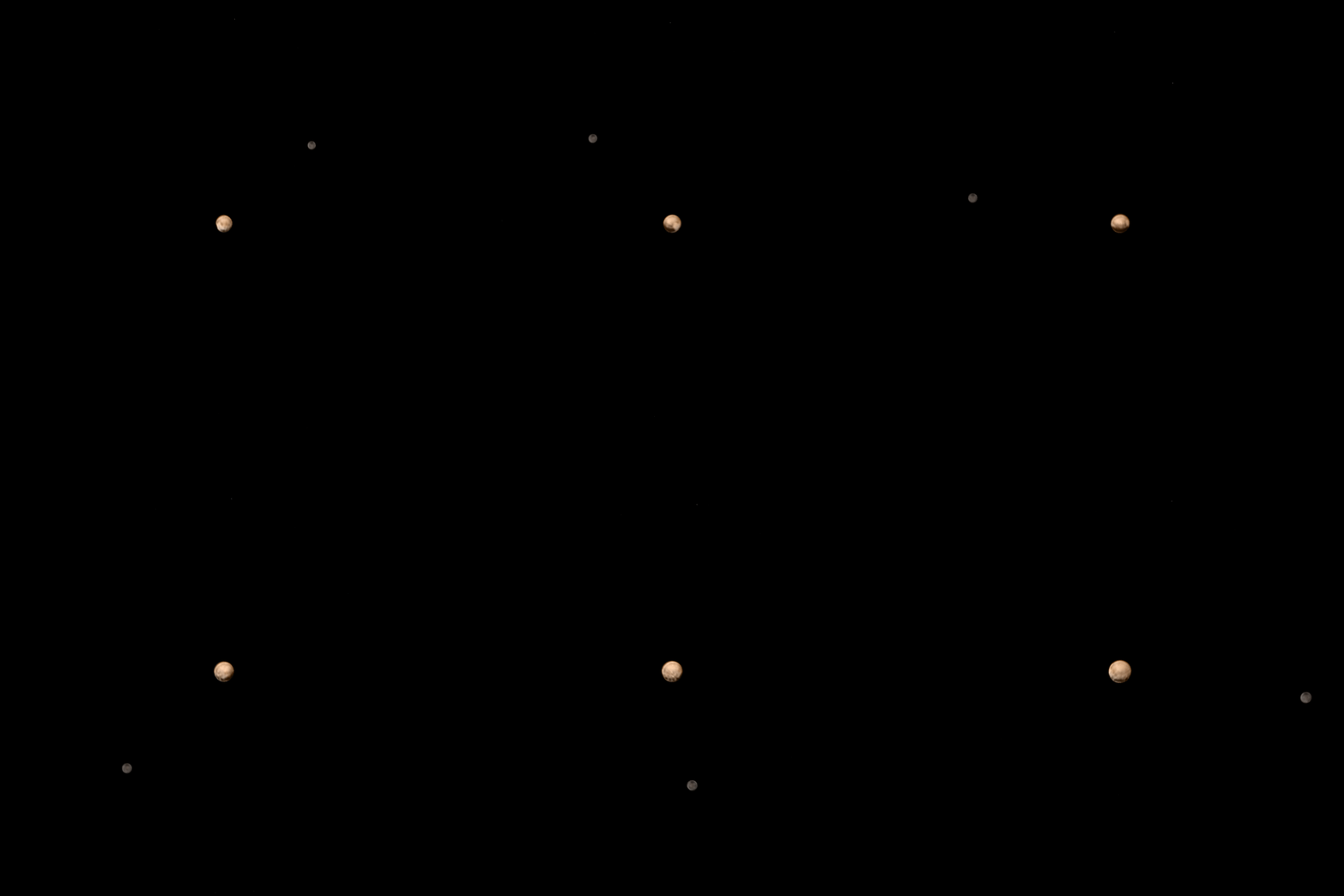
Amazing Image of Pluto and Charon

The film above shows us that New Horizons has arrived at Pluto and is already sending back amazing imagery.  Here is the story from NASA concerning the film above:
This is the first movie created by New Horizons to reveal color surface features of Pluto and its largest moon Charon. “It’s a bit unusual to see so much surface detail at this distance,” said New Horizons co-investigator William McKinnon of the Geology and Geophysics Investigation Team, Washington University in Saint Louis. “What’s especially noteworthy is the level of detail in both bodies. It’s certainly whetting our appetite for what’s to come.”
The images were taken between June 23 and June 29, 2015, as New Horizons’ distance to Pluto decreased from a distance of 15 million to 11 million miles (24 million to 18 million kilometers). Six high-resolution black-and-white images from New Horizons’ LORRI instrument were combined with color data from the Ralph instrument to produce the movie.

Sunday, October 21

New Moons Around Pluto

While Pluto might no longer be considered a planet, NASA still plans to visit the dwarf planet via New Horizons in July 2015.  Launched in 20016, the New Horizons space craft is already half-way to Pluto after passing Uranus. 

In preparation for the flight, the Hubble space telescope has been monitoring Pluto's neighborhood to make sure the New Horizons spacecraft does not smack into any unknown objects.  This turned out to be a pretty good idea since Hubble has already discovered two new moons over the course of about a year. 

In July 2011, NASA announced the discovery of a fourth moon, labeled P4.  This new moon has a diameter of only 8 to 21 miles, making it small enough to escape detection all of these years but large enough to cause problems for a NASA mission.  And this past July, Hubble located Pluto's fifth moon, P5 (yes, this naming is quite creative).  P5 is even smaller than P4.  Oddly, NASA's New Horizons website has yet to announce this discovery.  The graphic below provides some size comparisons.


Remember, Hubble located the second and third moon, Nix and Hydra, back in 2005.  The largest moon, Charon, was discovered in 1978 by the U.S. Naval Observatory.  Pluto and its moons reside inside the Kuiper Belt about 3 billion miles from the Sun.

If you are looking for more on why Pluto is no longer a "real" planet, you can always read Mike Brown's book How I Killed Pluto and Why It Had It Coming.  Mike Brown is the Richard and Barbara Rosenberg Professor of Planetary Astronomy at the California Institute of Technology,  As he explains, not everyone was happy with his discovery of 10th planet, Eris:

My daughter Lilah, now five years old, is mad at me for killing Pluto. When I began a project 13 years ago to chart the slowly-moving objects of the distant outer solar system, my goal was never to pull Pluto off of its cherished planetary pedestal. I wanted to be a planet discoverer, like William Herschel or Clyde Tombaugh before me. I had a strong feeling that somewhere out there something bigger than Pluto was lurking, and I knew that whoever found it would get to claim the mantle as the only living planet discoverer. 

I was right. Something bigger than Pluto was out there (or at least something more massive than Pluto; sizes are a little harder to pin down precisely) and one January morning in 2005, my small team of astronomers and I found it. We announced the discovery of the 10th planet to an unsuspecting world late on the afternoon of Lilah’s 22nd day of life. A little after her first birthday, though, the doors to the planetary club were locked and Pluto and my own discovery were kicked out on the curb. The solar system was down to only eight planets.