Showing posts with label Hubble Space Telescope. Show all posts

Sunday, October 16

"My God, it's full of galaxies!"

Scientists now believe we have underestimated the number of observable galaxies by a factor of 10. That's right, instead of 200 billion galaxies it is more like 2 trillion. That also means a heck of a lot more planets and places for life.

A team lead by Christopher Conselice of the University of Nottingham, U.K., looked at one small patch of sky and discovered 10 times more galaxies than ever expected.  His team used data taken from the Hubble Space Telescope and other observatories.  This sampling appears to be similar to the Kepler approach when it too viewed a patch of sky to project the sample of discovered exoplanets to entire night sky.  You can read the team's paper here.

Conselice noted:
It boggles the mind that over 90 percent of the galaxies in the universe have yet to be studied. Who knows what interesting properties we will find when we discover these galaxies with future generations of telescopes? In the near future, the James Webb Space Telescope will be able to study these ultra-faint galaxies,
The quote in the title of this piece comes from the HubbleSite, which notes:
In Arthur C. Clarke's novel "2001: A Space Odyssey," astronaut David Bowman exclaims, "My God, it's full of stars!" before he gets pulled into an alien-built wormhole in space. When the Hubble Space Telescope made its deepest views of the universe, astronomers might have well exclaimed: "My God, it's full of galaxies!"
As is often the case, reality mimics science fiction and then runs with it far beyond what we imagined.

Monday, July 4

Something to Ponder on the Fourth of July

The Wall Street Journal had an enlightening article this weekend titled "Fleeing the Czars, Defying Gravity: A Fourth of July Immigrant Tale."  It leads up to the career of astronaut Jeffrey Hoffman, pictured above, who was part of the missions to keep the Hubble Space Telescope operating properly.  Hoffman retired from NASA in 1997 and is now a professor of aeronautics and astronautics at MIT. You can read more about his career here.

Friday, May 20

Portrait of Mars

The Hubble Space Telescope is useful for "family" shots in our own solar system, as this new image taken May 12th demonstrates.

Here is the rest from NASA:
The large, dark region at far right is Syrtis Major Planitia, one of the first features identified on the surface of the planet by seventeenth-century observers. Christiaan Huygens used this feature to measure the rotation rate of Mars. (A Martian day is about 24 hours and 37 minutes.) Today we know that Syrtis Major is an ancient, inactive shield volcano. Late-afternoon clouds surround its summit in this view.
A large oval feature to the south of Syrtis Major is the bright Hellas Planitia basin. About 1,100 miles across and nearly five miles deep, it was formed about 3.5 billion years ago by an asteroid impact. 
The orange area in the center of the image is Arabia Terra, a vast upland region in northern Mars that covers about 2,800 miles. The landscape is densely cratered and heavily eroded, indicating that it could be among the oldest terrains on the planet. Dried river canyons (too small to be seen here) wind through the region and empty into the large northern lowlands. 
South of Arabia Terra, running east to west along the equator, are the long dark features known as Sinus Sabaeus (to the east) and Sinus Meridiani (to the west). These darker regions are covered by dark bedrock and fine-grained sand deposits ground down from ancient lava flows and other volcanic features. These sand grains are coarser and less reflective than the fine dust that gives the brighter regions of Mars their ruddy appearance. Early Mars watchers first mapped these regions. 
An extended blanket of clouds can be seen over the southern polar cap. The icy northern polar cap has receded to a comparatively small size because it is now late summer in the northern hemisphere. Hubble photographed a wispy afternoon lateral cloud extending for at least 1,000 miles at mid-northern latitudes. Early morning clouds and haze extend along the western limb.
Image Credit: NASA, ESA, the Hubble Heritage Team (STScI/AURA), J. Bell (ASU), and M. Wolff (Space Science Institute)

Saturday, May 7

The Search for Habitable Planets Expands

It is amazing that Star Trek in the 1960s and Cosmos on the 1970s speculated about distant planets, and here we are today actually studying thousands of newly discovered planets, searching for moons around these planets, and even planning to analyze the atmospheres on the planets themselves. We may not have flying cars as promised, but we are starting to see those distant worlds we predicted which I believe is far more fascinating.

Last month, NPR had a story on the search for moons around approximately 1,000 distant planets by astronomer David Kipping at Columbia University. He believes gaseous planets similar to Jupiter and Saturn may have habitable moons where life is possible. We know our solar system has such moons, such as Europa and Enceladus, that we have yet to adequately explore for signs of life. So we have plenty of work to do here at home as well. 

Another NPR story this month discussed three nearby planets that circle a red star. Only 40 light years away, the Earth-size planets may offer a habitable environment for life. And using the Hubble Space Telescope, astronomers hope to be able to learn about the atmospheres of these planets as sunlight filters though them, while the upcoming James Webb Space Telescope will be able to provide details on the chemical composition of the atmosphere. More reasons to be excited about new space investments.

The search can only get more interesting as our technology improves and our curiosity grows. Whether in our solar system or far beyond, there is so much to study and understand. 

Above Image: Top row, left to right, is Titan, Earth's Moon, Europa, and Encelasus. Bottom row, left to right, Callisto, Charon, Ariel, and Io.

Bottom Image: Artist's rendering of the three distant planets around a red star. ESO/M. Kornmesser/Nature

Friday, September 4

Great Image: Twin Jet Nebula

The image above was captured by the Hubble Space Telescope.  You are viewing the Twin Jet Nebula where two stars are thought to be at its heart.  NASA provides more on this amazing image:
It is called the Twin Jet Nebula as well as answering to the slightly less poetic name of PN M2-9.

The M in this name refers to Rudolph Minkowski, a German-American astronomer who discovered the nebula in 1947. The PN, meanwhile, refers to the fact that M2-9 is a planetary nebula. The glowing and expanding shells of gas clearly visible in this image represent the final stages of life for an old star of low to intermediate mass. The star has not only ejected its outer layers, but the exposed remnant core is now illuminating these layers — resulting in a spectacular light show. However, the Twin Jet Nebula is not just any planetary nebula, it is a bipolar nebula.

Ordinary planetary nebulae have one star at their center, bipolar nebulae have two, in a binary star system. Astronomers have found that the two stars in this pair each have around the same mass as the sun, ranging from 0.6 to 1.0 solar masses for the smaller star, and from 1.0 to 1.4 solar masses for its larger companion. The larger star is approaching the end of its days and has already ejected its outer layers of gas into space, whereas its partner is further evolved, and is a small white dwarf.
This Hubblecast video provides more on the nebula above and others. 

Sunday, June 14

New NASA Video on the Hubble Space Telescope

A new NASA video titled "Oh Planet, What Art Thou?" continues the celebration of Hubble's 25th anniversary by noting how the telescope has helped to determine the composition of exoplanet atmospheres.  And while Hubble has focused on larger planets, the new James Webb Space Telescope should assist with smaller planets.  

Wednesday, April 22

Happy Birthday, Hubble!

This week represents the 25th anniversary of the Hubble Space Telescope.  Launched on April 24th, 1990, the telescope has been hard a work ever since opening our eyes to the universe around us.  NASA's video 25 Years Started Here: Kennedy and the Launch of the Hubble is a nice place to start in revisiting the history of the space telescope.  The Hubble was a significant achievement as well as an expensive piece of hardware that required five separate space shuttle missions to keep it functioning. 

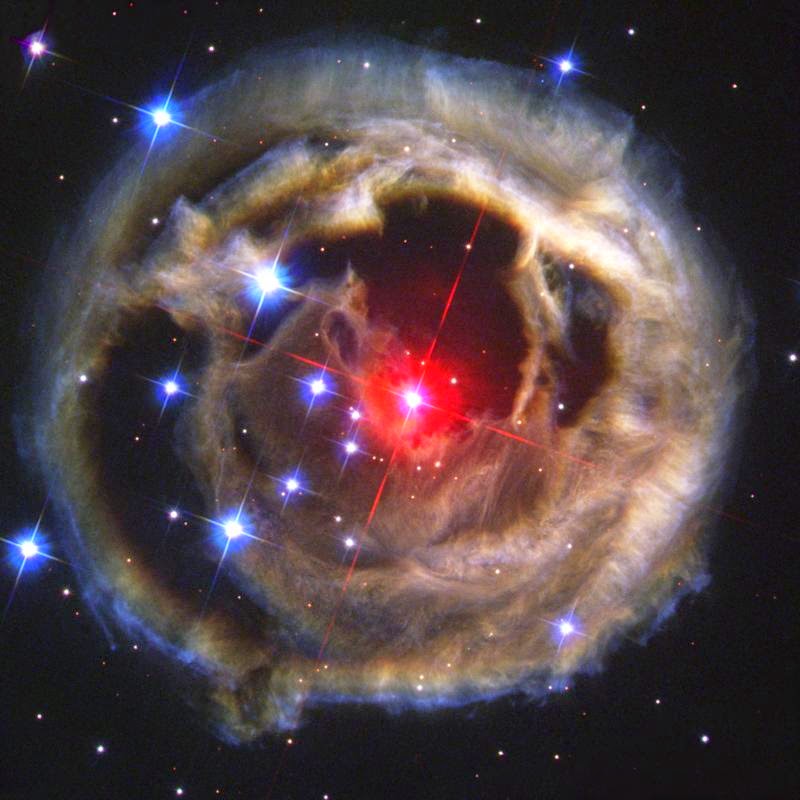
You can see plenty of images, interviews, and videos at the Hubble Space Telescope channel on YouTube, or visit hubblesite.org for some of Hubble's top shots (such as the Horsehead Nebula shown here).  The Hubble allowed all of us to see an amazing universe in ways that not even the science fiction writers could imagine.  The inventory of images is awe inspiring, including the image below called "Light Echo From Star V838 Monocerotis." 

As far as the future beyond Hubble, we can look forward to the James Webb Space Telescope, expected to be launched in 2018.  In another video, NASA Astrophysicist Dr. Amber Straughn discusses both the Hubble and James Webb space telescopes.  The James Web Space Telescope will be stationed far beyond the moon and no longer in a position for future repairs, so we are entering into a new realm where we need to get everything perfect the first time.  No pressure, of course.  This additional NASA video shows the complexity of the telescope's deployment.

Tuesday, January 6

Great Image: Our Neighboring Galaxy

Above is an amazingly clear Hubble image of the Andromeda Galaxy, a mere 2.5 million light years away.  NASA offers a startling analogy regarding this clarity: 
The Hubble Space Telescope is powerful enough to resolve individual stars in a 61,000-light-year-long stretch of the galaxy’s pancake-shaped disk. It's like photographing a beach and resolving individual grains of sand. And there are lots of stars in this sweeping view -- over 100 million, with some of them in thousands of star clusters seen embedded in the disk...Because the galaxy is only 2.5 million light-years from Earth, it is a much bigger target in the sky than the myriad galaxies Hubble routinely photographs that are billions of light-years away. This means that the Hubble survey is assembled together into a mosaic image using 7,398 exposures taken over 411 individual pointings. 
Image credit: NASA, ESA, J. Dalcanton, B.F. Williams, and L.C. Johnson (University of Washington), the PHAT team, and R. Gendler

Friday, November 14

Great Image: Cat's Eye Nebula

With all the fascinating images in the movie Interstellar, we could forget that nature itself it stunningly beautiful all by itself, as demonstrated by this Hubble Space Telescope image of the Cat's Eye nebula (or NGC 6543).  Here is NASA's tale of this amazing picture:
The alluring Cat's Eye nebula, however, lies three thousand light-years from Earth across interstellar space. A classic planetary nebula, the Cat's Eye (NGC 6543) represents a final, brief yet glorious phase in the life of a sun-like star. This nebula's dying central star may have produced the simple, outer pattern of dusty concentric shells by shrugging off outer layers in a series of regular convulsions. But the formation of the beautiful, more complex inner structures is not well understood. Seen so clearly in this digitally sharpened Hubble Space Telescope image, the truly cosmic eye is over half a light-year across. Of course, gazing into this Cat's Eye, astronomers may well be seeing the fate of our sun, destined to enter its own planetary nebula phase of evolution ... in about 5 billion years.

Image Credit: NASA, ESA, HEIC, and The Hubble Heritage Team (STScI/AURA)

Saturday, October 18

Great Image: Life Cycle in a Nebula


This Hubble Space Telescope image of a nebula shows emerging stars, fast-burning stars exhausting their fuel, and even planets trying to form from a disk of gas and dust.  We see a full spectrum of life to death in one image.  NASA explains:

From beginning to end, different stages of a star's life appear in this exciting Hubble Space Telescope picture of the environs of galactic emission nebula NGC 3603. For the beginning, eye-catching "pillars" of glowing hydrogen at the right signal newborn stars emerging from their dense, gaseous, nurseries. Less noticeable, dark clouds or "Bok globules" at the top right corner are likely part of a still earlier stage, prior to their collapse to form stars. At picture center lies a cluster of bright hot blue stars whose strong winds and ultraviolet radiation have cleared away nearby material. Massive and young, they will soon exhaust their nuclear fuel. Nearing the end of its life, the bright supergiant star Sher 25 is seen above and left of the cluster, surrounded by a glowing ring and flanked by ejected blobs of gas. The ring structure is reminiscent of Supernova 1987a and Sher 25 itself may be only a few thousand years from its own devastating finale. But what about planets? Check out the two teardrop-shaped objects below the cluster toward the bottom of the picture. Although larger, these emission nebulae are similar to suspected proto-planetary disks (proplyds) encompassing stars in the Orion Nebula.
Credit: Wolfgang Brandner (JPL/IPAC), Eva K. Grebel (U. Wash.), You-Hua Chu (UIUC), NASA

Sunday, June 8

Great Image: Hubble Ultra Deep Field

Last week NASA released an amazing image of the universe from the Hubble Space Telescope that took 9 years to create. It is a beautiful composite of of more than 10,000 colorful galaxies stretching back to the beginning of the universe.  Here is the official explanation from NASA: 

Astronomers using NASA's Hubble Space Telescope have assembled a comprehensive picture of the evolving universe – among the most colorful deep space images ever captured by the 24-year-old telescope.
Researchers say the image, in new study called the Ultraviolet Coverage of the Hubble Ultra Deep Field, provides the missing link in star formation. The Hubble Ultra Deep Field 2014 image is a composite of separate exposures taken in 2003 to 2012 with Hubble's Advanced Camera for Surveys and Wide Field Camera 3.
Astronomers previously studied the Hubble Ultra Deep Field (HUDF) in visible and near-infrared light in a series of images captured from 2003 to 2009. The HUDF shows a small section of space in the southern-hemisphere constellation Fornax. Now, using ultraviolet light, astronomers have combined the full range of colors available to Hubble, stretching all the way from ultraviolet to near-infrared light. The resulting image -- made from 841 orbits of telescope viewing time -- contains approximately 10,000 galaxies, extending back in time to within a few hundred million years of the big bang.
Image Credit:  http://hubblesite.org/news/2014/27

Tuesday, December 25

Great Image: A Gathering of Galaxies

This Hubble Space Telescope image is labeled "A Day in the Lives of Galaxies" on the hubblesite.org website.  Here is the rest of the story: 

Like a photographer clicking random snapshots of a crowd of people, NASA's Hubble Space Telescope has taken a view of an eclectic mix of galaxies. In taking this picture, Hubble's Advanced Camera for Surveys was not looking at any particular target. The camera was taking a picture of a typical patch of sky, while Hubble's infrared camera was viewing a target in an adjacent galaxy-rich region. 

The jumble of galaxies in this image, taken in September 2003, includes a yellow spiral whose arms have been stretched by a possible collision [lower right]; a young, blue galaxy [top] bursting with star birth; and several smaller, red galaxies.

But the most peculiar-looking galaxy of the bunch – the dramatic blue arc in the center of the photo — is actually an optical illusion. The blue arc is an image of a distant galaxy that has been smeared into the odd shape by a phenomenon called gravitational lensing. This "funhouse- mirror effect" occurs when light from a distant object is bent and stretched by the mass of an intervening object. In this case the gravitational lens, or intervening object, is a red elliptical galaxy nearly 6 billion light-years from Earth. The red color suggests that the galaxy contains older, cooler stars.

The distant object whose image is smeared into the long blue arc is about 10 billion light-years away. This ancient galaxy existed just a few billion years after the Big Bang, when the universe was about a quarter of its present age. The blue color indicates that the galaxy contains hot, young stars.
Gravitational lenses can be seen throughout the sky because the cosmos is crowded with galaxies. Light from distant galaxies, therefore, cannot always travel through space without another galaxy getting in the way. It is like walking through a crowded airport. In space, a faraway galaxy's light will travel through a galaxy that is in the way. But if the galaxy is massive enough, its gravity will bend and distort the light.

Long arcs, such as the one in this image, are commonly seen in large clusters of galaxies because of their huge concentrations of mass. But they are not as common in isolated galaxies such as this one. For the gravitational lens to occur, the galaxies must be almost perfectly aligned with each other.
Gravitational lenses yield important information about galaxies. They are a unique and extremely useful way of directly determining the amount of mass, including dark matter, in a galaxy. Galaxies are not just made up of stars, gas, and dust. An invisible form of matter, called dark matter, makes up most of a galaxy's mass. A study of this newly discovered system, dubbed J033238-275653, was published in the Astrophysical Journal Letters. This study, together with similar observations, may allow astronomers to make the first direct measurements of the masses of bright, nearby galaxies.

Wednesday, October 31

Great Images: The Ant Nebula

The image at right, titled the Ant Nebula, was first captured in 1997 by the Hubble Space Telescope and is available on Hubblesite.org.  The accompanying description of what we are seeing may say something about our own future as well:

From ground-based telescopes, the so-called "ant nebula" (Menzel 3, or Mz 3) resembles the head and thorax of a garden-variety ant. This dramatic NASA/ESA Hubble Space Telescope image, showing 10 times more detail, reveals the "ant's" body as a pair of fiery lobes protruding from a dying, Sun-like star.

The Hubble images directly challenge old ideas about the last stages in the lives of stars. By observing Sun-like stars as they approach their deaths, the Hubble Heritage image of Mz 3 — along with pictures of other planetary nebulae — shows that our Sun's fate probably will be more interesting, complex, and striking than astronomers imagined just a few years ago. 

Though approaching the violence of an explosion, the ejection of gas from the dying star at the center of Mz 3 has intriguing symmetrical patterns unlike the chaotic patterns expected from an ordinary explosion. Scientists using Hubble would like to understand how a spherical star can produce such prominent, non-spherical symmetries in the gas that it ejects. 

One possibility is that the central star of Mz 3 has a closely orbiting companion that exerts strong gravitational tidal forces, which shape the outflowing gas. For this to work, the orbiting companion star would have to be close to the dying star, about the distance of the Earth from the Sun. At that distance the orbiting companion star wouldn't be far outside the hugely bloated hulk of the dying star. It's even possible that the dying star has consumed its companion, which now orbits inside of it, much like the duck in the wolf's belly in the story "Peter and the Wolf." 

A second possibility is that, as the dying star spins, its strong magnetic fields are wound up into complex shapes like spaghetti in an eggbeater. Charged winds moving at speeds up to 1000 kilometers per second from the star, much like those in our Sun's solar wind but millions of times denser, are able to follow the twisted field lines on their way out into space. These dense winds can be rendered visible by ultraviolet light from the hot central star or from highly supersonic collisions with the ambient gas that excites the material into florescence.

Sunday, September 30

Great Images: Pillar and Jets

More and more I find the beauty of space is more astounding than any artist can imagine here on Earth.  To the right is a fascinating NASA-provided image captured by the Hubble Space Telescope:
  
This Hubble photo is of a small portion of one of the largest-seen star-birth regions in the galaxy, the Carina Nebula. Towers of cool hydrogen laced with dust rise from the wall of the nebula. The pillar is also being pushed apart from within, as infant stars buried inside it fire off jets of gas that can be seen streaming from towering peaks. 

The much larger image shown below was released in 2007 to celebrate the 17th anniversary of the launch of the Hubble Space Telescope:

...a 50-light-year-wide view of the central region of the Carina Nebula where a maelstrom of star birth — and death — is taking place. This image is a mosaic of the Carina Nebula assembled from 48 frames taken with Hubble's Advanced Camera for Surveys. The Hubble images were taken in the light of neutral hydrogen during March and July 2005. Color information was added with data taken in December 2001 and March 2003 at the Cerro Tololo Inter-American Observatory in Chile. Red corresponds to sulfur, green to hydrogen, and blue to oxygen emission. 


If you are trying to locate the Pillars and Jets within the larger image, you can zoom the photo here.  Take a look in the upper right quadrant.