Showing posts with label Falcon 9. Show all posts

Wednesday, September 14

Blue Origin Joins the Big League

It wasn't long ago Elon Musk was laughing about Blue Origin's successful return of the New Shepard reusable rocket because it was suborbital. Well, Elon, you may not be laughing now that Blue Origins is planning to go head-to-head with the United Launch Alliance and SpaceX by building its own heavy-lift rocket for major off-Earth missions.

The New Glenn rocket (playing on an astronaut's name again) at 313 feet will be almost as large of the workhorse Saturn V rocket at 363 feet, and pack quite a punch with multiple BE-4 engines.

Jeffrey Bezos is certainly looking towards a future beyond space tourism, stating: 
New Glenn is designed to launch commercial satellites and to fly humans into space...The three-stage variant—with its high specific impulse hydrogen upper stage—is capable of flying demanding beyond-LEO missions.
Of course, Mr. Bezos could still work with tourists, but now they can go to the Moon or Mars for a vacation.  This is a very big deal that shuffles the cards again in the private space industry.

Sunday, September 11

SpaceX Leads Investigation of Rocket Explosion

It appears SpaceX will take the lead on the investigation of the Falcon 9 explosion on September 1, though NASA, the Air Force, the Federal Aviation Administration, and others will participate.  The fact that this was a commercial operation allows SpaceX to stay in the lead.  You may recall that last year's explosion involving a NASA mission was also investigated by SpaceX, much to the consternation of some in Congress

Elon Musk has a lot on his hands these days.  After so much praise earlier this summer, the explosion has set him back at a time he is struggling with cash problems at Telsa and SolarCity.  And even though the satellite destroyed in the recent explosion was insured, SpaceX may still need to pay another $50 million to satellite owner Space Communication Ltd. 

Even given such bleak news, SpaceX still remains an enormously innovative and successful company suffering some growing pains but still very much on the right track.  And such incidents are unlikely to shake the industry's faith in greater diversification of vendors, thought insurance rates are certain to go up.  In addition, some companies may start to wonder about the advantage of cheaper launches given the increased risk.  This can only help the industry stalwart United Launch Alliance.

The investigation should tell us more about whether this was a fluke or a design problem.  On Friday, Mr. Musk tweeted:
Still working on the Falcon fireball investigation. Turning out to be the most difficult and complex failure we have ever had in 14 years.

Tuesday, December 22

SpaceX: Welcome Back, Baby

SpaceX has succeeded in its attempt to safely land a Falcon 9 rocket after it put communication satellites into orbit, creating the first official reusable rocket by a company supplying the space station. The successful attempt happened yesterday in Florida, as noted by Bloomberg news:
Using rocket propulsion, SpaceX guided the stage to a slow, controlled stop at Landing Zone 1, a former U.S. Air Force rocket and missile testing range last used in 1978 in Cape Canaveral, Florida.
Following the landing, SpaceX founder Elon Must tweeted "Welcome back, baby."  And with that the space industry take another large leap. 

Thursday, October 22

Falcon 9 Returning in December

In December we should see SpaceX's Falcon 9 rocket back on the launch pad blasting two commercial satellites into orbit. This will be about six months after the loss of the Falcon 9/Dragon mission to the International Space Station.

The two missions will allow SpaceX to test the rocket's second stage booster, which was determined to be the location of the June failure. The first commercial satellite launch will not even require the second stage to achieve orbit, so the system can be tested before being used for the next launch. Pretty smart.  

Universe Today has more on the upcoming missions.

Wednesday, July 22

More on the Falcon 9 Mishap

SpaceX's Elon Musk earlier in the week announced that Falcon 9 failure was due to a faulty strut that did not properly contain a helium bottle within  the rocket's liquid oxygen tank.  This is certainly better news than an engine failure.  Mr. Musk is still hopeful his company can start sending humans into space in about two years.

This video by Scott Manley, the Scott astronomer, gives you a colorful explanation of the accident and cause.  He noted that the strut supplier will probably not be used again, which is a good idea. He also discusses accelerometers placed around the rocket tracking vibrations and waves that helped to pinpoint the area of failure.

The most important point is that the Dragon capsule survived the explosion, indicating that a human mission facing a similar mishap might have had a safe landing.  SpaceX is working on software and additional safety features in anticipation of such a need.  That is very encouraging. 

Sunday, February 8

SpaceX: If at First You Don't Succeed...

SpaceX is trying a Falcon 9 soft landing on a sea-based platform later today - the second try after a failed effort last month.  The space company will be launching the Deep Space Climate Observatory (DSCOVR) from Cape Canaveral Air Force Base in Florida at 6:10 p.m. EST.  It is nice to see SpaceX has such determination, and reusable rockets will be a great improvement for the space industry. 

Here is the information from the SpaceX presskit on the mission:
This mission will launch the Deep Space Climate Observatory  (DSCOVR), a satellite in partnership with NOAA, NASA, and the  USAF that will observe and provide advanced warning of extreme  emissions from the sun which can affect power grids, communications  systems, and satellites close to Earth. At launch, DSCOVR will weigh approximately 570 kg and is equipped with two deployable solar  arrays, a propulsion module, boom, and high-gain antenna.

Ultimately, DSCOVR will be positioned at the Sun - Earth L1  Lagrangian point, 1,500,000 kilometers (930,000 mi) from Earth, more than four times farther than the Moon. SpaceX will deliver DSCOVR to a parking orbit just under 200km, and the satellite will reach its final orbit 110 days after launch.
Update The Sunday launch was delayed due to a ground-based radar issue. The mission will be attempted again on Monday.

Second Update: SpaceX successfully launched the DSCOVR satellite on Wednesday (Feb. 11). However, the Falcon 9 did not land on the platform. SpaceX stated:
While extreme weather prevented SpaceX from attempting to recover the first stage, data shows the first stage successfully soft landed in the Atlantic Ocean within 10 meters of its target.  The vehicle was nicely vertical and the data captured during this test suggests a high probability of being able to land the stage on the drone ship in better weather. 

Saturday, January 17

SpaceX and the Falcon 9 Hard Landing

The good news about SpaceX's fifth cargo mission to the International Space Station (ISS) is that the cargo itself arrived at the station.  Of course, it arrived during a week when the occupants had to evacuate to one end of the station after a potential ammonia leak that turned out to be a false alarn, but that is not the fault of SpaceX. 

And what did the Dragon bring to the station?  Here is what SpaceX reported in its press kit:
The Dragon spacecraft will be filled with more than 5, 200 pounds of supplies and payloads, including  critical materials to support 256 science and research investigations that will occur during Expeditions 42 and 43. Science payloads will enable model organism research using fruit flies and will study flatworms to better understand wound healing in space.
One science payload is the Cloud – Aerosol Transport System (CATS), a laser remote sensing experiment that will orbit on the International Space Station. CATS will characterize and measure the worldwide distribution of clouds and aerosols: tiny particles that make up haze, dust, air pollutants and smoke. Knowing where aerosols are in the atmosphere can be critically important, as these particles can affect weather, climate, airplane safety, and human health. NASA's Goddard Space Flight Center, Greenbelt, Maryland, developed the instrument. For more on CATS, visit: www.nasa.gov/cats

The mission also delivers an IMAX camera for filming during four increments and tools that will be used in future spacewalks to prepare the station for the installation of the new international docking adapters. After four weeks at the space station, the spacecraft will return with over 3,600 pounds of cargo and packaging, including crew supplies, hardware and computer resources, science experiments, space station hardware and trash.
But with all this success, the mission was not what SpaceX wanted because the Falcon 9 first stage did not successfully land on the sea-based platform (though it did reach it).  Well, now we have some video and shots below of the hard landing from Elon Musk. Back to the drawing board.


Image Credits:  SpaceX

Friday, January 9

SpaceX Resupply Delays

The International Space Station will need to wait a little longer for its supplies. SpaceX has delayed its Dragon resupply mission until tomorrow (January 10) though it had originally planned to send the mission today after it scrubbed the Tuesday launch. 

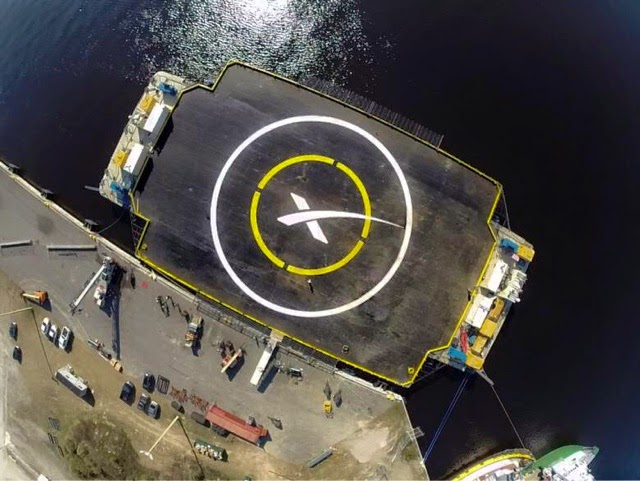
While the resupply mission has become routine, the Saturday mission will also attempt to land the first stage of the Falcon 9 rocket on an ocean platform (shown above). If successful, we are seeing the first of what should be many more reusable rockets. 

SpaceX continues to push the private sector industry to new heights, though it has plenty of battles back here on the surface.  For instance, it still has a lawsuit against the Pentagon concerning competition for rockets and now the Air Force has delayed its clearance of SpaceX rockets for such competition by another 6 months.  It makes the vacuum of space look enticing.

Update:  Earlier Saturday the launch to the space station was a success but the platform landing of the first stage of the Falcon 9 rocket failed.  SpaceX is not discouraged and testing will continue. 

Sunday, August 24

A Misfire for Space X

SpaceX defines its Falcon 9 as "a two-stage rocket designed and manufactured by SpaceX for the reliable and safe transport of satellites and the Dragon spacecraft into orbit."  That was not the case on Friday when a Falcon 9 rocket exploded shortly after taking off from the company's McGregor, Texas, flight facility.  CBS News reported this explanation from SpaceX:

Earlier today, in McGregor, Texas, SpaceX conducted a test flight of a three-engine version of the F9R test vehicle (successor to Grasshopper)...During the flight, an anomaly was detected in the vehicle and the flight termination system automatically terminated the mission...Throughout the test and subsequent flight termination, the vehicle remained in the designated flight area. There were no injuries or near injuries. An FAA representative was present at all times.

The Falcon 9 is scheduled to launch the Dragon with another set of supplies to the International Space Station on September 19th.  There is no reason to believe this test of a new system will impact the planned launch for NASA.  I should add that SpaceX has plenty of good news to report, as reported in the press releases on its website earlier today (see below), and yet is strangely silent on this latest incident. 

  • August 6:  SpaceX Launches Asiasat 8 Telecommunications Satellite to GTO
  • July 31:  SpaceX Launches 3D-Printed Part to Space, Creates Printed Engine Chamber
  • July 14:  Falcon 9 Launches ORBCOMM OG2 Satellites to Orbit

 NASA and others did not get where they are without costly losses.  This is part of the process. Let's just hope Congress understands this as well.

Update: SpaceX was back in business on September 7 with the successful launch of an AsiaSat 6 communications satellite from Cape Canaveral.