Showing posts with label Dragon. Show all posts

Friday, April 8

SpaceX: Success!

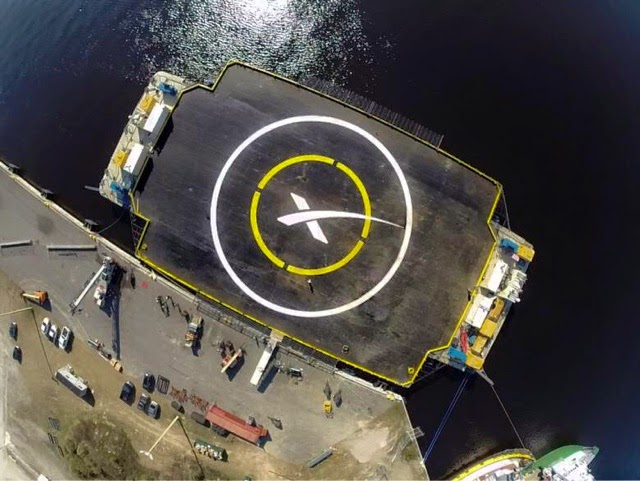
SpaceX has done it!  Earlier today the space company's Falcon 9 rocket successfully landed on a drone platform off the coast of Florida following a successful launch of a Dragon cargo ship towards the International Space Station. Long-awaited good news for all. 

President Obama was also impressed, tweeting:
Congrats SpaceX on landing a rocket at sea. It's because of innovators like you & NASA that America continues to lead in space exploration.
Update:  The Dragon cargo ship safely arrived at the International Space Station yesterday (April 10th).  One of the items delivered is BEAM, or the Bigelow Expandable Activity Module, which will serve as inflatable space habitat attached to the station.

Monday, April 4

International Space Station Traffic Jam

Things are getting busy up there in low Earth orbit.  The other week Orbital ATK sent up a Cygnus cargoship.  And then Russian resupply ship Progress 63 (animation shown above) was launched from the Baikonur Cosmodrome in Kazakhstan on March 31st.  Progress 61 had to undock and depart to make way for Progress 63. 

And now SpaceX is preparing for another Dragon resupply run on April 8th with a crew of mice to see how their little bodies handle space.  The mice will later be dissected and sent back to Earth for further study.  Scott Kelly did a little better than that with his mission. 

It is nice to see this complex interchange becoming so routine with the private sector playing a growing role.  A good sign for future cooperation and space projects. 

Wednesday, July 22

More on the Falcon 9 Mishap

SpaceX's Elon Musk earlier in the week announced that Falcon 9 failure was due to a faulty strut that did not properly contain a helium bottle within  the rocket's liquid oxygen tank.  This is certainly better news than an engine failure.  Mr. Musk is still hopeful his company can start sending humans into space in about two years.

This video by Scott Manley, the Scott astronomer, gives you a colorful explanation of the accident and cause.  He noted that the strut supplier will probably not be used again, which is a good idea. He also discusses accelerometers placed around the rocket tracking vibrations and waves that helped to pinpoint the area of failure.

The most important point is that the Dragon capsule survived the explosion, indicating that a human mission facing a similar mishap might have had a safe landing.  SpaceX is working on software and additional safety features in anticipation of such a need.  That is very encouraging. 

Saturday, January 17

SpaceX and the Falcon 9 Hard Landing

The good news about SpaceX's fifth cargo mission to the International Space Station (ISS) is that the cargo itself arrived at the station.  Of course, it arrived during a week when the occupants had to evacuate to one end of the station after a potential ammonia leak that turned out to be a false alarn, but that is not the fault of SpaceX. 

And what did the Dragon bring to the station?  Here is what SpaceX reported in its press kit:
The Dragon spacecraft will be filled with more than 5, 200 pounds of supplies and payloads, including  critical materials to support 256 science and research investigations that will occur during Expeditions 42 and 43. Science payloads will enable model organism research using fruit flies and will study flatworms to better understand wound healing in space.
One science payload is the Cloud – Aerosol Transport System (CATS), a laser remote sensing experiment that will orbit on the International Space Station. CATS will characterize and measure the worldwide distribution of clouds and aerosols: tiny particles that make up haze, dust, air pollutants and smoke. Knowing where aerosols are in the atmosphere can be critically important, as these particles can affect weather, climate, airplane safety, and human health. NASA's Goddard Space Flight Center, Greenbelt, Maryland, developed the instrument. For more on CATS, visit: www.nasa.gov/cats

The mission also delivers an IMAX camera for filming during four increments and tools that will be used in future spacewalks to prepare the station for the installation of the new international docking adapters. After four weeks at the space station, the spacecraft will return with over 3,600 pounds of cargo and packaging, including crew supplies, hardware and computer resources, science experiments, space station hardware and trash.
But with all this success, the mission was not what SpaceX wanted because the Falcon 9 first stage did not successfully land on the sea-based platform (though it did reach it).  Well, now we have some video and shots below of the hard landing from Elon Musk. Back to the drawing board.


Image Credits:  SpaceX

Friday, January 9

SpaceX Resupply Delays

The International Space Station will need to wait a little longer for its supplies. SpaceX has delayed its Dragon resupply mission until tomorrow (January 10) though it had originally planned to send the mission today after it scrubbed the Tuesday launch. 

While the resupply mission has become routine, the Saturday mission will also attempt to land the first stage of the Falcon 9 rocket on an ocean platform (shown above). If successful, we are seeing the first of what should be many more reusable rockets. 

SpaceX continues to push the private sector industry to new heights, though it has plenty of battles back here on the surface.  For instance, it still has a lawsuit against the Pentagon concerning competition for rockets and now the Air Force has delayed its clearance of SpaceX rockets for such competition by another 6 months.  It makes the vacuum of space look enticing.

Update:  Earlier Saturday the launch to the space station was a success but the platform landing of the first stage of the Falcon 9 rocket failed.  SpaceX is not discouraged and testing will continue. 

Sunday, September 21

SpaceX Becomes More Integral to U.S. Space Missions

As SpaceX's Dragon heads back to the International Space Station today with necessary supplies, such as spacesuit batteries and 3D printers, the company is slated to take a much larger role in the U.S. space program.  NASA has named Boeing and SpaceX as the two suppliers of spacecraft to take U.S astronauts in to low-Earth orbit.  Earlier last week NASA announced its selection of the two companies for the Commercial Crew Transportation Capability contracts, stating:
 ...today we are one step closer to launching our astronauts from U.S. soil on American spacecraft and ending the nation’s sole reliance on Russia by 2017. Turning over low-Earth orbit transportation to private industry will also allow NASA to focus on an even more ambitious mission – sending humans to Mars.
Boeing received the larger contract of $4.2 billion, but SpaceX is also getting $2.6 billion.  Yes, it is playing second fiddle to Boeing, but it is now in the big leagues and I can only see it getting better for SpaceX and hopefully other small companies in the future.  SpaceX announced:
SpaceX is deeply honored by the trust NASA has placed in us, and we welcome today’s decision and the mission it advances with gratitude and seriousness of purpose. Under the $2.6 billion contract, SpaceX will launch the Crew Dragon spacecraft atop the Falcon 9 launch vehicle from Kennedy Space Center in Cape Canaveral, Florida.

Sunday, August 24

A Misfire for Space X

SpaceX defines its Falcon 9 as "a two-stage rocket designed and manufactured by SpaceX for the reliable and safe transport of satellites and the Dragon spacecraft into orbit."  That was not the case on Friday when a Falcon 9 rocket exploded shortly after taking off from the company's McGregor, Texas, flight facility.  CBS News reported this explanation from SpaceX:

Earlier today, in McGregor, Texas, SpaceX conducted a test flight of a three-engine version of the F9R test vehicle (successor to Grasshopper)...During the flight, an anomaly was detected in the vehicle and the flight termination system automatically terminated the mission...Throughout the test and subsequent flight termination, the vehicle remained in the designated flight area. There were no injuries or near injuries. An FAA representative was present at all times.

The Falcon 9 is scheduled to launch the Dragon with another set of supplies to the International Space Station on September 19th.  There is no reason to believe this test of a new system will impact the planned launch for NASA.  I should add that SpaceX has plenty of good news to report, as reported in the press releases on its website earlier today (see below), and yet is strangely silent on this latest incident. 

  • August 6:  SpaceX Launches Asiasat 8 Telecommunications Satellite to GTO
  • July 31:  SpaceX Launches 3D-Printed Part to Space, Creates Printed Engine Chamber
  • July 14:  Falcon 9 Launches ORBCOMM OG2 Satellites to Orbit

 NASA and others did not get where they are without costly losses.  This is part of the process. Let's just hope Congress understands this as well.

Update: SpaceX was back in business on September 7 with the successful launch of an AsiaSat 6 communications satellite from Cape Canaveral.

Sunday, May 18

ISS Crew and Dragon Return to Earth

Last week we saw the return of three of the crew from the International Space Station (ISS) after 188 days in space. The Russian Soyuz spacecraft successfully landed in Kazakhstan with the Expedition 39 crew, including Commander Koichi Wakata of the Japan Aerospace Exploration Agency, Soyuz Commander Mikhail Tyurin of Roscosmos, the Russian Federal Space Agency, and Flight Engineer Rick Mastracchio of NASA. Mastracchio was busy during this last mission with three spacewalks to repair both a cooling pump and a computer backup.  NASA stated the next crew is not expected to launch to the ISS until May 28th.  

SpaceX's Dragon was also released earlier today for its return to the Pacific Ocean (see picture above).  The Dragon first arrived on April 20th with about 2.5 tons of crew supplies, cargo, and science gear.  This is SpaceX's third successful delivery to the ISS. Hopefully, sooner rather than later we can get crew members onto the ISS with the help of SpaceX and other U.S. parties. 

Image Credit:  NASA

Saturday, March 29

SpaceX Delays Returns to the Space Station

After a delay earlier this month, SpaceX was scheduled to its third resupply mission to the International Space Station (ISS) on March 30th.  However, the mission, SpaceX-3 (pictured here), has been delayed again due to an electrical short in the tracking radar. According to the U.S. Air Force:
A mandatory range asset supporting the NROL-67 launch went offline, March 24, 2014. An investigation revealed a tracking radar experienced an electrical short, overheating the unit and rendering it inoperable. The outage resulted in an inability to meet minimum public safety requirements needed for flight, so the launch was postponed.
Initial assessment indicates repair of the tracking radar will take approximately three weeks. The Air Force is evaluating the feasibility of returning an inactive radar to full mission capability to resume operations sooner. The launch schedule impact is to be determined, pending resolution of the anomaly. Early indications are all launches scheduled for FY14 will be supported. More information will be provided as it becomes available.
The launch, originally schedule for March 16, will provide the ISS with a variety of needed items while also delivering and removing scientific cargo.  According to SpaceX, the Dragon cargo includes:
 ...about 4,600 pounds of supplies and payloads, including critical materials to support more than150 investigations that will occur during Expeditions 39 and 40. Dragon will carry four powered cargo payloads in its pressurized section and two in its unpressurized trunk, a first for SpaceX. Dragon will return with about 3,600 pounds of cargo, which includes crew supplies, hardware and computer resources, science experiments, biotechnology,and space station hardware.
 Science payloads include the Optical Payload for Lasercomm Science (OPALS), which will test the use of laser optics to transfer information to Earth from space; the Vegetable Production System (VEGGIE), a unit capable of producing salad-type vegetables in space; and the T-Cell Activation in Aging experiment that seeks the cause of a depression in the human immune system while astronauts are in microgravity. In addition, the High Definition Earth Viewing (HDEV) investigation includes four high-definition cameras to be placed on the space station’s exterior for use in streaming live video of Earth for online viewing.
Go here for the completed press kit from SpaceX.  You can also stay up to date on the mission via NASA's SpaceX Blog. 

Tuesday, March 5

SpaceX: A Scary Mission Ends Successfully

The good new is that on Sunday the SpaceX Dragon successfully attached to the International Space Station (ISS) to resupply the crew.  According to NASA:

Space station Expedition 34 crew members Kevin Ford and Tom Marshburn of NASA used the station's robotic arm to successfully capture Dragon at 5:31 a.m. The capture came one day, 19 hours and 22 minutes after the mission's launch. The station was 253 miles above northern Ukraine.

The bad news is that the Dragon seemed to have problems along the way that SpaceX will need to resolve for future missions.  To recap, about 10 minutes after Friday launch of the Dragon capsule, three of the four sets of rocket thrusters failed to engage.   Here is now SpaceX explained it:

After Dragon separated from Falcon 9’s second stage approximately nine minutes after launch, a minor issue with some of Dragon’s oxidizer tanks was detected. Within a few hours, SpaceX engineers had identified and corrected the issue, normalizing the oxidizer pressure and returning operations to normal. Dragon recomputed its ascent profile as it was designed to and is now on its way to the International Space Station (ISS) with possible arrival on Sunday, just one day past the original timeline.

I am not surprised SpaceX will spin it as a "minor issue," but was it?  Hopefully, NASA and SpaceX will thoroughly investigate the problem.  You may recall that the first resupply mission to the ISS also had an "anomaly" in a rocket engine.  Given the complex nature of such missions, problems such as these are not unheard of.  The key is learning from the problems. And SpaceX's Mr. Musk does not want to do anything to jeopardize future missions with NASA.

In 22 days, the Dragon will return to Earth, bringing back various science experiments being tested on the ISS. Let's hope things are smooth for the rest of the mission.

Thursday, February 21

Elon Musk: Car Trouble

Elon Musk seems to be having much better luck in space than down here on Earth.  While SpaceX has been a great success proving his abilities to service the International Space Station (ISS) with a homemade rocket, his Telsa Motors car enterprise has gotten off to a rocky start. 

Telsa Motors is still recovering from a bad review of its Model S in The New York Times.  On February 8th, John M. Broder wrote an article titled "Stalled Out on Tesla’s Electric Highway" where he listed all of the problems he encountered with the car and charging stations during a drive from Newark, Delaware, to Milford, Connecticut.  Mr. Musk did not take the review very well, noting on his company blog that Telsa Motors was "played for a fool":

When Tesla first approached The New York Times about doing this story, it was supposed to be focused on future advancements in our Supercharger technology. There was no need to write a story about existing Superchargers on the East Coast, as that had already been done by Consumer Reports with no problems! We assumed that the reporter would be fair and impartial, as has been our experience with The New York Times, an organization that prides itself on journalistic integrity. As a result, we did not think to read his past articles and were unaware of his outright disdain for electric cars. We were played for a fool and as a result, let down the cause of electric vehicles. For that, I am deeply sorry.

If Mr. Musk wanted attention for his new car he got it. 

This is just one of many battles being fought by Mr. Musk as he rolls out his cars nationwide.  Last October the Los Angeles Times discussed Telsa Motors struggle to bypass traditional franchise networks and sell directly to customers.  In the article titled "Shock to the System," the South African owner of Telsa Motors questioned the U.S. approach for selling cars:

"Existing franchise dealers have a fundamental conflict of interest between selling gasoline cars," Musk said. "It is impossible for them to explain the advantages of going electric without simultaneously undermining their traditional business."

State automobile dealer associations are now suing Telsa Motors to halt his direct sales.  Again, the feisty Mr. Musk is making a name for himself for himself and his cars. 

With all of this, SpaceX is still on schedule to send a Dragon capsule to the ISS on March 1 for its second resupply mission.  Let's hope no one from The New York Times is on capsule rating the ride. 

Wednesday, May 23

SpaceX: We Have Liftoff!

Yesterday (May 22nd), at 3:44 am EST, SpaceX successfully launched the Falcon 9 from the Cape Canaveral Air Force Station for a rendezvous with the International Space Station.  While much more remains to be done, this is a hopeful start to a new era in space. 

“We obviously have to go through a number of steps to berth with the Space Station, but everything is looking really good and I think I would count today as a success no matter what happens with the rest of the mission,” CEO Elon Musk said in a SpaceX press release.

Musk went on to state,

This mission heralds the dawn of a new era of space exploration, one in which there is a significant commercial space element. It is like the advent of the Internet in the mid-1990s when commercial companies entered what was originally a government endeavor. That move dramatically accelerated the pace of advancement and made the Internet accessible to the mass market. I think we’re at a similar inflection point for space. I hope and I believe that this mission will be historic in marking that turning point towards a rapid advancement in space transportation technology.

NASA's Administrator Charles Bolden had his own sentiments as well:
 
I want to congratulate SpaceX for its successful launch, and salute the NASA team that worked alongside them to make it happen. 

Today marks the beginning of a new era in exploration; a private company has launched a spacecraft to the International Space Station that will attempt to dock there for the first time. And while there is a lot of work ahead to successfully complete this mission, we are certainly off to good start. 

Under President Obama’s leadership, the nation is embarking upon an ambitious exploration program that will take us farther into space than we have ever traveled before, while helping create good-paying jobs right here in the United States of America. 

We’re handing off to the private sector our transportation to the International Space Station so that NASA can focus on what we do best -- exploring even deeper into our solar system, with missions to an asteroid and Mars on the horizon. 

We’re committed to ending the outsourcing of work on America’s space program and bringing these jobs back to the United States. 

And we’re working to promote competition and have multiple private sector partners so we don’t find ourselves in the situation we are today -- having only one way to get to the space station. 

The decision to end the shuttle program back in 2004 was a difficult one. But with the kind of hard work, determination and ingenuity for which NASA and this nation are known, we’re now on the brink of a new future. 

A future that stands on the shoulders of Mercury and Gemini; Apollo and Shuttle. A future that embraces the innovation the private sector brings to the table, and a future that opens up the skies to endless possibilities. ‪ 

Again, congratulations to the SpaceX and NASA teams, and Godspeed Dragon.

Does this make Musk the Google or Facebook of the space program?  We shall see, but SpaceX has done what no other private company has done before.  As with Facebook, the future is unknown and subject to some rough seas ahead, but like NASA I would put my money on Musk and those who follow.

Update:  On May 25th at 12:02 pm EST the Dragon successfully docked with the International Space Station. And at 5:53 am EST today the Dragon hatch was open and the mission was determined to be a success (here is the NASA video of the hatch opening).  That's one big step for SpaceX and an even bigger step for a nation with its hopes set on commercial partners.

Second Update:  On May 31st at 11:42 am EST the Dragon safely splashed down in the Pacific Ocean about 560 miles west of Baja California.