Showing posts with label Russia. Show all posts

Sunday, October 23

Traffic at the International Space Station

This has been a busy weekend on the International Space Station (ISS), where the amazing has become mundane. 

First, a Russian Soyuz spacecraft delivered three new crew members to the station - US astronaut Robert Shane and Russian cosmonauts Sergei Ryzhikov and Andrei Borisenko.  One could even argue a fourth crew member accompanied them - the relics of Saint Seraphim of Sarov.  

Second, Orbital ATK's Cygnus cargo ship also arrived at the ISS.  Orbital ATK knows these missions are not mundane having lost a rocket and Cygnus cargo ship two years ago.

Someday we may see such traffic heading to the Moon and Mars as well.  However, the Orbital ATK mishap, SpaceX rocket explosions, and recent ExoMars lander failure shows that the space industry is still facing enormous risks. Fortunately, all of the missions just named did not involve human passengers. That adds a whole new level of risk and related risk management. 
Image Credit:  The photo at the top from NASA shows the new six-member Expedition 49 crew gathers in the Zvezda service module. The three newest arrivals (front row from left) Andrey Borisenko, Sergey Ryzhikov and Shane Kimbrough talk to family members and mission officials back on Earth. In the back row from left are, Kate Rubins, Anatoly Ivanishin and Takuya Onishi. The bottom photo shows the Orbital ATK Cygnus cargo ship arriving at the ISS and is also from NASA.

Tuesday, April 19

A $600 Million Ride to the Moon?

The Russians made an offer sometime back to Amazon CEO Jeff Bezos to see how much he wanted to go to the moon - $200 million to circle the moon in a Soyuz spacecraft. When Mr. Bezos said he wanted Russia to test the mission first, the Russians agreed for another $400 million. I guess anything is possible with a few dollars on your pocket.

Of course, Mr. Bezos said no and now he hopes to create new space tourists via his company Blue Origin at a much lower costs. I think this is a much better way to spend his funds.

You can read the full story at Space.com.

Monday, April 4

International Space Station Traffic Jam

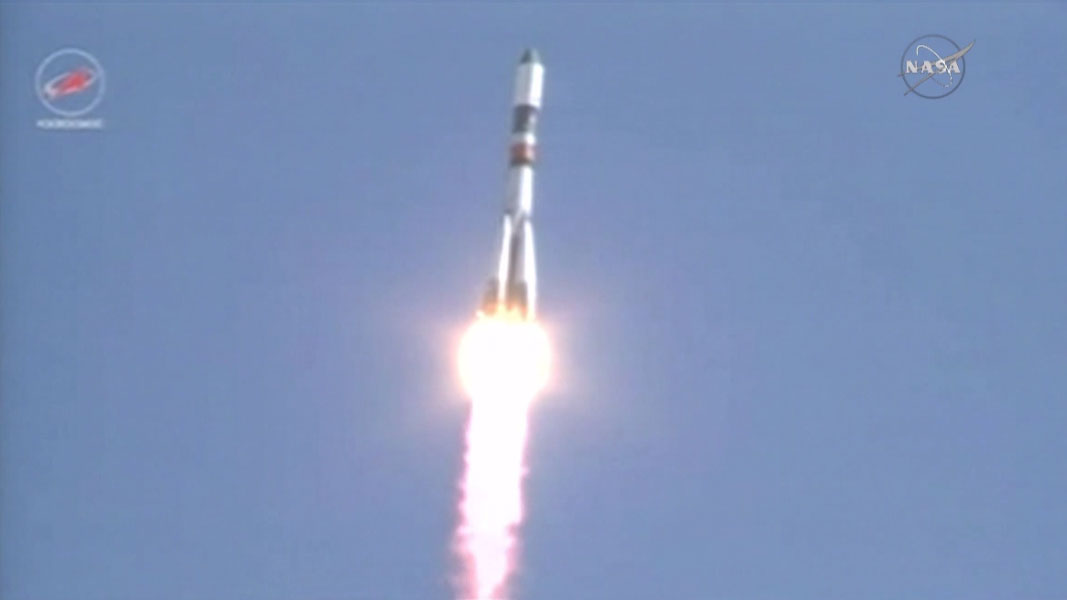
Things are getting busy up there in low Earth orbit.  The other week Orbital ATK sent up a Cygnus cargoship.  And then Russian resupply ship Progress 63 (animation shown above) was launched from the Baikonur Cosmodrome in Kazakhstan on March 31st.  Progress 61 had to undock and depart to make way for Progress 63. 

And now SpaceX is preparing for another Dragon resupply run on April 8th with a crew of mice to see how their little bodies handle space.  The mice will later be dissected and sent back to Earth for further study.  Scott Kelly did a little better than that with his mission. 

It is nice to see this complex interchange becoming so routine with the private sector playing a growing role.  A good sign for future cooperation and space projects. 

Saturday, February 6

Star Wars: Watching China, Russia, and Others

It would be unfortunate if money that could be used for space exploration is sidelined for space defense operations against other nations, but that is a real possibility as some prepare for battles in space.  Take this scenario from a recent story in The Washington Post: 
A Chinese fighter jet accidentally crashes into a Navy P-8 Poseidon surveillance plane while attempting to buzz it over the South China Sea, killing all on board both aircraft. Fearing U.S. retaliation, China goes a relatively unexpected route: It uses surface-to-air missives to shoot numerous U.S. satellites out of the heavens in quick succession. 
Certainly a scary scenario and now something that will absorb more defense dollars. Of course, the Pentagon has been planning for such attacks for some time now.  For instance, in a 2007 report by the U.S.-China Economic and Security Review Commission titled An Assessment of China's Anti-Satellite and Space Warfare programs, Policies and Doctrines,we read: 
In each of their books, Chinese Colonels Li, Jia and Yuan all advocated covert deployment of a sophisticated antisatellite weapon system to be used against United States in a surprise manner without warning. Even a small scale antisatellite attack in a crisis against 50 US satellites [assuming a mix of targeted military reconnaissance, navigation satellites, and communication satellites] could have a catastrophic effect not only on US military forces, but of the US civilian economy. It is not clear from US open sources how rapidly--if at all--United States could launch “spare” satellites to replace a few dozen that had been incapacitated in orbit by a Chinese attack. US sources refer to many [very expensive] countermeasures such as maneuvering satellites in orbit to escape destruction, using constellations of small satellites, rapid replacement with spares, and even prompt counter strikes on the Chinese launchers.
In addition to a direct attack, the paper notes the Chinese could potentially cause damage and not be singled out for retaliation:
Many of the concepts recommended include both jamming and attacking ground stations, rather than the permanent destruct ruction of US satellites.  In both cases, the Chinese authors imply the United States may lack the “forensic” ability to know which nation had neutralized US space systems through covert attack, jamming or destruction of ground stations by missile or Special Forces raids. 
Satellite attacks were noted as early as 2007, including:

  • On October 20, 2007, Landsat-7, a U.S. earth observation satellite jointly managed by the National Aeronautics and Space Administration and the U.S. Geological Survey, experienced 12 or more minutes of interference. This interference was only discovered following a similar event in July 2008 (see below).
  • On June 20, 2008, Terra EOS [earth observation system] AM–1, a National Aeronautics and Space Administration-managed program for earth observation, experienced two or more minutes of interference. The responsible party achieved all steps required to command the satellite but did not issue commands.
  • On July 23, 2008, Landsat-7 experienced 12 or more minutes of interference. The responsible party did not achieve all steps required to command the satellite.
  • On October 22, 2008, Terra EOS AM–1 experienced nine or more minutes of interference. The responsible party achieved all steps required to command the satellite but did not issue commands.
In February 2015 testimony before the Commission, Richard D. Fisher Jr., Senior Fellow, Asian Military Affairs, at the International Assessment and Strategy Center, stated:
Based on an accumulation of data, it is possible to conclude that the PLA’s apparent goal is to exercise denial and then dominance in Low Earth Orbit (LEO) and then to extend control into the Earth-Moon system. Since the early 1990s China has developed four, possibly five, attack-capable space-combat systems. China may be the only country developing such variety of space weapons to include: ground-based and air-launched counter-space weapons; unmanned space combat and Earth-attack platforms; and dual-use manned platforms.
Control of the "Earth-Moon system"?  It sounds like something from science fiction stories, and yet it is a real concern.  And now we have to worry about the North Koreans potentially putting more satellites over our heads, with an "observation" satellite being launched as early as this Monday. So the race is on and it could be very destructive for everyone.

The Secretary of Defense announced new funding priorities this week, including more troops near Russia.  He also mentioned China and North Korea, while saying this about space defense:
I also want to mention space because at times in the past, space was seen as a sanctuary, new and emerging threats make clear that that's not the case anymore and we must be prepared for the possibility of a conflict that extends in space.  Last year we added over $5 billion in new investments to make us better postured for that.  And then in 2017 we’re doing even more, enhancing our ability to identify, attribute and negate all threatening actions in space.  For so many commercial space endeavors, we want this domain to be just like the oceans and the Internet: free and safe for all. 

There are some in this world who don't want that to happen – who see America's dominance in these and other areas and want to take that away from us in the future so that we can't operate effectively around the globe.  So we’re not waiting to invest until the threats are fully realized.  We're investing now so we stay ahead of them. 
Let's hope the deterrence holds and no one tries to top the other.  A space war could litter our sky with debris and limit, threaten scientific missions, and turn our space budgets into war budgets.  We need to be looking at Earth as a starting point and not a graveyard of our space ambitions. As the late Carl Sagan noted when viewing an image of the Earth from afar:
Like it or not, for the moment, the Earth is where we make our stand. It has been said that astronomy is a humbling and character-building experience. There is perhaps no better demonstration of the folly of human conceits than this distant image of our tiny world.  To me, it underscores our responsibility to deal more kindly with one another and to preserve and cherish the pale blue dot, the only home we've ever known.
Update:  As noted, North Korea tested the patience of the international community with the launch of a long-range rocket on Sunday, February 7th.  The Associated Press noted:

The firing came about two hours after an eight-day launch window opened Sunday morning. It follows North Korea's widely disputed claim last month to have tested a hydrogen bomb. Washington and its allies will consider it a further provocation and push for more tough sanctions. The United States and Japan quickly requested an emergency meeting of the U.N. Security Council on Sunday morning, saying Pyongyang violated a council ban on ballistic missile launches.

Sunday, December 6

Russian Budget Cuts and the Moon

NASA is not the only space Agency facing budget cuts. Russia too has limited resources in the space arena. The Moscow Times recently reported:
Russia's federal space agency Roscosmos will receive just 1.5 trillion rubles ($22.5 billion) in government funding over the next ten years, less than half of estimated figures cited by space officials earlier this year, a Roscosmos statement said on Monday evening.
Hard times in Russia are taking their toll.  Yet optimism appears to be in the air.  A TASS article in the same week discussed Russia's plans to send cosmonauts to the moon by 2029, stating
According to a preliminary plan, Russia’s first manned flight to the Moon is possible in 2029. One year ahead of that it is planned to conduct a flight around the Moon, the testing and qualification of space systems for the future manned landing. However, this project may become a reality only if the work to create a new-generation manned transport spacecraft, the Angara-A5 rocket, lunar boosters and other needed rocket and space technology and infrastructure is included in the draft Federal Space Program for 2016-2025.
Russia also plans to send a lunar lander, Luna 25, to the moon's south pole in 2024. Certainly an ambitious schedule for a space agency short of funds.  Yet clear targets can better center efforts and resources.  We need more of that in the US (as well as more funds). 
 http://photocdn1.itar-tass.com/width/750_7d39028b/tass/m2/en/uploads/i/20141215/1074989.png

Thursday, December 3

Space Junk: Apollo 16 Booster Crash Site Located

It appears a Johns Hopkins University physicist just located the crash site of the Apollo 16 third-stage booster.  Until now, NASA had no idea where the booster landed.  The 1972 mission was the fifth to land on the moon and the second-to-last for the Apollo program. 

But wait, didn't the Russian question the whole moon landing story last summer?   In a Moscow Times article, we learned that Russia's Investigative Committee spokesman, Vladimir Markin, expressed concerns about the disappearance of film footage associated with the 1969 moon landing as well as missing moon rocks. 

The paper quoted Mr. Markin as stating:
We are not contending that they did not fly [to the moon], and simply made a film about it. But all of these scientific — or perhaps cultural — artifacts are part of the legacy of humanity, and their disappearance without a trace is our common loss. An investigation will reveal what happened.
Maybe this latest booster sighting will help Mr. Markin sleep a little better.  Russia can train its telescopes on the site if it wants its own footage of moon rocks disturbed by a U.S. lunar landing.  

Sunday, November 8

Simulated Russian Moon Mission

Tass reported six women recently completed a simulated moon mission over nine days. The project at the Russian Institute of Biomedical Problems involved issues that might come up during a real mission, including collecting lunar soil samples. What is odd is that the quarters simulated the International Space Station and not a capsule or lunar module. The article also noted that none of the girls "coped," but did not elaborate. 

Russia was the first country to put a woman into space yet has fallen behind in subsequent years. Only last year did it send the first female cosmonaut to the space station. 

Wednesday, October 7

Russian Space Exhibit in London

Your best chance to learn about Russia's space program may entail a trip to London. A special exhibit, Cosmonauts: Birth of the Space Age, can be found at London's Science Museum.  And fortunately you have until March 2016 to see it. 

Some of the items on display include: 

- Vostok 6: the capsule flown by Valentina Tereshkova, the first ever woman in space. 
- Voskhod 1: the capsule used on the first mission to carry more than one crew member. 
- LK-3 Lunar Lander: a single cosmonaut craft built to compete with Apollo.
- A collection of gadgets that cosmonauts – and pioneering space dogs – need to live in space, including a shower, toilet, medical instruments, and survival kits for crash landings.

Russia has made significant contributions to space travel and this special exhibit allows you to see the equipment and other items up close. 

In a review of the exhibit, London's The Guardian noted:
A key figure is Konstantin Tsiolkovsky, a bearded provincial schoolteacher, almost completely deaf, who wielded a vast ear trumpet of his own design and manufacture and who from the late 1870s until his death in 1935 studied questions of weightlessness and space travel, and tried to communicate them through science fiction. The exhibition shows his notes and sketches for a 1930s film called Cosmic Voyage, on which he was a consultant. Their style has a schoolboy naivety, but they show insights into the ways and means of reaching space, including escape velocity, fuel, and the use of multi-stage rockets remarkably close to those that would eventually be employed.
The exhibit has received glowing reviews and provides the public with a better understanding of Russia's role getting us to where we are today in our quest to explore our solar system and more.  Since many will never travel to Russia, nor be able to see all of these items in one place again, this is a unique opportunity for space enthusiasts and others.

Saturday, September 12

Spacecraft or Ice Breakers?

I used to think the battle over a cold planet would take place on the moon or Mars, but it appears the territorial battles are taking place at the North Pole. With the Russians restarting their arctic military bases, the Chinese sending warships to the region the other week, and the U.S. contemplating spending billions on new icebreakers, it seems the new terra nova race may be more terrestrial than previously thought. The northern reaches are now open to competition because of global climate change, which makes raw materials much more accessible.  Yes, the global climate change some do not want NASA to monitor is now a new reason to move funds from space exploration to mineral exploration backed up by the US military.  Heck, who needs to grab an asteroid when everything is for the taking here at home? 

Here is the White House's position on these changes:
Climate change is reshaping the Arctic in profound ways. The global Arctic has warmed approximately twice as fast as the rest of the world, resulting in significant impacts on land and sea. Among the most noticeable changes is the retreat of Arctic sea ice, which has experienced significant, sustained declines in both extent and thickness in recent decades...As sea-ice cover diminishes because of climate change, marine traffic is expected to increase in the Arctic, including traffic from fishing and mineral exploration to cargo shipping and tourism...That is why the Administration will propose to accelerate acquisition of a replacement heavy icebreaker to 2020 from 2022, begin planning for construction of additional icebreakers, and call on Congress to work with the Administration to provide sufficient resources to fund these critical investments. These heavy icebreakers will ensure that the United States can meet our national interests, protect and manage our natural resources, and strengthen our international, state, local, and tribal relationships.
Can we do it all?  Explore the Arctic and Mars?  Certainly.  We fought a war while putting men on the moon.  Yet that is not the ideal situation at anytime, and especially in these budget-cutting times. Let's hope we have the vision and the funding to build both Martian rovers and icebreakers.   

Image Credit:  F-22 on a runway with Alaska's Chugach Mountains as a backdrop (Michael Dinneen for LA Times)

Saturday, September 5

Space Station Traffic Picking Up

The crew of the International Space Station (ISS) just went to nine yesterday as the Russian Soyuz spacecraft (TMA-18M) docked at the station and Sergey Volkov of Roscosmos, Andreas Mogensen of the European Space Agency, and Aidyn Aimbetov of the Kazakh Space Agency stepped aboard. We are already a long way from earlier this year when we were worried about even getting supplies to the station after numerous rocket explosions.  Since then, a Russian Soyuz resupplied the station and just last week a Japanese mission added more emergency supplies. 

The NASA image above shows the ISS configuration with all of the attached capsules. The Soyuz TMA-18M spacecraft is docked to the Poisk mini-research module. The Soyuz TMA-16M spacecraft is docked to the Zvezda service module. The ISS Progress 60 spacecraft is docked to the Pirs docking compartment. The Soyuz TMA-17M spacecraft is docked to the Rassvet mini-research module. Japan’s “Kounotori” HTV-5 is berthed to the Harmony module.

Sunday, July 5

Supplies Aboard the Space Station

After numerous attempts, the International Space Station finally has been resupplied by a Russian Soyuz capsule.  The Progress 60 mission (shown above) successfully docked with the station earlier today, bringing water, spare parts, propellant, oxygen, and more.  You can watch the docking process here. 

I imagine all of this is more excitement that Astronaut Scott Kelly was anticipating when he signed up to spend a year on the station.  If the purpose of the mission is to test his reaction to stress, NASA is doing a great job piling it on. 

Update: Speaking of Mr. Kelly, he shared his experiences recently with CBS Evening News.  He compared his time on the space station to time in prison:
...no matter what happens, you're not going home. We don't get to go outside, so that's a little bit different. I would imagine in a lot of jails people get fresh air. You don't get that here. And you don't get real sunlight. ... The big difference, though, is we're here by choice. So that makes, I guess, the situation a little bit better.
But he also discussed the importance of his research, giving an example concerning why NASA needs to study the impact of long-term space travel on the eyes:
 You wouldn't want some astronauts to get on Mars after a year and a half, or longer when they're coming home, and not be able to see...It's something we don't understand, but it's something we're working hard at understanding and mitigating the effects. We've done a lot of research up here since I've been here to better understand that.

Friday, July 3

Russia to the Rescue: New Supplies Heading to the Space Station

Earlier today the Russians launched the Progress 60 resupply mission aboard a Soyuz rocket.  The International Space Station (ISS) will soon have its supplies while SpaceX and NASA decide the next steps for future Falcon/Dragon resupply missions.  SpaceX's next resupply mission to the ISS was scheduled for September, but that has been put on hold pending the investigation results.

Saturday, June 6

New York Times: Maintain the Russian Rocket Ban

It is nice to see the Russian rocket ban is getting more attention these days, as in this New York Times editorial:
The core problem is that the United States let itself become dependent on Russian rocket engines for national security missions. After the Cold War, it made sense to encourage cooperation between the nations and offer opportunities to Russian scientists and technicians so they would be less likely to sell their skills to Iran and North Korea. But in recent years, Mr. Putin has become increasingly at odds with the United States. Meanwhile, United Launch Alliance, a joint venture of the defense giants Lockheed Martin and Boeing also known as ULA, has become the Pentagon’s primary rocket maker and gets its engines from NPO Energomash, a Russian company that reportedly has close ties to Mr. Putin...After leaning on France to cancel the sale of two ships to Russia because of the invasion of Ukraine, the United States can hardly insist on continuing to buy national security hardware from one of Mr. Putin’s cronies.
Sadly, the Obama administration seems to be going soft on sanctions, which is ridiculous since it has already gone soft on a military option.  What is left?  Someday I hope relations with a new Russian regime improve, but in the meantime it is in the interest of the United States to build its own rockets for its own missions. 

Image Credit:  Photo taken by 23-year old Lana Sator who sneaked into the Russian Energomash's manufacturing plant.
ana Sator in the Energomash plant.

Wednesday, May 27

Russian Space Program: High Expectations, but Questionable Delivery

Russian President Putin is again talking about building a space station, but with recent rocket failures, it appears Russian needs to get back to basics.  Last week, Deputy Prime Minister Dmitry Rogozin stated:
The task to create a new orbital station has been set by the president. This week we will report plans on the development of piloted cosmonautics to the president.
However, this announcement follows the second failure of a major rocket mission in the past month, the first being the Russian resupply spacecraft Progress 59 to the International Space Station followed by the failure of a Russian Proton-M rocket carrying a Mexican satellite.  

And all of this follows continued stories of budget cuts, construction problems at Vostochny Cosmodrome, the new space launch facility, and continued corruption within the space program.  Quoting the Deputy Prime Minister again, he stated:
With such a level of moral decay, one should not be surprised at the high accident rate.
In these tight times, expansion and corruption are not good bed fellows.  Russia needs to refocus its priorities and clean up its ranks if it wants to get off the ground. 

Image Credit:   Business Insider.  Then-Russian Prime Minister Vladimir Putin, second right, looks at a plan while visiting a site of a new launch facility, cosmodrome Vostochny, outside Uglegorsk, some 3,600 miles (5800 kilometers) east of Moscow, Russia, in 2010.

Saturday, May 23

Noteworthy Quote: Russian Rocket Roulette

"Yet why send hundreds of millions of dollars more to cash-strapped Russia when engines from three American companies will be able to launch rockets that can do the same job as Russian-engine-fitted Atlas V rockets? At about $100 million a launch with an American-made rocket compared with ULA’s $400 million a launch, that’s a bargain in more ways than one."

-- Ron Wahid in a Wall Street Journal editorial titled "American Plays Russsian Rocket Roulette."   The three American companies he mentions are SpaceX, Aerojet Rocketdyne, and Blue Origin. 

Wednesday, April 29

ISS: Russian Progress 59 Lost in Space

Tuesday's International Space Station Russian resupply spacecraft, Progress 59, started spinning out of control after separating from its Soyuz rocket.  The resupply mission has now been written off as a failure, which is the second in a year after the Antares rocket explosion last October (blamed on an old Soviet rocket).

Fortunately, SpaceX's Dragon resupplied the station earlier this month and will return in June with more supplies. Redundancy, and private ventures, to the rescue.

Update: Progress 59 is expected to reenter to atmosphere and burn up in the next two weeks.

Monday, April 27

60 Minutes: Space Wars

If you missed the 60 Minutes piece last Sunday on the budding space war between the United States, China, and Russia, then you missed a significant story on how Earthbound battles may draw funding and energy away from a space program that looks beyond Earth.

Most of the country's concerns involved the Chinese capabilities to reach the outermost US defense satellites, but the Russians were mentioned as well since one of their recent satellites seems to have the ability to change orbit and trail other satellites. It appears space is now fair game for all.

Of course, the U.S. is not without its own arsenal to track and protect satellites, from the Starfire Optical Range in Albuquerque, a laser that tracks satellite movement, to the Air Force's X37B unmanned space shuttle. And while China has worried the space community with a satellite kill (and troublesome debris) a few years back, the program noted that the U.S. had an earlier satellite kill and a second one more recently. Hence, we are not innocents here.

If the space race becomes a local war we all lose and go nowhere. Let's hope the goal becomes Mars instead. As with the lunar race, we need healthy competition that takes us to new places. Carl Sagan has already warned us about the lonely Pale Blue Dot.

Saturday, April 4

Does SpaceX Want to Build Space Stations?

Space News provided this quote by William Gerstenmaier, NASA associate administrator for human exploration and operations, in a speech at the Federal Aviation Administration Commercial Space Transportation Conference in February:
At some point this space station will wear out and there needs to be a follow-on space station...What we’re hoping for is that the private sector picks that up.
This was part of a larger story about Russia's interest in funding the International Space Station (ISS) through 2024 and working with the U.S. on a successor to the ISS.  Russia has been very fickle in its discussions about a space station, no doubt driven by funding worries due to a struggling economy.
 
Given SpaceX's innovative ideas and new products, it is only a matter of time before it is approached to design a new space station.  However, one wonders if Mr. Musk is more interested in bigger fish at this point, such as colonizing Mars.

And if the Russians are looking for a space station partner, the Chinese could be a good bet.  China plans to launch a second space station into orbit next year. 

Tuesday, February 17

Does Ukraine Still Have a Space Industry?

Last week I read a piece in Parabolic Arc stating the Ukrainian space industry was close to collapsing. The article relates to Yazhmash, the rocket manufacturer and cornerstone of the Ukrainian space industry, and its recent notice about problems with orders from the Russians.  The article quotes the company's press release:
Yuzhmash
Yuzhmash
Factor of negative trends – landslide production cutbacks due to rupture of ties with traditional customers, who provided most of the orders.

The actual bankruptcy of the enterprise will result in the loss of Ukraine’s status as a space power, failure of the obligations of the State to enter into international agreements, irreversible loss of proven technologies.
At present, the SE “PA YuMZ behalf AM Makarov” is a participant in the high-tech large-scale international projects: "Sea Launch","Land Launch", "Taurus II / Antares", "Dnepr","Cyclone-4", "Vega". 
For instance, Orbital Science's uses the Antares rocket that was built in cooperation with Yazhmash.

Russian has been threatening for some time to find substitutes for the Ukrainian rocket parts, with the Moscow Times noting:
Russia's dependence on Ukrainian defense imports is a by-product of the collapse of the former Soviet Union. When the Ukrainian Soviet Socialist Republic became an independent state in 1991, Kiev found itself in possession of vital Soviet-era defense industry assets such as the Yuzhmash factory in Eastern Ukraine, which produces space rockets, satellites and missiles along with machinery for civilian uses.
Bloomberg Business highlighted the company's plight, stating:
Sales to Russia plummeted from $1.7 billion in 2011 to only $28 million last year, Yuzhmash said in a statement posted on its website last month. The Dnepropetrovsk-based company owes some $140 million in back wages to its 15,000 workers and partially suspended manufacturing operations until late February. The company did not respond to calls from Bloomberg Business.
Russia has already caused enough problems for Ukraine, and now this.  Maybe the US government can find a way to bring Ukraine into its military and civilian space industry while continuing to exclude the Russians.
At present, the SE “PA YuMZ behalf AM Makarov” is a participant in the high-tech large-scale international projects:” Sea Launch “,” Land Launch »,« Taurus II / Antares »,« Dnepr “,” Cyclone-4 »,« Vega ». - See more at: http://www.parabolicarc.com/2015/02/10/ukraine-space-industry-verge-collapse/#sthash.TyzNMQhQ.dpuIf you go to the company's website you will fin
Factor of negative trends – landslide production cutbacks due to rupture of ties with traditional customers, who provided most of the orders.
The actual bankruptcy of the enterprise will result in the loss of Ukraine’s status as a space power, failure of the obligations of the State to enter into international agreements, irreversible loss of proven technologies.
- See more at: http://www.parabolicarc.com/2015/02/10/ukraine-space-industry-verge-collapse/#sthash.4nIVIOJO.dpuf
Factor of negative trends – landslide production cutbacks due to rupture of ties with traditional customers, who provided most of the orders.
The actual bankruptcy of the enterprise will result in the loss of Ukraine’s status as a space power, failure of the obligations of the State to enter into international agreements, irreversible loss of proven technologies.
- See more at: http://www.parabolicarc.com/2015/02/10/ukraine-space-industry-verge-collapse/#sthash.4nIVIOJO.dpuf

Friday, January 16

Noteworthy Quote: Too Much Reliance on the Russians


“Russia’s status as the current gatekeeper of the International Space Station could threaten our capability to explore and learn, stunting our capacity to reach new heights and share innovations with free people everywhere...The United States should work alongside our international partners, but not be dependent on them.”

-  Statement by Senator Ted Cruz, newly installed chairman of the Senate Commerce Subcommittee on Space, Science and Competitiveness, which oversees the NASA program (as quoted in The Hill). 

Image Credit:  NASA