Showing posts with label The Martian. Show all posts

Wednesday, April 27

The Martian: Art May Create Reality


"When I saw the U.S. film 'The Martian', which envisages China-U.S. cooperation on a Mars rescue mission under emergency circumstances, it shows that our U.S. counterparts very much hope to cooperate with us."

--Comments by Xu Dazhe, the chief of the China National Space Administration, quoted in a Reuters article 

Wednesday, January 6

Top 15 Space and Astronomy Stories from Slate

Phil Plait in Slate put together a helpful video discussing the Top Space and Astronomy Stories in 2015, including New Horizons arriving at Pluto, the Dawn spacecraft over Ceres, and reusable rockets.  He also has time to mention the science in the movie The Martian as well as a cameo by Elon Musk on the Simpsons.  It is quite a list, as it has been quite a year. 

Sunday, January 3

Star Wars Versus Close Encounters

In a recent interview with Smithsonian magazine, Richard Dreyfuss shared his opinion on the 1977 release of both Star Wars and Close Encounters of the Third Kind:
If Close Encounters had opened first, the idea of space and stories about aliens would have been lifted to a certain level of audience maturity.  And I think that some of the great writers and some of the great screenwriters would have been making films in that genre as opposed to bang-bang Star Wars and Star Wars sequels.  Close Encounters was, from the beginning to the end, about something far more intelligent, or intellectual, or uplifting...The first line for Close Encounters was 'You have nothing to fear by looking up.
It is clear that Star Wars won, as we see with the billion-dollar release of the seventh episode of the franchise.  I don't remember a sequel to Close Encounters.  But that does seem to be the way of the world and Hollywood.  And yet I am hopeful.  The release of The Martian last year was a stunning scientific film that captured everyone's imagination without light sabers and Death Stars.  And let us not forget the movie Contact, putting Carl Sagan's book of the same name onto the silver screen.  And even Star Trek can be said to be a somewhat more realistic take on human expansion into space, or at least a little more hopeful that the Star Wars version of the galaxy (or some other galaxy far, far away), and it precedes Lucas' story by a decade.  So cheer up, Richard. 

Update:  Tom Shone has an informative article in Slate that discusses the overlapping careers of Lucas and Spielberg.  It is worth a look.

Friday, November 6

Historic Moments: Mars 1M No.1

While last month marked release of The Martian, it is worth remembering that missions to Mars (and mission failures) have been a real issue for more than 50 years. Last month (October 10 to be exact) marked the 55th anniversary of the Soviet Mars 1M No. 1 probe, the first attempt to send a spacecraft to Mars.  The launch was a failure, as was the launch of Mars 1M No. 2 a few days later.  Nonetheless, the long race to Mars started.

Monday, October 5

The Martian: Where Were the Russians?

If you have yet to see the new film The Martian you should ignore this post. But if you have seen the movie, maybe you too wondered about the Chinese assistance to NASA. Having the future Chinese assist with a rescue mission to Mars is not the issue. What I wonder is why the Russians were not consulted since they are far ahead of the Chinese today and would presumably be in the same position in the future.

And what about private ventures such as SpaceX and others? Are we to presume NASA was the only game in town? If so, this is a bleak view of the future.  I won't even mention Mars One (since maybe that mission was already dead on another side of the planet - or still in orbit).

Maybe the book explains these things, but I am hoping the future does not depend on only one or two government programs.

Sunday, October 4

Dust Storms and The Martian

If you have yet to see the new film The Martian, you are in for a treat.  This amazingly beautiful and superbly acted film with stay with you for a long time, and hopefully it will increase the public awareness of the awesomeness as well as risks related to a Martian mission. The other words that come to mind after seeing the movie are duct tape, disco, and cooperation in space.  But you will know what I am talking about after you see it for yourself.

Of course, one of the stars in the film is the Martian weather, and the winds in particular.  In the movie, the winds proved destructive to the mission on Mars and continually rattled the equipment and housing modules.  NASA provided some insights on this in an article titled "The Fact and Fiction of Martian Dust Storms," noting:
“Once every three Mars years (about 5 ½ Earth years), on average, normal storms grow into planet-encircling dust storms, and we usually call those ‘global dust storms’ to distinguish them,” Smith said.
It is unlikely that even these dust storms could strand an astronaut on Mars, however. Even the wind in the largest dust storms likely could not tip or rip apart major mechanical equipment. The winds in the strongest Martian storms top out at about 60 miles per hour, less than half the speed of some hurricane-force winds on Earth.
Hence, the winds are not fun when trying to accomplish a task on the surface of Mars, yet they are not likely to destroy habitats or knock over a rocket.  This is not to pick on the film as much as to point out that we have a lot of things to worry about related to a Martian mission and fortunately this is not one of them.  That said, you should see the film and enjoy the show.

Image Credit:   This close-up image of a dust storm on Mars was acquired by the Mars Color Imager instrument on NASA's Mars Reconnaissance Orbiter on November 7, 2007, around 3 p.m. local time on Mars. The full story from NASA is here.

Wednesday, September 2

Send Mr. Sterner to a Deserted Island


In discussing the upcoming movie The Martian in a recent issue of SpaceNews, Eric R. Sterner, who served as NASA’s associate deputy administrator for policy and planning and in the Department of Defense, was not all that optimistic about the movie's impact on planning for future Mars missions:
Sadly, if the space community seeks to turn “The Martian” into a commercial for sending people to Mars, we will fail miserably. The 2000 movie “Castaway” was nominated for multiple awards, including an Academy Award for Tom Hanks. It did not increase public support for sending people to deserted islands. Neither will “The Martian” bring them closer to Mars.
I can understand Mr. Sterner's frustration, but I am somewhat optimistic that a good film, just like a good television series, can stir a nation and especially its youth.  Will inspired youth get us to Mars tomorrow?  Certainly not.  But who knows where they will take us down the road.  And I think Mars is a little more inspiring than a deserted island.

Thursday, August 20

Get Ready for The Martian

What happens when you are left behind on Mars for four years?  And no, this is not a Mars One scenario.  Instead, it is the new film The Martian with Matt Damon.  Take a look at the trailer to see what's in store for you. 

The film will be released October 2nd.  Unlike last year's film Interstellar, also starring Matt Damon, this film is a little closer to home and reality.  Mars enthusiasts, prepare yourselves!

Sunday, February 1

Bookmark: An Interview with the Author of The Martian

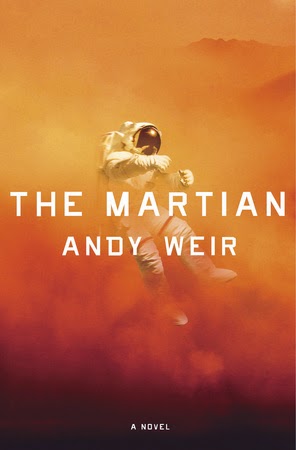
Last month Nautilus magazine posted an interview with Andy Weir, author of The MartianIf you have not heard about this book, here is a short blurb to entice you:
Six days ago, astronaut Mark Watney became one of the first people to walk on Mars.
Now, he's sure he'll be the first person to die there.
After a dust storm nearly kills him and forces his crew to evacuate while thinking him dead, Mark finds himself stranded and completely alone with no way to even signal Earth that he’s alive—and even if he could get word out, his supplies would be gone long before a rescue could arrive.
Chances are, though, he won't have time to starve to death. The damaged machinery, unforgiving environment, or plain-old "human error" are much more likely to kill him first.
But Mark isn't ready to give up yet. Drawing on his ingenuity, his engineering skills—and a relentless, dogged refusal to quit—he steadfastly confronts one seemingly insurmountable obstacle after the next. Will his resourcefulness be enough to overcome the impossible odds against him?
In the interview, Mr. Weir describes the process of going from a self-published author to a best selling author, the underlying science in his story, the role of water and methane on Mars, his preference to be an author rather than an astronaut, and his ideas for his next book. 

Mr. Weir also talks about how recent discoveries on Mars could have changed his plot and will potentially change the plot of mankind's future missions to Mars:
At the time that I wrote my book, Curiosity hadn’t landed yet and they hadn’t discovered how much water there was. It was since the book was released that we discovered there’s actually tons and tons of water on Mars. It’s all as ice crystals suffused in the sand, but if you take a cubic meter of dirt from Mars, or at least from the area Curiosity is in, you get something like 35 liters of water. It’s this huge amount, far more water than anybody expected, which is really exciting because the only missing thing to making your own rocket fuel on Mars was hydrogen. The original plan was to bring the hydrogen with you, and for every kilogram of hydrogen you bring you can make 13 kilograms of rocket fuel. But now you don’t even need to do that. Now you just need rovers and machinery to harvest water out of the soil, and you can literally send a device to Mars that can make its rocket fuel with nothing. Which is really exciting!
Science and science fiction have been married for many years, with one stimulating the other.  Mr. Weir is the latest in a long line of authors who continually push our minds and hopefully our endeavors.