Sally Ride, America's first woman in space, died on Monday at the age of 61. Ms. Ride's first entered the Earth's orbit via the Challenger Space Shuttle about 29 years ago on June 18, 1983. Her list of accomplishments beyond this event is quite impressive:
-- Ph.D. in physics from Stanford.
-- Joined NASA in 1978.
-- Helped develop a shuttle robot arm for NASA.
-- Part of the Rogers Commission to investigate the Challenger explosion in 1986.
-- Part of the commission to investigate the Columbia explosion in 2003.
-- Member of the Augustine Committee to make recommendations on the future of human spaceflight.
-- Science fellow at the Center for International Security and Arms Control at Stanford University.
-- Professor of physics at the University of California in San Diego.
-- Started Sally Ride Science in 2001 to encourage children to seek careers in science and technology.
While she was not the first woman in space, with Russia being the first nation to do so in 1963 (while China hit this goal earlier this year), Ms. Ride certainly blazed a bright trail for other woman to follow. She may also be the first gay astronaut. Sally Ride Science's obituary noted:
In addition to Tam O’Shaughnessy, her partner of 27 years, Sally is
survived by her mother, Joyce; her sister, Bear; her niece, Caitlin, and
nephew, Whitney; her staff of 40 at Sally Ride Science; and many
friends and colleagues around the country.
Most importantly, as her organization's biography noted, was her love of space and determination to share it with others:
Sally’s historic flight into space captured the nation’s imagination
and made her a household name. She became a symbol of the ability of
women to break barriers and a hero to generations of adventurous young
girls. After retiring from NASA, Sally used her high profile to champion
a cause she believed in passionately—inspiring young people, especially
girls, to stick with their interest in science, to become
scientifically literate, and to consider pursuing careers in science and
engineering.
Sally, we wish you well on your new voyage.
Thursday, July 26
Monday, July 23
Great Images: Jupiter and Ganymede
This image is part of the NASA Planetary Photo Journal Collection and found at nasaimages.org. Here is the photo's accompanying text:
The solar system's largest moon, Ganymede, is captured here alongside the planet Jupiter in a color picture taken by NASA's Cassini spacecraft on Dec. 3, 2000.
Ganymede is larger than the planets Mercury and Pluto and Saturn's largest moon, Titan. Both Ganymede and Titan have greater surface area than the entire Eurasian continent on our planet. Cassini was 26.5 million kilometers (16.5 million miles) from Ganymede when this image was taken. The smallest visible features are about 160 kilometers (about 100 miles) across.
The bright area near the south (bottom) of Ganymede is Osiris, a large, relatively new crater surrounded by bright icy material ejected by the impact, which created it. Elsewhere, Ganymede displays dark terrains that NASA's Voyager and Galileo spacecraft have shown to be old and heavily cratered. The brighter terrains are younger and laced by grooves. Various kinds of grooved terrains have been seen on many icy moons in the solar system. These are believed to be the surface expressions of warm, pristine, water-rich materials that moved to the surface and froze.
Ganymede has proven to be a fascinating world, the only moon known to have a magnetosphere, or magnetic environment, produced by a convecting metal core. The interaction of Ganymede's and Jupiter's magnetospheres may produce dazzling variations in the auroral glows in Ganymede's tenuous atmosphere of oxygen.
Cassini is a cooperative project of NASA, the European Space Agency and the Italian Space Agency. The Jet Propulsion Laboratory, a division of the California Institute of Technology in Pasadena, manages the Cassini mission for NASA's Office of Space Science, Washington, D.C.
Here is an earlier shot of Ganymede from NASA's Jet Propulsion Laboratory's Photojournal page:
In this global view of Ganymede's trailing side, the colors are enhanced to emphasize color differences. The enhancement reveals frosty polar caps in addition to the two predominant terrains on Ganymede, bright, grooved terrain and older, dark furrowed areas. Many craters with diameters up to several dozen kilometers are visible. The violet hues at the poles may be the result of small particles of frost which would scatter more light at shorter wavelengths (the violet end of the spectrum). Ganymede's magnetic field, which was detected by the magnetometer on NASA's Galileo spacecraft in 1996, may be partly responsible for the appearance of the polar terrain. Compared to Earth's polar caps, Ganymede's polar terrain is relatively vast. The frost on Ganymede reaches latitudes as low as 40 degrees on average and 25 degrees at some locations. For comparison with Earth, Miami, Florida lies at 26 degrees north latitude, and Berlin, Germany is located at 52 degrees north.
North is to the top of the picture. The composite, which combines images taken with green, violet, and 1 micrometer filters, is centered at 306 degrees west longitude. The resolution is 9 kilometers (6 miles) per picture element. The images were taken on 29 March 1998 at a range of 918000 kilometers (570,000 miles) by the Solid State Imaging (SSI) system on NASA's Galileo spacecraft.
The Jet Propulsion Laboratory, Pasadena, CA manages the Galileo mission for NASA's Office of Space Science, Washington, DC.
The solar system's largest moon, Ganymede, is captured here alongside the planet Jupiter in a color picture taken by NASA's Cassini spacecraft on Dec. 3, 2000.
Ganymede is larger than the planets Mercury and Pluto and Saturn's largest moon, Titan. Both Ganymede and Titan have greater surface area than the entire Eurasian continent on our planet. Cassini was 26.5 million kilometers (16.5 million miles) from Ganymede when this image was taken. The smallest visible features are about 160 kilometers (about 100 miles) across.
The bright area near the south (bottom) of Ganymede is Osiris, a large, relatively new crater surrounded by bright icy material ejected by the impact, which created it. Elsewhere, Ganymede displays dark terrains that NASA's Voyager and Galileo spacecraft have shown to be old and heavily cratered. The brighter terrains are younger and laced by grooves. Various kinds of grooved terrains have been seen on many icy moons in the solar system. These are believed to be the surface expressions of warm, pristine, water-rich materials that moved to the surface and froze.
Ganymede has proven to be a fascinating world, the only moon known to have a magnetosphere, or magnetic environment, produced by a convecting metal core. The interaction of Ganymede's and Jupiter's magnetospheres may produce dazzling variations in the auroral glows in Ganymede's tenuous atmosphere of oxygen.
Cassini is a cooperative project of NASA, the European Space Agency and the Italian Space Agency. The Jet Propulsion Laboratory, a division of the California Institute of Technology in Pasadena, manages the Cassini mission for NASA's Office of Space Science, Washington, D.C.
Here is an earlier shot of Ganymede from NASA's Jet Propulsion Laboratory's Photojournal page:
In this global view of Ganymede's trailing side, the colors are enhanced to emphasize color differences. The enhancement reveals frosty polar caps in addition to the two predominant terrains on Ganymede, bright, grooved terrain and older, dark furrowed areas. Many craters with diameters up to several dozen kilometers are visible. The violet hues at the poles may be the result of small particles of frost which would scatter more light at shorter wavelengths (the violet end of the spectrum). Ganymede's magnetic field, which was detected by the magnetometer on NASA's Galileo spacecraft in 1996, may be partly responsible for the appearance of the polar terrain. Compared to Earth's polar caps, Ganymede's polar terrain is relatively vast. The frost on Ganymede reaches latitudes as low as 40 degrees on average and 25 degrees at some locations. For comparison with Earth, Miami, Florida lies at 26 degrees north latitude, and Berlin, Germany is located at 52 degrees north.
North is to the top of the picture. The composite, which combines images taken with green, violet, and 1 micrometer filters, is centered at 306 degrees west longitude. The resolution is 9 kilometers (6 miles) per picture element. The images were taken on 29 March 1998 at a range of 918000 kilometers (570,000 miles) by the Solid State Imaging (SSI) system on NASA's Galileo spacecraft.
The Jet Propulsion Laboratory, Pasadena, CA manages the Galileo mission for NASA's Office of Space Science, Washington, DC.
Friday, July 20
Anniversary of Skylab's Return to Earth
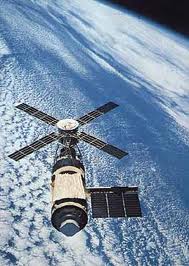
Thirty-three years ago on July 11 America's Skylab returned to earth in pieces littering the Indian Ocean and Australia. First launched in 1974, Skylab was America's first space station and hosted three sets of 3-man U.S. space crews during its operation, with the station itself having been occupied a total of 171 days. The station may have lasted longer had the new NASA Space Shuttle program been further along to repair the station and adjust its orbit.
What did Skylab accomplish? According to a NASA paper on the program, the primary impact was highlighting the value of a manned operation:
While the program unquestionably yielded valuable scientific information, its greatest value came from its demonstration of the importance of the human element in the space program. As John Disher, NASA Director of Advanced Programs in the Office of Space Transportation Systems, would later note, Skylab "turned around many people who thought men in space were a hindrance rather than a help." Echoing this sentiment, Program Director William Schneider stated that Skylab had shown that, regarding the space program, "the limit is only our resolve, not the ability of men to work, and not our technical knowledge."
We need more of that resolve as we look to future manned missions.
What did Skylab accomplish? According to a NASA paper on the program, the primary impact was highlighting the value of a manned operation:
While the program unquestionably yielded valuable scientific information, its greatest value came from its demonstration of the importance of the human element in the space program. As John Disher, NASA Director of Advanced Programs in the Office of Space Transportation Systems, would later note, Skylab "turned around many people who thought men in space were a hindrance rather than a help." Echoing this sentiment, Program Director William Schneider stated that Skylab had shown that, regarding the space program, "the limit is only our resolve, not the ability of men to work, and not our technical knowledge."
We need more of that resolve as we look to future manned missions.
Sunday, July 15
The U.S. Still Has a Space Shuttle Program
Even with the demise of NASA's shuttle program, we should remember that the United States has been running a separate shuttle program under the Pentagon that is alive and well. The USAF has been operating the X-37B unmanned shuttle, or Orbital Test Vehicle-2 (OTV-2), which safely landed last month after being aloft since March 5, 2011. This is the X-37B's second flight, the first one taking place in 2010 and lasting 244 days.
The X-37B is not only unmanned but also considerably smaller than the better known space shuttles, being only 29 feet long and 15 feet wide. This mini-shuttle was originally planned by NASA and later picked up by the USAF. A second larger craft, the X-37C, is also in the works. This larger shuttle should be able to carry crew and cargo.
Earlier stories in The Register also discusses various aspects of the "secret" mini-shuttle program as well as NASA's shuttle program:
-- NASA saw the craft as a potential "lifeboat" for the International Space Station;
-- The X-37B is supposed to be much more advanced in terms of turnaround time, heat shields, and more than the Shuttle.
-- It is often forgotten nowadays that the Shuttle was originally intended not just for NASA operations from Cape Canaveral, but also for military operations from a dedicated complex at Vandenberg Airforce Base in California;
-- Hopes for out of the X-37B seem likely to focus on the same things the Air Force originally wanted from the Shuttle: mainly the ability to recover horrifyingly expensive surveillance hardware from space for repairs, replenishment of manoeuvring fuel and/or upgrading; and
-- If you want to get out into the wilder speculative realms you could postulate a mission lifting off to retrieve, not a US satellite, but someone else's. The initial launch would be explained as delivery of a normal secret payload, but in fact the spaceplane would lift empty, scoop up its target on one pass and return to land on a "Mission 3B" style profile without ever flying above a hostile telescope or radar station.
And how does the USAF describe the X-37B? Here is what their factsheet says: "The primary objectives of the X-37B are twofold: reusable spacecraft technologies for America's future in space and operating experiments which can be returned to, and examined, on Earth."
Other space-faring nations see it a little differently. Quoted in China Daily, Zhao Xiaozhuo, a research fellow of military studies under China's Academy of Military Science of the People's Liberation Army, said "As a superpower, the US has been calling for nuclear disarmament all these years and urged other countries to be more responsible for world peace and safety...But in the meantime, its development of the space plane may lead to an arms race in space." Of course, the Chinese have more and more happening in orbit, from spy satellites to space station missions, so their paranoia is understandable.
So it appears the U.S. has the funds to operate a separate space program with its own shuttles. And now it is moving towards manned shuttles while NASA has no means to assist our astronauts in the International Space Station without the assistance of the Russians. Does this make sense?
Chinese space success has been partly attributed to the combined civilian and military space program. I can only wonder if two pots of money is really better than one, not to say the two are not already mixed. While NASA and the USAF maintain separate launch facilities in Florida, the NASA space shuttle program was often used to launch military satellites.
Maybe in a time of scarce resources, or at least the perception of scarce resources, more should be done to share equipment and even missions. Yes, we want a "peaceful" and scientific NASA space program, but we are only kidding ourselves if we think NASA stands completely separate from our national defense goals. The very existence of NASA is owed to its role in beating our Cold War adversary to the moon, and now we are facing other nations also racing to the moon while NASA seems to lack a meaningful manned mission. And let's not forget the science done by Napoleon when he arrived in Egypt or Darwin when he was aboard the HMS Beagle, a 10-gun brig-sloop of the Royal Navy. It may be time for some new thinking.
Interesting Note: The British-built Beagle 2 was sent to Mars for scientific studies as part of the European Space Agency's (ESA) Mars Express mission. Unfortunately, ESA lost contact with the Beagle 2 just before it was scheduled to land on the Martian surface.
The X-37B is not only unmanned but also considerably smaller than the better known space shuttles, being only 29 feet long and 15 feet wide. This mini-shuttle was originally planned by NASA and later picked up by the USAF. A second larger craft, the X-37C, is also in the works. This larger shuttle should be able to carry crew and cargo.
Earlier stories in The Register also discusses various aspects of the "secret" mini-shuttle program as well as NASA's shuttle program:
-- NASA saw the craft as a potential "lifeboat" for the International Space Station;
-- The X-37B is supposed to be much more advanced in terms of turnaround time, heat shields, and more than the Shuttle.
-- It is often forgotten nowadays that the Shuttle was originally intended not just for NASA operations from Cape Canaveral, but also for military operations from a dedicated complex at Vandenberg Airforce Base in California;
-- Hopes for out of the X-37B seem likely to focus on the same things the Air Force originally wanted from the Shuttle: mainly the ability to recover horrifyingly expensive surveillance hardware from space for repairs, replenishment of manoeuvring fuel and/or upgrading; and
-- If you want to get out into the wilder speculative realms you could postulate a mission lifting off to retrieve, not a US satellite, but someone else's. The initial launch would be explained as delivery of a normal secret payload, but in fact the spaceplane would lift empty, scoop up its target on one pass and return to land on a "Mission 3B" style profile without ever flying above a hostile telescope or radar station.
And how does the USAF describe the X-37B? Here is what their factsheet says: "The primary objectives of the X-37B are twofold: reusable spacecraft technologies for America's future in space and operating experiments which can be returned to, and examined, on Earth."
Other space-faring nations see it a little differently. Quoted in China Daily, Zhao Xiaozhuo, a research fellow of military studies under China's Academy of Military Science of the People's Liberation Army, said "As a superpower, the US has been calling for nuclear disarmament all these years and urged other countries to be more responsible for world peace and safety...But in the meantime, its development of the space plane may lead to an arms race in space." Of course, the Chinese have more and more happening in orbit, from spy satellites to space station missions, so their paranoia is understandable.
So it appears the U.S. has the funds to operate a separate space program with its own shuttles. And now it is moving towards manned shuttles while NASA has no means to assist our astronauts in the International Space Station without the assistance of the Russians. Does this make sense?
Chinese space success has been partly attributed to the combined civilian and military space program. I can only wonder if two pots of money is really better than one, not to say the two are not already mixed. While NASA and the USAF maintain separate launch facilities in Florida, the NASA space shuttle program was often used to launch military satellites.
Maybe in a time of scarce resources, or at least the perception of scarce resources, more should be done to share equipment and even missions. Yes, we want a "peaceful" and scientific NASA space program, but we are only kidding ourselves if we think NASA stands completely separate from our national defense goals. The very existence of NASA is owed to its role in beating our Cold War adversary to the moon, and now we are facing other nations also racing to the moon while NASA seems to lack a meaningful manned mission. And let's not forget the science done by Napoleon when he arrived in Egypt or Darwin when he was aboard the HMS Beagle, a 10-gun brig-sloop of the Royal Navy. It may be time for some new thinking.
Interesting Note: The British-built Beagle 2 was sent to Mars for scientific studies as part of the European Space Agency's (ESA) Mars Express mission. Unfortunately, ESA lost contact with the Beagle 2 just before it was scheduled to land on the Martian surface.
Saturday, July 14
The Planetary Society is Having a Curiosity Party
The Planetary Society will be watching and hopefully celebrating the successful landing of the Curiosity rover on Mars next month. You can join the Society members at Planetfest 2012, being held August 4th and 5th in Pasadena, CA. The purpose of the gathering is pretty simple:
Few space events carry the power of a Mars landing in real-time – experienced with a community of other people interested in space, and with experts describing the process as it unfolds. It’s nail-biting time as the countdown nears – to the yet unknown success or failure of one of engineering’s greatest feats, a landing on an alien world. Discussions and entertainment wrap around the actual landing, building excitement and also knowledge, especially for future explorers.
Other similar events are being held in other parts of the country. Check here for the latest list.
Whether or not you can attend an event you can still watch Planetfest 2012 via webcast. Wherever you might be, you will want to watch this historic event.
Few space events carry the power of a Mars landing in real-time – experienced with a community of other people interested in space, and with experts describing the process as it unfolds. It’s nail-biting time as the countdown nears – to the yet unknown success or failure of one of engineering’s greatest feats, a landing on an alien world. Discussions and entertainment wrap around the actual landing, building excitement and also knowledge, especially for future explorers.
Other similar events are being held in other parts of the country. Check here for the latest list.
Whether or not you can attend an event you can still watch Planetfest 2012 via webcast. Wherever you might be, you will want to watch this historic event.
Labels:
Curiosity,
Mars,
Planetary Society,
Planetfest
Saturday, July 7
Curiosity Landing Takes Place Next Month
NASA's Curiosity rover is scheduled to land on the surface of Mars on August 5th (at exactly 10:31 pm PT). It will be nice to see more U.S. exploration of Mars, even if it is only a robotic mission. Launched aboard an Atlas V on November 26, 2011, from the Cape Canaveral Air Force Station, the car-sized rover has been slowly making its way to the Red Planet these past seven and a half months.
NASA has put together a nice video called 7 Minutes of Terror describing the 7 minutes from the time the spacecraft carrying Curiosity hits the Martian atmosphere to the point of landing on the surface. I would all it 8 months of terror given the complexity of the mission, but I am not writing the script. Given the fact that the entire landing had to be perfectly choreographed long ago and will happen without any intervention from NASA once it starts, in some ways the mission is more amazing and complex than one including human intervention. I away find these missions, be it landing on the surface of a planet to looping around the solar system for the perfect fly-by of a distant planet, to be a more spectacular demonstration of mankind's ability than the construction of the pyramids or Notre Dame.
If all goes well, which is always a question when traveling to Mars (just ask the Russians), Curiosity will begin its two-year exploration of Gale Crater and the informally named Mount Sharp, described by NASA as follows:
Mount Sharp rises about 3 miles (5 kilometers) above the landing target on the crater floor, higher than Mount Rainier above Seattle, though broader and closer. It is not simply a rebound peak from the asteroid impact that excavated Gale Crater. A rebound peak may be at its core, but the mountain displays hundreds of flat-lying geological layers that may be read as chapters in a more complex history billions of years old.
Twice as tall as the sequence of colorful bands exposed in Arizona's Grand Canyon, the stack of layers in Mount Sharp results from changing environments in which layers are deposited, younger on top of older, eon after eon, and then partially eroded away.
A successful landing will be the start of a new period of exploration and hopefully offer new insights to the life of Mars and maybe even the likelihood of prior life on Mar. One can also hope that this mission will renew interest in future trips to Mars, including a manned mission down the road. It is worth recalling that Curiosity itself was planned before President Obama took office and quite possibly would not have been possible under this Administration. Moreover, the United States has already pulled out of ExoMars, another Mars mission planned with our European friends, forcing them to look to Russia for a reliable partner. Let's hope we can get past our current Earth-bound problems and reach for the stars (or at least neighboring planets) again.
Note: Mount Sharp (shown below in terms of size) pays tribute to geologist Robert P. Sharp (1911-2004), a founder of planetary science, influential teacher of many current leaders in the field, and team member for NASA's first few Mars missions. Sharp taught geology at the California Institute of Technology (Caltech), in Pasadena, from 1948 until past his retirement. Life magazine named him one of the 10 best college teachers in the nation.
NASA has put together a nice video called 7 Minutes of Terror describing the 7 minutes from the time the spacecraft carrying Curiosity hits the Martian atmosphere to the point of landing on the surface. I would all it 8 months of terror given the complexity of the mission, but I am not writing the script. Given the fact that the entire landing had to be perfectly choreographed long ago and will happen without any intervention from NASA once it starts, in some ways the mission is more amazing and complex than one including human intervention. I away find these missions, be it landing on the surface of a planet to looping around the solar system for the perfect fly-by of a distant planet, to be a more spectacular demonstration of mankind's ability than the construction of the pyramids or Notre Dame.
If all goes well, which is always a question when traveling to Mars (just ask the Russians), Curiosity will begin its two-year exploration of Gale Crater and the informally named Mount Sharp, described by NASA as follows:
Mount Sharp rises about 3 miles (5 kilometers) above the landing target on the crater floor, higher than Mount Rainier above Seattle, though broader and closer. It is not simply a rebound peak from the asteroid impact that excavated Gale Crater. A rebound peak may be at its core, but the mountain displays hundreds of flat-lying geological layers that may be read as chapters in a more complex history billions of years old.
Twice as tall as the sequence of colorful bands exposed in Arizona's Grand Canyon, the stack of layers in Mount Sharp results from changing environments in which layers are deposited, younger on top of older, eon after eon, and then partially eroded away.
A successful landing will be the start of a new period of exploration and hopefully offer new insights to the life of Mars and maybe even the likelihood of prior life on Mar. One can also hope that this mission will renew interest in future trips to Mars, including a manned mission down the road. It is worth recalling that Curiosity itself was planned before President Obama took office and quite possibly would not have been possible under this Administration. Moreover, the United States has already pulled out of ExoMars, another Mars mission planned with our European friends, forcing them to look to Russia for a reliable partner. Let's hope we can get past our current Earth-bound problems and reach for the stars (or at least neighboring planets) again.
Note: Mount Sharp (shown below in terms of size) pays tribute to geologist Robert P. Sharp (1911-2004), a founder of planetary science, influential teacher of many current leaders in the field, and team member for NASA's first few Mars missions. Sharp taught geology at the California Institute of Technology (Caltech), in Pasadena, from 1948 until past his retirement. Life magazine named him one of the 10 best college teachers in the nation.
Labels:
Curiosity,
ExoMars,
Gale Crater,
Mars,
Mount Sharp,
NASA
Thursday, July 5
"I think we have it"
With that statement, Rolf-Dieter Heuer, director general of CERN, announced the existence of the elusive Higgs-like particle.
So what does it all mean? Here is how CERN describes the situation in its July 4 press release:
The Standard Model describes the fundamental particles from which we, and every visible thing in the universe, are made, and the forces acting between them. All the matter that we can see, however, appears to be no more than about 4% of the total. A more exotic version of the Higgs particle could be a bridge to understanding the 96% of the universe that remains obscure.
So, in other words we have now found about 96 percent of the universe. I guess that helps to fill the gap in our knowledge. London's The Guardian put it high on the list of scientific achievements:
The discovery of the Higgs particle ranks as one of the most important scientific advances of the past 100 years. It proves there is an invisible energy field that pervades the vacuum of the known universe. This field is thought to give mass to the smallest building blocks of matter, the quarks and electrons that make up atoms. Without the field, or something like it, there would be no planets, stars, or life as we know it.
The BBC covers the topic well in this documentary. The story adds some useful context to the topic.
Update: Slate magazine has a good analogy for explaining Higgs bosom:
So what does it all mean? Here is how CERN describes the situation in its July 4 press release:
The Standard Model describes the fundamental particles from which we, and every visible thing in the universe, are made, and the forces acting between them. All the matter that we can see, however, appears to be no more than about 4% of the total. A more exotic version of the Higgs particle could be a bridge to understanding the 96% of the universe that remains obscure.
So, in other words we have now found about 96 percent of the universe. I guess that helps to fill the gap in our knowledge. London's The Guardian put it high on the list of scientific achievements:
The discovery of the Higgs particle ranks as one of the most important scientific advances of the past 100 years. It proves there is an invisible energy field that pervades the vacuum of the known universe. This field is thought to give mass to the smallest building blocks of matter, the quarks and electrons that make up atoms. Without the field, or something like it, there would be no planets, stars, or life as we know it.
The BBC covers the topic well in this documentary. The story adds some useful context to the topic.
Update: Slate magazine has a good analogy for explaining Higgs bosom:
Imagine a room full of
physicists. Suddenly Einstein enters and attempts to cross the room, but the
star-struck physicists cluster around him and impede his movements, effectively
increasing his mass. Now imagine that I enter the room. As a lowly
grad student, nobody wants to interact with me, so I pass through the
physicists relatively unimpeded—no effective mass for me! Lastly, imagine that
somebody whispers a rumor, causing the physicists to cluster together excitedly
on their own.
In this analogy, the room full
of physicists represents the Higgs field in space, Einstein represents a
particle with high mass, I represent a particle with low mass (or no mass), and
a cluster of physicists represents an excitation of the field, which is
effectively a Higgs boson.
Tuesday, June 26
NASA News: NEOWISE Spots Hazards & Mining Possibilities
A recent NASA story notes that the NEOWISE project, an unplanned extension of the Wide-field Infrared Survey Explorer (WISE), has found more potentially hazardous asteroids than initially estimated by scientists (also called PHAs by those government types who can find a acronym for anything - AFA). These PHAs can most likely make it through our atmosphere and do some serious damage below. NASA findings indicate there are about 4,700 PHAs with diameters larger than 330 feet. And where did they come from? Most likely collisions in the asteroid belt between Mars and Jupiter.
This could be good news for those who plan to mine the asteroids, such as Planetary Resources. The company has a simple mission:
Planetary Resources’ mission is clear: apply commercial, innovative techniques to explore space. We will develop low-cost robotic spacecraft to explore the thousands of resource-rich asteroids within our reach. We will learn everything we can about them, then develop the most efficient capabilities to deliver these resources directly to both space-based and terrestrial customers. Asteroid mining may sound like fiction, but it’s just science.
Whether or not we need to go so far for such resources is another question. Of course, this is something the private sector can decide. As Slate noted:
This space-mining venture is either going to be a spectacular success or a spectacular failure. Either way, the emphasis will be on spectacular. And the best part of all is that U.S. taxpayers won’t bear the risk if these extraordinary plans fail to pan out.
This could be good news for those who plan to mine the asteroids, such as Planetary Resources. The company has a simple mission:
Planetary Resources’ mission is clear: apply commercial, innovative techniques to explore space. We will develop low-cost robotic spacecraft to explore the thousands of resource-rich asteroids within our reach. We will learn everything we can about them, then develop the most efficient capabilities to deliver these resources directly to both space-based and terrestrial customers. Asteroid mining may sound like fiction, but it’s just science.
Whether or not we need to go so far for such resources is another question. Of course, this is something the private sector can decide. As Slate noted:
This space-mining venture is either going to be a spectacular success or a spectacular failure. Either way, the emphasis will be on spectacular. And the best part of all is that U.S. taxpayers won’t bear the risk if these extraordinary plans fail to pan out.
Monday, June 25
Hubble: There's an App for That
Do you need a little inspiration when going about your errands? Is the night sky still hours away yet you want to see something interesting now? Well, download the HubbleSite app from the iTunes store and you will have the universe at your fingertips.
Here is the quick description from the app site:
HubbleSite, the online home of NASA’s Hubble Space Telescope, invites you to help choose the world’s most popular Hubble images. Get wallpaper, Hubble facts, and more.
Hubble’s vast collection of images awaits your critical and discerning eye. Become part of the Hubble mission by voting for the most spectacular and awe-inspiring sights from Hubble’s archive.
The app provides a selection of Hubble wallpaper images, chosen and edited for visually stunning results on the iPhone and iPod Touch. Plus, get facts about Hubble history; the telescope; and the scientific discoveries it’s revealed, from the age of the universe to the mysterious force known as dark energy. The app has been optimized for iPhone and iPod Touch’s Retina display.
For over 20 years, Hubble has orbited the Earth, beaming home images of celestial splendor. Join in the excitement of the Hubble mission.
And if you need more, try out the Hubble Top 100 app from the European Southern Observatory.
Here is the quick description from the app site:
HubbleSite, the online home of NASA’s Hubble Space Telescope, invites you to help choose the world’s most popular Hubble images. Get wallpaper, Hubble facts, and more.
Hubble’s vast collection of images awaits your critical and discerning eye. Become part of the Hubble mission by voting for the most spectacular and awe-inspiring sights from Hubble’s archive.
The app provides a selection of Hubble wallpaper images, chosen and edited for visually stunning results on the iPhone and iPod Touch. Plus, get facts about Hubble history; the telescope; and the scientific discoveries it’s revealed, from the age of the universe to the mysterious force known as dark energy. The app has been optimized for iPhone and iPod Touch’s Retina display.
For over 20 years, Hubble has orbited the Earth, beaming home images of celestial splendor. Join in the excitement of the Hubble mission.
And if you need more, try out the Hubble Top 100 app from the European Southern Observatory.
Tuesday, June 19
Another Chinese Space Launch
China sent its first woman astronaut (Liu Yang) to space this week as the Shenzhou-9 spacecraft successfully docked with the orbiting
Tiangong-1 space laboratory on Monday. The Tiangong-1 was placed in orbit last fall as a prototype of a larger station to follow in 2020. Over a 10-day period, three Chinese astronauts will stay aboard the "space station" to conduct tests.
The great space race continues, with both the private sector (SpaceX) and other nations taking the lead. China has already moved up its manned moon-landing to 2016, showing an increasing confidence in its space capabilities. While the U.S. has lost its shuttles and will lose the $100 billion International Space Station by 2020, others are stepping up the challenge with broad plans for expansion. SpaceX is even talking about $500,000 trips to Mars while the U.S. has no such plans on the drawing board.
Sunday, June 17
Great Images: Death of a Star
This computer-generated image from NASA shows the death of a red giant as it is consumed by a black hole (PS1-10jh) located 2 billion light-years from Earth. The destruction was captured in 2010 by NASA's orbiting Galaxy Evolution Explorer (GALEX) and the ground-based Pan-STARRS telescope in Hawaii.
More on GALEX: GALEX is an orbiting space telescope observing galaxies in ultraviolet light across 10 billion years of cosmic history. Launched into orbit on April 28th, 2003 and originally planned as a 29-month mission, its mission lifetime was extended.
GALEX’s observations are telling scientists how galaxies, the basic structures of our Universe, evolve and change. Additionally, GALEX observations are investigating the causes of star formation during a period when most of the stars and elements we see today had their origins.
Led by the California Institute of Technology, GALEX is conducting several first-of-a-kind sky surveys, including an extra-galactic (beyond our galaxy) ultraviolet all-sky survey. During its mission GALEX will produce the first comprehensive map of a Universe of galaxies under construction, bringing us closer to understanding how galaxies like our own Milky Way were formed.
More on Pan-STARRS: The Panoramic Survey Telescope & Rapid Response System is a wide-field imaging facility developed at the University of Hawaii's Institute for Astronomy. The combination of relatively small mirrors with very large digital cameras results in an economical observing system that can observe the entire available sky several times each month. The prototype single-mirror telescope PS1 is now operational on Mount Haleakala; its scientific research program is being undertaken by the PS1 Science Consortium - a collaboration between ten research organizations in four countries,
A major goal of Pan-STARRS is to discover and characterize Earth-approaching objects, both asteroids and comets, that might pose a danger to our planet. Its vast database is also ideal for research in several other astronomical areas, particularly those which involve an aspect of time variability.
More on GALEX: GALEX is an orbiting space telescope observing galaxies in ultraviolet light across 10 billion years of cosmic history. Launched into orbit on April 28th, 2003 and originally planned as a 29-month mission, its mission lifetime was extended.
GALEX’s observations are telling scientists how galaxies, the basic structures of our Universe, evolve and change. Additionally, GALEX observations are investigating the causes of star formation during a period when most of the stars and elements we see today had their origins.
Led by the California Institute of Technology, GALEX is conducting several first-of-a-kind sky surveys, including an extra-galactic (beyond our galaxy) ultraviolet all-sky survey. During its mission GALEX will produce the first comprehensive map of a Universe of galaxies under construction, bringing us closer to understanding how galaxies like our own Milky Way were formed.
More on Pan-STARRS: The Panoramic Survey Telescope & Rapid Response System is a wide-field imaging facility developed at the University of Hawaii's Institute for Astronomy. The combination of relatively small mirrors with very large digital cameras results in an economical observing system that can observe the entire available sky several times each month. The prototype single-mirror telescope PS1 is now operational on Mount Haleakala; its scientific research program is being undertaken by the PS1 Science Consortium - a collaboration between ten research organizations in four countries,
A major goal of Pan-STARRS is to discover and characterize Earth-approaching objects, both asteroids and comets, that might pose a danger to our planet. Its vast database is also ideal for research in several other astronomical areas, particularly those which involve an aspect of time variability.
Saturday, June 16
Ray Bradbury: The Loss of a Dark Magician
Everyone must leave something behind when he dies, my grandfather said.
A child or a book or a painting or a house or a wall built or a pair of
shoes made. Or a garden planted. Something your hand touched some way
so your soul has somewhere to go when you die, and when people look at
that tree or that flower you planted, you're there.
It doesn't matter what you do, he said, so long as you change something from the way it was before you touched it into something that's like you after you take your hands away. The difference between the man who just cuts lawns and a real gardener is in the touching, he said. The lawn-cutter might just as well not have been there at all; the gardener will be there a lifetime.
― Ray Bradbury, Fahrenheit 451
I have read a fair amount of science fiction over the years and Ray Bradbury was always one of my favorites. He was certainly a gardener. While his view of the future was not as consistently dark as Philip K. Dick's version, he often had a warning wrapped within his fascinating and insightful tales. Given his lack of a college education and inability to drive a car, I find his understanding of the past, present, and future to be all the more amazing. He was a man full of stories that needed to be shared.
Hopefully, Bradbury's death last week at the age of 91 will only increase the attention paid to his work and cause us all to dream a little more and think harder about the world we want to inhabit. As Bradbury said, in reference to his story Fahrenheit 451, "There are worse crimes than burning books. One of them is not reading them."
The New York Times published a nice summary of Bradbury's take on the future called Uncle Ray's Dystopia, which was filled with examples of his warning about technology. The author sums up Bradbury's vision in this way:
There’s already been a lot of rhapsodizing about Ray Bradbury’s “sense of wonder,” the dark magic and October chill he infused into his work. But let’s not turn him into something harmless, a kindly, childlike uncle spinning marvelous tales of rocket ships and dinosaurs. Don’t forget that he was also the crazy uncle, the dangerous one, a malcontent and a crank, alarming everyone at the dinner table with impassioned rants and dire warnings.
I think its time to take his stories off the shelf and read through them again. I am sure I will see them in a new light now that many years have passed. And I know I will miss the dark magician and his dire warnings. As Bradbury noted in his own words, "People call me a science fiction writer, but I don't think that's quite true. I think that I'm a magician who is capable of making things appear and disappear right in front of you and you don't know how it happened."
It doesn't matter what you do, he said, so long as you change something from the way it was before you touched it into something that's like you after you take your hands away. The difference between the man who just cuts lawns and a real gardener is in the touching, he said. The lawn-cutter might just as well not have been there at all; the gardener will be there a lifetime.
― Ray Bradbury, Fahrenheit 451
I have read a fair amount of science fiction over the years and Ray Bradbury was always one of my favorites. He was certainly a gardener. While his view of the future was not as consistently dark as Philip K. Dick's version, he often had a warning wrapped within his fascinating and insightful tales. Given his lack of a college education and inability to drive a car, I find his understanding of the past, present, and future to be all the more amazing. He was a man full of stories that needed to be shared.
Hopefully, Bradbury's death last week at the age of 91 will only increase the attention paid to his work and cause us all to dream a little more and think harder about the world we want to inhabit. As Bradbury said, in reference to his story Fahrenheit 451, "There are worse crimes than burning books. One of them is not reading them."
The New York Times published a nice summary of Bradbury's take on the future called Uncle Ray's Dystopia, which was filled with examples of his warning about technology. The author sums up Bradbury's vision in this way:
There’s already been a lot of rhapsodizing about Ray Bradbury’s “sense of wonder,” the dark magic and October chill he infused into his work. But let’s not turn him into something harmless, a kindly, childlike uncle spinning marvelous tales of rocket ships and dinosaurs. Don’t forget that he was also the crazy uncle, the dangerous one, a malcontent and a crank, alarming everyone at the dinner table with impassioned rants and dire warnings.
I think its time to take his stories off the shelf and read through them again. I am sure I will see them in a new light now that many years have passed. And I know I will miss the dark magician and his dire warnings. As Bradbury noted in his own words, "People call me a science fiction writer, but I don't think that's quite true. I think that I'm a magician who is capable of making things appear and disappear right in front of you and you don't know how it happened."
Sunday, May 27
Space Art by David A Hardy
I have seen David A. Hardy's art in The Planetary Society's magazine The Planetary Report, so I decided to check out his webpage. I was impressed with the variety of pieces. I recommend a visit to Mr. Hardy's site at AstroArt.org. One of my favorites was Sagan's Moon shown to the left. Here is how he explains this painting:
Carl
Sagan commissioned this acrylic painting of a Jupiter-type exoplanet
with an earthlike moon, seen from another, airless moon. There is no
reason why a large satellite of a gas-giant should not have air and
water, and therefore life – though it's seasons and the pattern of
night, day and eclipses would be complicated!
Note Regarding the Image: All material is Copyright ©David A. Hardy/AstroArt.org. It is NOT 'public domain', and any unauthorised use will be detected and action taken.
Labels:
art,
Carl Sagan,
David Hardy,
The Planetary Society
Wednesday, May 23
SpaceX: We Have Liftoff!
Yesterday (May 22nd), at 3:44 am EST, SpaceX successfully launched the Falcon 9 from the Cape Canaveral Air Force Station for a rendezvous with the International Space Station. While much more remains to be done, this is a hopeful start to a new era in space.
“We obviously have to go through a number of steps to berth with the Space Station, but everything is looking really good and I think I would count today as a success no matter what happens with the rest of the mission,” CEO Elon Musk said in a SpaceX press release.
Musk went on to state,
This mission heralds the dawn of a new era of space exploration, one in which there is a significant commercial space element. It is like the advent of the Internet in the mid-1990s when commercial companies entered what was originally a government endeavor. That move dramatically accelerated the pace of advancement and made the Internet accessible to the mass market. I think we’re at a similar inflection point for space. I hope and I believe that this mission will be historic in marking that turning point towards a rapid advancement in space transportation technology.
NASA's Administrator Charles Bolden had his own sentiments as well:
I want to congratulate SpaceX for its successful launch, and salute the NASA team that worked alongside them to make it happen.
Today marks the beginning of a new era in exploration; a private company has launched a spacecraft to the International Space Station that will attempt to dock there for the first time. And while there is a lot of work ahead to successfully complete this mission, we are certainly off to good start.
Under President Obama’s leadership, the nation is embarking upon an ambitious exploration program that will take us farther into space than we have ever traveled before, while helping create good-paying jobs right here in the United States of America.
We’re handing off to the private sector our transportation to the International Space Station so that NASA can focus on what we do best -- exploring even deeper into our solar system, with missions to an asteroid and Mars on the horizon.
We’re committed to ending the outsourcing of work on America’s space program and bringing these jobs back to the United States.
And we’re working to promote competition and have multiple private sector partners so we don’t find ourselves in the situation we are today -- having only one way to get to the space station.
The decision to end the shuttle program back in 2004 was a difficult one. But with the kind of hard work, determination and ingenuity for which NASA and this nation are known, we’re now on the brink of a new future.
A future that stands on the shoulders of Mercury and Gemini; Apollo and Shuttle. A future that embraces the innovation the private sector brings to the table, and a future that opens up the skies to endless possibilities.
Again, congratulations to the SpaceX and NASA teams, and Godspeed Dragon.
Does this make Musk the Google or Facebook of the space program? We shall see, but SpaceX has done what no other private company has done before. As with Facebook, the future is unknown and subject to some rough seas ahead, but like NASA I would put my money on Musk and those who follow.
Update: On May 25th at 12:02 pm EST the Dragon successfully docked with the International Space Station. And at 5:53 am EST today the Dragon hatch was open and the mission was determined to be a success (here is the NASA video of the hatch opening). That's one big step for SpaceX and an even bigger step for a nation with its hopes set on commercial partners.
Second Update: On May 31st at 11:42 am EST the Dragon safely splashed down in the Pacific Ocean about 560 miles west of Baja California.
“We obviously have to go through a number of steps to berth with the Space Station, but everything is looking really good and I think I would count today as a success no matter what happens with the rest of the mission,” CEO Elon Musk said in a SpaceX press release.
Musk went on to state,
This mission heralds the dawn of a new era of space exploration, one in which there is a significant commercial space element. It is like the advent of the Internet in the mid-1990s when commercial companies entered what was originally a government endeavor. That move dramatically accelerated the pace of advancement and made the Internet accessible to the mass market. I think we’re at a similar inflection point for space. I hope and I believe that this mission will be historic in marking that turning point towards a rapid advancement in space transportation technology.
NASA's Administrator Charles Bolden had his own sentiments as well:
I want to congratulate SpaceX for its successful launch, and salute the NASA team that worked alongside them to make it happen.
Today marks the beginning of a new era in exploration; a private company has launched a spacecraft to the International Space Station that will attempt to dock there for the first time. And while there is a lot of work ahead to successfully complete this mission, we are certainly off to good start.
Under President Obama’s leadership, the nation is embarking upon an ambitious exploration program that will take us farther into space than we have ever traveled before, while helping create good-paying jobs right here in the United States of America.
We’re handing off to the private sector our transportation to the International Space Station so that NASA can focus on what we do best -- exploring even deeper into our solar system, with missions to an asteroid and Mars on the horizon.
We’re committed to ending the outsourcing of work on America’s space program and bringing these jobs back to the United States.
And we’re working to promote competition and have multiple private sector partners so we don’t find ourselves in the situation we are today -- having only one way to get to the space station.
The decision to end the shuttle program back in 2004 was a difficult one. But with the kind of hard work, determination and ingenuity for which NASA and this nation are known, we’re now on the brink of a new future.
A future that stands on the shoulders of Mercury and Gemini; Apollo and Shuttle. A future that embraces the innovation the private sector brings to the table, and a future that opens up the skies to endless possibilities.
Again, congratulations to the SpaceX and NASA teams, and Godspeed Dragon.
Does this make Musk the Google or Facebook of the space program? We shall see, but SpaceX has done what no other private company has done before. As with Facebook, the future is unknown and subject to some rough seas ahead, but like NASA I would put my money on Musk and those who follow.
Update: On May 25th at 12:02 pm EST the Dragon successfully docked with the International Space Station. And at 5:53 am EST today the Dragon hatch was open and the mission was determined to be a success (here is the NASA video of the hatch opening). That's one big step for SpaceX and an even bigger step for a nation with its hopes set on commercial partners.
Second Update: On May 31st at 11:42 am EST the Dragon safely splashed down in the Pacific Ocean about 560 miles west of Baja California.
Labels:
Dragon,
Elon Musk,
International Space Station,
Space X
Sunday, May 20
Space X Mission Patch
Each NASA space mission needed a patch to remember the event, and SpaceX is no different. Above is the official patch for the latest (delayed) mission. According to Collectspace, the
official flight kit" onboard the Dragon includes: 2,000 lapel pins that are in the shape of the space station;
2,900 patches, 4,000 decals and 750 lapel pins with the NASA COTS 2 emblem;
2,500 SpaceX mission patches; and one copper medallion. These items will be returned to earth, unlike the supplies heading to the International Space Station. Telephone operators are standing by for your order...
Saturday, May 19
By the Way: Light is Still Pretty Fast
You may remember my earlier piece about the 10 Biggest Science Stories, including this story:
Flying faster than the speed of light just might be possible after all: Discusses the CERN experiment that found neutrinos may have been traveling faster than light.
We we can re-categorize this story under Worst Science Stories. It seems the CERN experiment had some problems. In fact, the scientist associated with the experiment has resigned. As reported by the Wall Street Journal,
CERN now says it had identified two possible effects that could have affected the interpretation of the data. One relates to a device known as an oscillator that plays a role in synchronizing clocks at the Swiss and Italian ends. If the oscillator was wrongly calibrated, that would mean the neutrinos had actually traveled slower than light, and all would be right with the world.
A
separate—and more troublesome—glitch may have occurred in a fiber-optic
cable that brings a Global Positioning System, or GPS, signal to a
master clock.
"If this is the case, it could have led to an underestimate of the time of flight of the neutrinos," CERN said in a one-paragraph "update" posted on its website.
Even last year there were a number of skeptics about this CERN findings, called OPERA. As The Telegraph reported last November,
..another group of scientists conducting a separate study on the same beam of neutrinos at Gran Sasso claims their findings "refute a superluminal (faster than light) interpretation of the OPERA result." Rather than measuring the time it took the neutrinos to travel from CERN to Gran Sasso the second experiment, known as ICARUS, monitored how much energy they had when they arrived. Physicists believe that travelling even slightly faster than light would cause the particles to lose most of their energy in the process. But the ICARUS team's calculations, published online last weekend, seemed to show they arrived with exactly the amount of energy particles moving at light speed should have had – and no more.
Just a quick note. It was so much easier to find Internet stories on the success of the CERN experiment rather than its failure. This says a lot about our news reporters, where the breaking news is put on page one and the correction of the story on page 16. I wanted to make sure I did not do that here (besides, I don't have a page 16 on the blog).
Flying faster than the speed of light just might be possible after all: Discusses the CERN experiment that found neutrinos may have been traveling faster than light.
We we can re-categorize this story under Worst Science Stories. It seems the CERN experiment had some problems. In fact, the scientist associated with the experiment has resigned. As reported by the Wall Street Journal,
CERN now says it had identified two possible effects that could have affected the interpretation of the data. One relates to a device known as an oscillator that plays a role in synchronizing clocks at the Swiss and Italian ends. If the oscillator was wrongly calibrated, that would mean the neutrinos had actually traveled slower than light, and all would be right with the world.
"If this is the case, it could have led to an underestimate of the time of flight of the neutrinos," CERN said in a one-paragraph "update" posted on its website.
Even last year there were a number of skeptics about this CERN findings, called OPERA. As The Telegraph reported last November,
..another group of scientists conducting a separate study on the same beam of neutrinos at Gran Sasso claims their findings "refute a superluminal (faster than light) interpretation of the OPERA result." Rather than measuring the time it took the neutrinos to travel from CERN to Gran Sasso the second experiment, known as ICARUS, monitored how much energy they had when they arrived. Physicists believe that travelling even slightly faster than light would cause the particles to lose most of their energy in the process. But the ICARUS team's calculations, published online last weekend, seemed to show they arrived with exactly the amount of energy particles moving at light speed should have had – and no more.
Just a quick note. It was so much easier to find Internet stories on the success of the CERN experiment rather than its failure. This says a lot about our news reporters, where the breaking news is put on page one and the correction of the story on page 16. I wanted to make sure I did not do that here (besides, I don't have a page 16 on the blog).
Tuesday, May 15
The Pending Launch of Falcon 9
On April 30, SpaceX successfully completed a 2 second static
fire the Falcon 9's engines in preparation
for the upcoming launch. SpaceX is hoping for a May 19th launch target with a backup on May 22nd. With a successful mission, including the docking of the Dragon capsule with the International Space Station (ISS), the American space industry gets closer to filling the transportation gap left behind by the space shuttles.
Should all go well, Space X will continue with it $1.6 billion contract with NASA to conduct 12 cargo missions to the space station with its Dragon spacecraft. And it cannot come soon enough. The Falcon 9 launch and dragon visit was initially scheduled for last year, and even the May launch seems optimistic to some.
And Space X has competition, with Orbital Technologies, Corp., also preparing for a test flight later this year. Orbital Technologies has a $1.9 billion contract to provide eight cargo delivery missions to the ISS. The company will use its Antares rocket to place the Cygnus spacecraft in orbit.
You have to love this new private sector space race!
Update: According to NASA, the May 19th launch has been scrubbed and the new goal is May 22nd or 23rd. NASA reported the following:
A SpaceX Falcon 9 aborted its launch May 19 moments after its engines ignited when computers detected higher pressure readings than allowed. The center engine pressure built above limits and a shutdown occurred one-half second before liftoff, SpaceX officials said.
The next launch attempt could come as early as Tuesday, May 22, but that determination won't be made until the engine itself is inspected, said Gwynne Shotwell, president of Space Exploration Technologies of Hawthorne, Calif., known as SpaceX. There also is an opportunity May 23.
Should all go well, Space X will continue with it $1.6 billion contract with NASA to conduct 12 cargo missions to the space station with its Dragon spacecraft. And it cannot come soon enough. The Falcon 9 launch and dragon visit was initially scheduled for last year, and even the May launch seems optimistic to some.
And Space X has competition, with Orbital Technologies, Corp., also preparing for a test flight later this year. Orbital Technologies has a $1.9 billion contract to provide eight cargo delivery missions to the ISS. The company will use its Antares rocket to place the Cygnus spacecraft in orbit.
You have to love this new private sector space race!
Update: According to NASA, the May 19th launch has been scrubbed and the new goal is May 22nd or 23rd. NASA reported the following:
A SpaceX Falcon 9 aborted its launch May 19 moments after its engines ignited when computers detected higher pressure readings than allowed. The center engine pressure built above limits and a shutdown occurred one-half second before liftoff, SpaceX officials said.
The next launch attempt could come as early as Tuesday, May 22, but that determination won't be made until the engine itself is inspected, said Gwynne Shotwell, president of Space Exploration Technologies of Hawthorne, Calif., known as SpaceX. There also is an opportunity May 23.
Monday, May 14
Great Images: Old Moon in Turin
This photo, first shared by Space.com, was taken by Stefano De Rosa on December 4, 2011 outside the Basilica of Superga on the hills outside Turin.
Friday, May 11
And We Were Worried About the Chinese
As we contemplate the latest race to the moon and potential plans for a moon base (yes, as discussed by Newt Gingrich), maybe we need to consider whether or not someone has already beat us to the moon. Could an earlier German space program have placed a secret base on the moon? The answer is no, but its the great premise of Iron Sky released at the Berlin Film Festival last month. This hilarious little film set in 2018 breathes life back into the "attack from mars" genre, with a fun twist. I mean, a secret Nazi base on the dark side of the moon that attacks Earth with spacecraft shaped like Zeppelins? This film teaser tells it all. At this point with all of the space program in a funk, I am happy to see any off-planet attention.
That is not to say Hollywood is missing in action (Iron Sky is a product of Finland), but a number of the more films coming out of California have been pretty bleak. Yes, we have a new Star Trek motion picture on the horizon, but I am thinking back to Melancholia and Another Earth.
In the case of Melancholia, you have a newly identified stray planet dancing in the Earth's orbit until it decides the dance is over (see image to right). This makes for a very dark movie, not to say the action before the disaster gives us any reason to be cheering for Earth. The film is beautiful to watch. Ultimate destruction has never been so amazing. And where did this new planet come from? We don't get much from the movie, though is was not really intended as a scientific film. One character does make an interesting comment noting that with the extinguishing of life on Earth all life will disappear from the universe. But I think that's the depression talking.
Another Earth is a quirky film on the appearance of a mirror Earth slowly arriving and then pairing up with our Earth. Again, this is not intended as a scientific film but rather a statement about possibilities and how things could be different if one event in a life were to change.
Hence, planets are backdrops to stories rather than the main characters. That is fine in itself. But we need to be adventurers acting on the universe to learn more this world of ours. We do not want to sit here waiting for the universe to come to us, maybe with disastrous consequences. Colonies in our solar system and elsewhere can protect us from an extinction event like Melancholia. And I too am interested in other Earths, but they will be found on a much more distant horizon using telescopes that will entail millions if not billions of dollars in expenditures. Disney spent $250 million on a dud movie about travel to Mars in John Carter, while we earthlings continue to ponder whether or not we really have the funds and ambitions to make a trip to Mars a reality. I look forward to more hopeful movies that dream about space missions beyond our small, blue planet. And, just as importantly if not more so, I look forward to steps that will turn these dreams into reality. To go where no man has gone before (sorry, I could not help myself).
That is not to say Hollywood is missing in action (Iron Sky is a product of Finland), but a number of the more films coming out of California have been pretty bleak. Yes, we have a new Star Trek motion picture on the horizon, but I am thinking back to Melancholia and Another Earth.
In the case of Melancholia, you have a newly identified stray planet dancing in the Earth's orbit until it decides the dance is over (see image to right). This makes for a very dark movie, not to say the action before the disaster gives us any reason to be cheering for Earth. The film is beautiful to watch. Ultimate destruction has never been so amazing. And where did this new planet come from? We don't get much from the movie, though is was not really intended as a scientific film. One character does make an interesting comment noting that with the extinguishing of life on Earth all life will disappear from the universe. But I think that's the depression talking.
Another Earth is a quirky film on the appearance of a mirror Earth slowly arriving and then pairing up with our Earth. Again, this is not intended as a scientific film but rather a statement about possibilities and how things could be different if one event in a life were to change. Hence, planets are backdrops to stories rather than the main characters. That is fine in itself. But we need to be adventurers acting on the universe to learn more this world of ours. We do not want to sit here waiting for the universe to come to us, maybe with disastrous consequences. Colonies in our solar system and elsewhere can protect us from an extinction event like Melancholia. And I too am interested in other Earths, but they will be found on a much more distant horizon using telescopes that will entail millions if not billions of dollars in expenditures. Disney spent $250 million on a dud movie about travel to Mars in John Carter, while we earthlings continue to ponder whether or not we really have the funds and ambitions to make a trip to Mars a reality. I look forward to more hopeful movies that dream about space missions beyond our small, blue planet. And, just as importantly if not more so, I look forward to steps that will turn these dreams into reality. To go where no man has gone before (sorry, I could not help myself).
Sunday, April 22
By the Way: Here is What Happened to the Phobos-Grunt
I wanted to revisit my earlier story on the failed Russian Phobos-Grunt probe, since I left the origin of the problems as a mystery. In February, the results of an inter-agency committee tasked to study the failure reported an on-board computer reboot "influenced" by heavy charged particles was the main cause:
...the
emergency situation onboard had been caused by a restart of two
semi-sets (processors) of the TsVM22 computer in the onboard calculation
complex, BVK, Roskosmos said. As a result of such "dual restart," the
nominal pre-programmed flight sequence was interrupted and the
spacecraft entered solar orientation, simultaneously waiting for ground
commands in X-band frequencies. However the spacecraft was designed to
communicate in X-band only during the cruise stage of the flight
(between the Earth and Mars, following the escape from the Earth orbit),
Roskosmos admitted.
The
most likely factor which caused a "double restart" was a local
influence of heavy charged particles from space, Roskosmos concluded.
This influence led to errors in the random-access memory modules, OZU,
in the TsVM22 computer during the second orbit of the mission. Errors in
RAM modules could be caused by intermittent interference caused by
heavy space particles on particular cells in computer modules, which
contain two chips of the same type -- WS512K32V20G24M. The influence of
heavy particles caused a distortion of the computer code and activated a
"guard" timer, which in turn triggered a reboot. Existing certification
documents do not regulate the particular model of heavy particle
influence, Roskosmos said. The investigation commission recommended to
develop and implement new certification guidelines which would contain
updated models of ionized radiation in space.
What is also interesting is how the Russians are willing to give it another try. According to Science magazine,
Lev Zelenyi, director of the Russian Academy of Science's Space Research
Institute (IKI), said at a 1 February press conference that the team
behind
the mission was keen to try again. A repeat would only cost half
as much as the first time round, he noted, because the infrastructure
for the mission
is already in place. Zelenyi told Science that this is still just an IKI proposal and is not yet funded. Phobos-Grunt-2 would be "improved and
simplified," he says, and would use a Soyuz Fregat booster rather than the Zenit booster of the original craft.
I am glad the Russians are no longer blaming outside parties and they are willing to give Phobos another try. Whether China and the Planetary Society are up for another mission remains to be seen, but this is a hopeful restart.
Subscribe to:
Posts (Atom)