Saturday, February 28

The Passing of Leonard Nimoy


Unlike the movies, the loss of Leonard Nimoy is final.  Mr. Nimoy passed away yesterday at the age of 83. And while he led a diverse life, he will always be Star Trek's Spock in the eyes of most of us left behind. Here is a little bit about his early life from a story in The Washington Post:

Leonard Simon Nimoy was born in Boston on March 26, 1931, to parents who had been peasants in what is now Ukraine. His father became a barber and urged his sons — Leonard and an older brother, Melvin — toward stable careers.

The boys grew up in a Yiddish-speaking household and attended Orthodox Jewish services, which became an unexpected influence on Mr. Nimoy’s role as Spock. His “Vulcan salute” — made by parting the middle and ring fingers of each hand — was based on a hand gesture he noticed while attending a synagogue as an 8-year-old.

So now we know where that ever famous gesture originated.

NASA has issued its own tribute with the photo below showing the Star Trek crew in front of the shuttle Enterprise in 1976:
RIP Leonard Nimoy. So many of us at NASA were inspired by Star Trek. Boldly go...go.nasa.gov/10F4Ci0 


And we can expect to hear and see a lot more about Leonard Nimoy in the weeks to come.  SyFy is planning to dedicate five hours of programming to Mr. Nimoy tomorrow. 

If imagination is the origination of much exploration, then Mr. Nimoy was a key part of the space program we see today and the dreams we have for tomorrow.

Tuesday, February 24

Great Image: Approaching the Dwarf Planet Ceres

The images above taken from NASA's spacecraft Dawn are only the parts of an amazing mission to Ceres, the inner solar system's only dwarf planet.  Having studies the asteroid Vesta earlier in its mission, Dawn will now provide visuals and data on Ceres far beyond any thing we have to date.  

Here is NASA's explanation: 
What are those bright spots on asteroid Ceres? As the robotic spacecraft Dawn approaches the largest asteroid in the asteroid belt, the puzzle only deepens. Sharper new images taken last week and released yesterday indicate, as expected, that most of the surface of dwarf planet Ceres is dark and heavily cratered like our Moon and the planet Mercury. The new images do not clearly indicate, however, the nature of comparatively bright spots -- although more of them are seen to exist. The enigmatic spots were first noticed on Texas-sized Ceres a few weeks ago during Dawn's approach. The intriguing mystery might well be solved quickly as Dawn continues to advance toward Ceres, being on schedule to enter orbit on March 6. 
Image Credit: NASA, JPL-Caltech, UCLA, MPS/DLR/IDA

Sunday, February 22

The 100 Mars One Finalists

The Mars One program has reduced the number of possible Mars colonists from 202,586 applicants to only 100 hopefuls.  The Mars One press release stated the hopefuls are equally divided between men and woman, and come from various continents, including 39 from the Americas, 31 from Europe, 16 from Asia, 7 from Africa, and 7 from Oceania.  

You can learn about all 100 finalists here.  For instance, you can obtain background on Sergii from Ukraine, who provided this video and profile:
I’m a engineer. I like research space and create space technologies. I have two reasons to go to Mars. Firstly, my dream is fly to space. I always dreamed explore other worlds, especially Mars. The dream lead me in my life. When I was a student I learned space systems and made microsatellite model. Secondly, humanity has long been ready to explore deep space and Mars is closest and more interesting object for this.

Saturday, February 21

Noteworthy Quote: A Turn Against Spaceports?


"I'm beginning to fear that the spaceport is a white elephant that was given to us by a former governor and an international billionaire and if we're not careful, all our hay is going to be eaten."

-- Sen. Mark Moores, R-Albuquerque, regarding the proposed sale of the $220 million Spaceport America.  Use of the facility has been delayed due to problems experienced by anchor tenant Virgin Galactic.

Friday, February 20

First Helicopters Exploring Planets, And Now Submarines!

Recently I wrote about plans to use a helicopter on Mars to assist the rover.  Well, NASA is thinking beyond land and air, and it is now considering the seas.  The proposed target would be the methane seas of Saturn's moon Titan.  Here is a video from earlier this month showing how it would work.  It appears that the video captured the media's attention, though NASA was talking about this new approach in June of last year, stating:
We propose to develop a conceptual design of a submersible autonomous vehicle (submarine) to explore extraterrestrial seas. Specifically, to send a submarine to Titan’s largest northern sea, Kraken Mare. This craft will autonomously carry out detailed scientific investigations under the surface of Kraken Mare, providing unprecedented knowledge of an extraterrestrial sea and expanding NASA’s existing capabilities in planetary exploration to include in situ nautical operations. Sprawling over some 1000 km, with depths estimated at 300 m, Kraken Mare is comparable in size to the Great Lakes and represents an opportunity for an unprecedented planetary exploration mission.
The approach makes perfect sense given the destination in mind. And as with helicopters, it adds a fascinating dimension to our robotic travels.  I wonder what else NASA has up its sleeves. 

Tuesday, February 17

Does Ukraine Still Have a Space Industry?

Last week I read a piece in Parabolic Arc stating the Ukrainian space industry was close to collapsing. The article relates to Yazhmash, the rocket manufacturer and cornerstone of the Ukrainian space industry, and its recent notice about problems with orders from the Russians.  The article quotes the company's press release:
Yuzhmash
Yuzhmash
Factor of negative trends – landslide production cutbacks due to rupture of ties with traditional customers, who provided most of the orders.

The actual bankruptcy of the enterprise will result in the loss of Ukraine’s status as a space power, failure of the obligations of the State to enter into international agreements, irreversible loss of proven technologies.
At present, the SE “PA YuMZ behalf AM Makarov” is a participant in the high-tech large-scale international projects: "Sea Launch","Land Launch", "Taurus II / Antares", "Dnepr","Cyclone-4", "Vega". 
For instance, Orbital Science's uses the Antares rocket that was built in cooperation with Yazhmash.

Russian has been threatening for some time to find substitutes for the Ukrainian rocket parts, with the Moscow Times noting:
Russia's dependence on Ukrainian defense imports is a by-product of the collapse of the former Soviet Union. When the Ukrainian Soviet Socialist Republic became an independent state in 1991, Kiev found itself in possession of vital Soviet-era defense industry assets such as the Yuzhmash factory in Eastern Ukraine, which produces space rockets, satellites and missiles along with machinery for civilian uses.
Bloomberg Business highlighted the company's plight, stating:
Sales to Russia plummeted from $1.7 billion in 2011 to only $28 million last year, Yuzhmash said in a statement posted on its website last month. The Dnepropetrovsk-based company owes some $140 million in back wages to its 15,000 workers and partially suspended manufacturing operations until late February. The company did not respond to calls from Bloomberg Business.
Russia has already caused enough problems for Ukraine, and now this.  Maybe the US government can find a way to bring Ukraine into its military and civilian space industry while continuing to exclude the Russians.
At present, the SE “PA YuMZ behalf AM Makarov” is a participant in the high-tech large-scale international projects:” Sea Launch “,” Land Launch »,« Taurus II / Antares »,« Dnepr “,” Cyclone-4 »,« Vega ». - See more at: http://www.parabolicarc.com/2015/02/10/ukraine-space-industry-verge-collapse/#sthash.TyzNMQhQ.dpuIf you go to the company's website you will fin
Factor of negative trends – landslide production cutbacks due to rupture of ties with traditional customers, who provided most of the orders.
The actual bankruptcy of the enterprise will result in the loss of Ukraine’s status as a space power, failure of the obligations of the State to enter into international agreements, irreversible loss of proven technologies.
- See more at: http://www.parabolicarc.com/2015/02/10/ukraine-space-industry-verge-collapse/#sthash.4nIVIOJO.dpuf
Factor of negative trends – landslide production cutbacks due to rupture of ties with traditional customers, who provided most of the orders.
The actual bankruptcy of the enterprise will result in the loss of Ukraine’s status as a space power, failure of the obligations of the State to enter into international agreements, irreversible loss of proven technologies.
- See more at: http://www.parabolicarc.com/2015/02/10/ukraine-space-industry-verge-collapse/#sthash.4nIVIOJO.dpuf

Sunday, February 15

Coming to a Theater Near You: Journey to Space

Watch out for NASA's new Journey to Space 3D IMAX film in your area.  Narrated by Star Trek's Patrick Stewart, the film discusses efforts to bring humans to Mars.  Here is the promo tag for the film:
In the past half century, humans have punched through the stratosphere, walked on the moon, and lived continuously in orbit. In the coming decades, our unquenchable curiosity will take our species beyond the cradle of Earth to touch the face of another world. Strap in for the next giant leap. Next stop ... Mars! 
The film will premiere at Washington, D.C.'s Air and Space Museum next month.  Hopefully, we will have the budget to match the hype, but at least NASA is getting out the message only a few blocks from the White House and Capitol Building. 


Tuesday, February 10

Noteworthy Quote: The First Martian?

"It would be challenging, nobody has done any research on giving birth in a low-gravity environment.  I think it would be a funny thing because the first child born on Mars would be the first Martian!"

- Statement by 24-year old Maggie Lieu, astrophysics student at the UK's Birmingham University, to the Mirror concerning her hopes to travel to Mars as one of the 600 finalists in the Dutch private-sector Mars One program.

Monday, February 9

Convention News: 18th Annual International Mars Society Convention

If you are looking for a place to learn more about past, present, and planned Mars missions, you could attend the Mars Society's 18th Annual International Mars Society Convention in Washington DC this coming August. Here are some details: 
The Mars Society will convene the 18th Annual International Mars Society Convention at the Catholic University of America (CUA) in the Edward J. Pryzbyla University Center (better known as "The Pryz") from August 13 - 16, 2015.

The four-day conference will bring together key experts, scientists, policymakers, government officials and journalists to discuss the latest news on Mars exploration and efforts to promote a human mission to the Red Planet in the coming years.

You can learn more about the upcoming conference here, though the speakers and agenda are not available at this time.

Sunday, February 8

SpaceX: If at First You Don't Succeed...

SpaceX is trying a Falcon 9 soft landing on a sea-based platform later today - the second try after a failed effort last month.  The space company will be launching the Deep Space Climate Observatory (DSCOVR) from Cape Canaveral Air Force Base in Florida at 6:10 p.m. EST.  It is nice to see SpaceX has such determination, and reusable rockets will be a great improvement for the space industry. 

Here is the information from the SpaceX presskit on the mission:
This mission will launch the Deep Space Climate Observatory  (DSCOVR), a satellite in partnership with NOAA, NASA, and the  USAF that will observe and provide advanced warning of extreme  emissions from the sun which can affect power grids, communications  systems, and satellites close to Earth. At launch, DSCOVR will weigh approximately 570 kg and is equipped with two deployable solar  arrays, a propulsion module, boom, and high-gain antenna.

Ultimately, DSCOVR will be positioned at the Sun - Earth L1  Lagrangian point, 1,500,000 kilometers (930,000 mi) from Earth, more than four times farther than the Moon. SpaceX will deliver DSCOVR to a parking orbit just under 200km, and the satellite will reach its final orbit 110 days after launch.
Update:  The Sunday launch was delayed due to a ground-based radar issue. The mission will be attempted again on Monday.

Second Update: SpaceX successfully launched the DSCOVR satellite on Wednesday (Feb. 11). However, the Falcon 9 did not land on the platform. SpaceX stated:
While extreme weather prevented SpaceX from attempting to recover the first stage, data shows the first stage successfully soft landed in the Atlantic Ocean within 10 meters of its target.  The vehicle was nicely vertical and the data captured during this test suggests a high probability of being able to land the stage on the drone ship in better weather. 

Saturday, February 7

Does Iran Still Have a Space Program?

I am somewhat confused as to whether the Iranians still have a space program.  Earlier in the week Iran launched an observation satellite - the Fajr ("Dawn") - into an orbit 280 miles above Earth (see rocket photo).  Iranian President Hassan Rouhani also stated "Our scientists have entered a new phase for conquering space. We will continue on this path." 

However, the other week I read an article stating Iran was rolling up its space program.  In an article titled "Iran Just Cancelled its Space Program" (a pretty definitive title), the author states,
After six years of massive expenditures and lurid propaganda, on Jan. 9 Tehran shut down its troubled space program. The unceremonious cancellation occurred without notice in the Iranian press.
It is possible that Iran is firing off the last of its rockets, as the previous author suggested at the end of his article.  It also also possible that the space program has simply shifted among ministries and it is now under the defense ministry.  This is not unusual.  Just look at how the US space program is divided between NASA and the Air Force.  NASA lost its shuttle years ago, but the Air Force is still operating its own shuttle on a variety of missions (none of which have been shared with the public). 

As of today, the Iranian Space Agency website is still up and running.  And until recently, Iran was still talking about manned space missions and sharing the cost of an space station with China.  It seems we will need to wait and see, though the recent launch certainly indicates the country maintains the hardware it needs to jump back in at any time (assuming it jumped out of the space race). 

Thursday, February 5

Great Image: Titan's Shining Seas

While exoplanets are the interest du jour, our own solar system continues to fascinate. Take Titan, Saturn's moon and the subject of numerous Cassini spacecraft observations as well as investigation by the Huygens probe 10 years ago.  The image above shows an artificially colors view of the moon's methane seas taken last summer (our summer, that is).  One more intriguing feature in the far reaches of our solar system that Cassini continues to monitor for our behalf.

Here is NASA's story concerning the image:
Why would the surface of Titan light up with a blinding flash? The reason: a sunglint from liquid seas. Saturn's moon Titan has numerous smooth lakes of methane that numerous passes of our Solar System's most mysterious moon, Cassini has revealed Titan to be a world with active weather -- including times when it rains a liquefied version of natural gas.
Image Credit: VIMS Team, Univerity of Arizona, ESA, NASA

Sunday, February 1

Bookmark: An Interview with the Author of The Martian

Last month Nautilus magazine posted an interview with Andy Weir, author of The Martian.  If you have not heard about this book, here is a short blurb to entice you:
Six days ago, astronaut Mark Watney became one of the first people to walk on Mars.
Now, he's sure he'll be the first person to die there.
After a dust storm nearly kills him and forces his crew to evacuate while thinking him dead, Mark finds himself stranded and completely alone with no way to even signal Earth that he’s alive—and even if he could get word out, his supplies would be gone long before a rescue could arrive.
Chances are, though, he won't have time to starve to death. The damaged machinery, unforgiving environment, or plain-old "human error" are much more likely to kill him first.
But Mark isn't ready to give up yet. Drawing on his ingenuity, his engineering skills—and a relentless, dogged refusal to quit—he steadfastly confronts one seemingly insurmountable obstacle after the next. Will his resourcefulness be enough to overcome the impossible odds against him?
In the interview, Mr. Weir describes the process of going from a self-published author to a best selling author, the underlying science in his story, the role of water and methane on Mars, his preference to be an author rather than an astronaut, and his ideas for his next book. 

Mr. Weir also talks about how recent discoveries on Mars could have changed his plot and will potentially change the plot of mankind's future missions to Mars:
At the time that I wrote my book, Curiosity hadn’t landed yet and they hadn’t discovered how much water there was. It was since the book was released that we discovered there’s actually tons and tons of water on Mars. It’s all as ice crystals suffused in the sand, but if you take a cubic meter of dirt from Mars, or at least from the area Curiosity is in, you get something like 35 liters of water. It’s this huge amount, far more water than anybody expected, which is really exciting because the only missing thing to making your own rocket fuel on Mars was hydrogen. The original plan was to bring the hydrogen with you, and for every kilogram of hydrogen you bring you can make 13 kilograms of rocket fuel. But now you don’t even need to do that. Now you just need rovers and machinery to harvest water out of the soil, and you can literally send a device to Mars that can make its rocket fuel with nothing. Which is really exciting!
Science and science fiction have been married for many years, with one stimulating the other.  Mr. Weir is the latest in a long line of authors who continually push our minds and hopefully our endeavors.

Sunday, January 25

Happy Birthday, Dr. Hawking!

While much of the buzz this month related to the Academy Award Best Actor nomination of Eddie Redmayne for his portrayal of Stephen Hawking in The Theory of Everything, the astonishing story is that Dr. Hawking celebrated his 73rd birthday earlier this month (January 8).  In addition to the amazing feats of man in space, we need to think of the amazing feats of man on Earth, one of whom devised brilliant theories changing our understanding of the universe while suffering with ALS since age 21, as well the others who supported him, be it his family and friends, or the doctors and engineers that made his existence better and his ideas known.

So often space exploration is thought of in terms of rockets and the brute ability to escape the gravity of this earth, and it is in part, but given man has never gone farther than the moon, all that we know about this remarkable galaxy is based the ideas, experimentation, and observation by multitudes on Earth, be it theories of black holes and the origin of the universe, to the application of theories, to telescopic investigations that now allow us to ponder billions of Earth-like planets in our own galaxy.  And who knows if some of the theories may lead us beyond brute force into something more amazing that allows us to physically explore this galaxy of ours.  Just as Hellenistic astronomers would be amazed by what we have learned and the solar system objects we have visited (mechanically), the story continues and hopefully the future will take us to new places we cannot even imagine today. 

As Dr. Hawking stated, “We are just an advanced breed of monkeys on a minor planet of a very average star. But we can understand the Universe. That makes us something very special.”

Saturday, January 24

A Helicopter on Mars?

While rovers have been the rage up to now, it seems helicopters may have a role to play as well.  NASA's Jet Propulsion Laboratory (JPL) recently announced it is developing a 2.2 pound prototype to assist rovers with reconnaisance:
Each NASA rover has delivered a wealth of information about the history and composition of the Red Planet, but a rover's vision is limited by the view of onboard cameras, and images from spacecraft orbiting Mars are the only other clues to where to drive it. To have a better sense of where to go and what's worth studying on Mars, it could be useful to have a low-flying scout.
Being solar-powered, the little craft will be able to fly only a few minutes a day.  But that should be enough to give the rover a better idea about its surroundings.  You can watch a video from JPL discussing the testing of the helicopter given the different environment on Mars. 

Friday, January 23

Learning About Home From Exoplanets

New Scientist magazine recently had an interesting article on how our study of exoplanets has raised questions about the beginnings of our own solar system.  In the piece, Mercury May Be the Sole Survivor of a Planetary Pile-up, the author notes that a number of planetary systems being seen elsewhere in the galaxy have small, rocky planets in an orbit closer to their suns than Mercury is to our sun.  The speculation now is that this may be the normal order of things in younger solar systems and over time the collision of these smaller planets may create one larger survivor such as Mercury.  Of course, these rocky planets could also pulverize one another into dust unless they are made of stronger stuff, which may explain why Mercury survived given its considerable iron core. 

This is another fascination off-shoot of our search for other planets and potential life in our galaxy.  While we are looking at the present situation in our neighborhood, we may learn quite a bit about our past as well.  And we are in the very early stages of our search.

Image Credit:  NASA Discovery Program.  Shows the process of collision and accretion created the four rocky, or terrestrial, planets of our inner solar system — Mercury, Venus, Earth, and Mars.

Monday, January 19

The Beagle Has Landed!


Earlier today on the Beagle2 website, this was still the concluding entry on the mission: 
Beagle 2 was due to land on Mars on 25th December 2003. The spacecraft was successfully ejected from Mars Express on 19th December 2003. Nothing has been heard from Beagle 2 and the mission is presumed lost.
Well, now we know that the United Kingdom's Beagle 2 Mars Lander (model shown below) made it to the surface of Mars.  As shown in the NASA image above from the Mars Reconnaissance Orbiter (MRO), the lander, parachute, and cover were all located close together.  NASA noted:
 Analysis of the images indicates what appears to be a partially deployed configuration, with what is thought to be the rear cover with its pilot/drogue chute (still attached) and main parachute close by. Due to the small size of Beagle 2 (less than 7 feet, or 2 meters across for the deployed lander) it is right at the limit of detection of HiRISE, the highest-resolution camera orbiting Mars. The targets are within the expected landing area at a distance of about three miles (five kilometers) from its center.
 A European Space Agency press release expressed relief that the Beagle's story was now known: 
"We are very happy to learn that Beagle-2 touched down on Mars. The dedication of the various teams in studying high-resolution images in order to find the lander is inspiring,” says Alvaro Giménez, ESA’s Director of Science and Robotic Exploration. 
“Not knowing what happened to Beagle-2 remained a nagging worry. Understanding now that Beagle-2 made it all the way down to the surface is excellent news,” adds Rudolf Schmidt, ESA’s Mars Express project manager at the time.
The Beagle2 website has an interesting Q&A on the chances of a rover stumbling upon it:
Is there any chance that NASA's rovers can go and find Beagle 2?
Beagle 2 has landed in the Isidis Planitia basin (about 90 degrees East, 10 degrees North). Spirit has landed in the Gusev Crater (about 175 degrees East, 15 degrees South). Opportunity is due to land on the Meridiani Planum (about 354 degrees East, 2 degrees South).
In Earth terms this is approximately equivalent to Beagle 2 being in Sri Lanka (in the Indian Ocean), Spirit being in Fiji (in the Pacific Ocean) and Opportunity being south of Ghana (in the South Atlantic Ocean). Mars is about half the diameter of Earth, but even with these figures you can get an idea of how far apart the landing sites are.
The NASA rovers can travel up to about a kilometre (0.6 miles) at an average rate of about 1 cm/sec (approximately 0.036 kmph or 0.02 mph), so contact with Beagle 2 would not be remotely possible.
Although NASA could not help with the rovers, but it certainly helped with the MRO. 
 
Top Image Credit: NASA/JPL-Caltech/Univ. of Arizona/University of Leicester. The image was taken in 2014 by NASA's MRO's HiRISE camera.
Bottom Image Credit:  Beagle 2 website.  All rights reserved Beagle 2.

Saturday, January 17

SpaceX and the Falcon 9 Hard Landing

The good news about SpaceX's fifth cargo mission to the International Space Station (ISS) is that the cargo itself arrived at the station.  Of course, it arrived during a week when the occupants had to evacuate to one end of the station after a potential ammonia leak that turned out to be a false alarn, but that is not the fault of SpaceX. 

And what did the Dragon bring to the station?  Here is what SpaceX reported in its press kit:
The Dragon spacecraft will be filled with more than 5, 200 pounds of supplies and payloads, including  critical materials to support 256 science and research investigations that will occur during Expeditions 42 and 43. Science payloads will enable model organism research using fruit flies and will study flatworms to better understand wound healing in space.
One science payload is the Cloud – Aerosol Transport System (CATS), a laser remote sensing experiment that will orbit on the International Space Station. CATS will characterize and measure the worldwide distribution of clouds and aerosols: tiny particles that make up haze, dust, air pollutants and smoke. Knowing where aerosols are in the atmosphere can be critically important, as these particles can affect weather, climate, airplane safety, and human health. NASA's Goddard Space Flight Center, Greenbelt, Maryland, developed the instrument. For more on CATS, visit: www.nasa.gov/cats

The mission also delivers an IMAX camera for filming during four increments and tools that will be used in future spacewalks to prepare the station for the installation of the new international docking adapters. After four weeks at the space station, the spacecraft will return with over 3,600 pounds of cargo and packaging, including crew supplies, hardware and computer resources, science experiments, space station hardware and trash.
But with all this success, the mission was not what SpaceX wanted because the Falcon 9 first stage did not successfully land on the sea-based platform (though it did reach it).  Well, now we have some video and shots below of the hard landing from Elon Musk. Back to the drawing board.


Image Credits:  SpaceX

Friday, January 16

Noteworthy Quote: Too Much Reliance on the Russians


“Russia’s status as the current gatekeeper of the International Space Station could threaten our capability to explore and learn, stunting our capacity to reach new heights and share innovations with free people everywhere...The United States should work alongside our international partners, but not be dependent on them.”

-  Statement by Senator Ted Cruz, newly installed chairman of the Senate Commerce Subcommittee on Space, Science and Competitiveness, which oversees the NASA program (as quoted in The Hill). 

Image Credit:  NASA

Monday, January 12

Neil deGrasse Tyson Gets HIs Own Show

After last year's successful stint with Cosmos, Dr. Tyson appears to be heading for a show of his own making rather than a remake of someone else's vision. He has already generated a following with his astronomy-related radio program Star Talk, and that will be the name of his new show this April on the National Geographic Channel. 

While Dr. Tyson can be a lightening rod at times when he challenges the prevailing public mood, as was the case with his Christmas tweet, his insights and sense of humor each week via his own program is good for science and the space program overall. I only wish we had more astronomers and astrophysicists scrambling to get such science into every American living room. 

Friday, January 9

SpaceX Resupply Delays

The International Space Station will need to wait a little longer for its supplies. SpaceX has delayed its Dragon resupply mission until tomorrow (January 10) though it had originally planned to send the mission today after it scrubbed the Tuesday launch. 

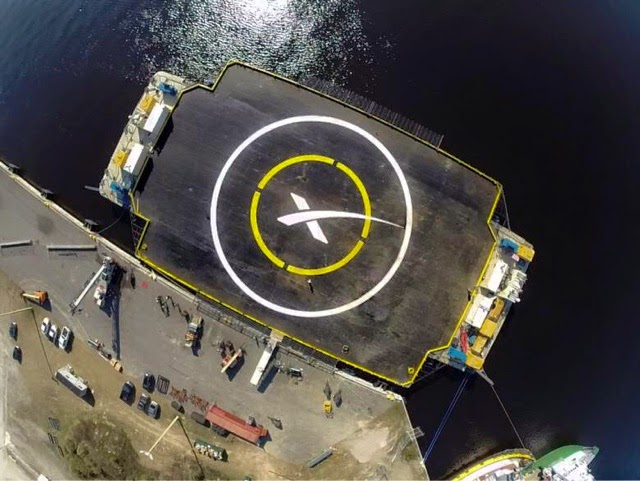
While the resupply mission has become routine, the Saturday mission will also attempt to land the first stage of the Falcon 9 rocket on an ocean platform (shown above). If successful, we are seeing the first of what should be many more reusable rockets. 

SpaceX continues to push the private sector industry to new heights, though it has plenty of battles back here on the surface.  For instance, it still has a lawsuit against the Pentagon concerning competition for rockets and now the Air Force has delayed its clearance of SpaceX rockets for such competition by another 6 months.  It makes the vacuum of space look enticing.

Update:  Earlier Saturday the launch to the space station was a success but the platform landing of the first stage of the Falcon 9 rocket failed.  SpaceX is not discouraged and testing will continue. 

Tuesday, January 6

Great Image: Our Neighboring Galaxy

Above is an amazingly clear Hubble image of the Andromeda Galaxy, a mere 2.5 million light years away.  NASA offers a startling analogy regarding this clarity: 
The Hubble Space Telescope is powerful enough to resolve individual stars in a 61,000-light-year-long stretch of the galaxy’s pancake-shaped disk. It's like photographing a beach and resolving individual grains of sand. And there are lots of stars in this sweeping view -- over 100 million, with some of them in thousands of star clusters seen embedded in the disk...Because the galaxy is only 2.5 million light-years from Earth, it is a much bigger target in the sky than the myriad galaxies Hubble routinely photographs that are billions of light-years away. This means that the Hubble survey is assembled together into a mosaic image using 7,398 exposures taken over 411 individual pointings. 
Image credit: NASA, ESA, J. Dalcanton, B.F. Williams, and L.C. Johnson (University of Washington), the PHAT team, and R. Gendler

Saturday, January 3

We Are Not Alone...

That is, we are not alone in our efforts to study the solar system and dream as a nation. This is good news, and yet also a little troubling since we saw ourselves as the smartest kid on the block (though one could argue that was not even the case with Russia during the Cold War until the Apollo landing).  While the Orion mission is a bold step forward, it is not clear where that step is leading as Congress debates destinations such as asteroids, the Moon, and Mars.  And the White House seems to be taking a back seat rather than voicing a vision. 

If you look at the traffic in space, you can see the "space race" is turning into rush hour:  Here are a few examples:

- Europe:  The Rosetta mission was a great accomplishment.  Landing a probe on a comet is no small task, and the European Space Agency (ESA) should be elated with this accomplishment.  ESA is also working with Russia on a new mission to Mars, something that the U.S. backed out of earlier.  Hence, alliances are forming with the U.S. being sidelined.

- China:  China continues to work on its plans for a space station and took further steps last year in its efforts to return samples from the moon.  China already has a rover on the Moon's surface. 

- Japan:  Japan launched the Hayabusa 2 mission last month (pictured above) heading for a 3,000-foot-wide asteroid named 1999 JU3.  NASA and the Japanese Aerospace Exploration Agency (JAXA) plan to share asteroid samples.

- Russia:  The Russians continue to build most of the rockets we depend upon, have discussed pulling out of the International Space Station so they can build their own station, and recently restated plans to put cosmonauts on the Moon.  Whether or not Russia will have the budget to do these things in coming years will depend upon economics as much as science and technology given the state of the Russian economy. 

- India:  India joined the big leagues last year with its successful Mars Orbiter Mission, which put a spacecraft in orbit around the Red Planet. India is also taking steps to build a new rocket and capsule for future manned missions.

- Private Sector:  In addition to the various national missions, the private sector has its own plans, including Planetary Resources mining asteroid, Mars One bringing humans to Mars, SpaceX hopefully allowing the U.S. to move away from Russian rockets, and Bigelow designing inflatable space stations (see photo) for both science and tourism. 

All of the activity is encouraging, and maybe it will give the NASA and the Congress a swift kick in the pants, letting them know that the world will not stand idle while Rome (or budgets) burn and committees fiddle.  Competition helped us get to the Moon, and it may do so again. 


Image Credits:  Hayabusa 2 from JAXA and inflatable space station from Bigelow.